





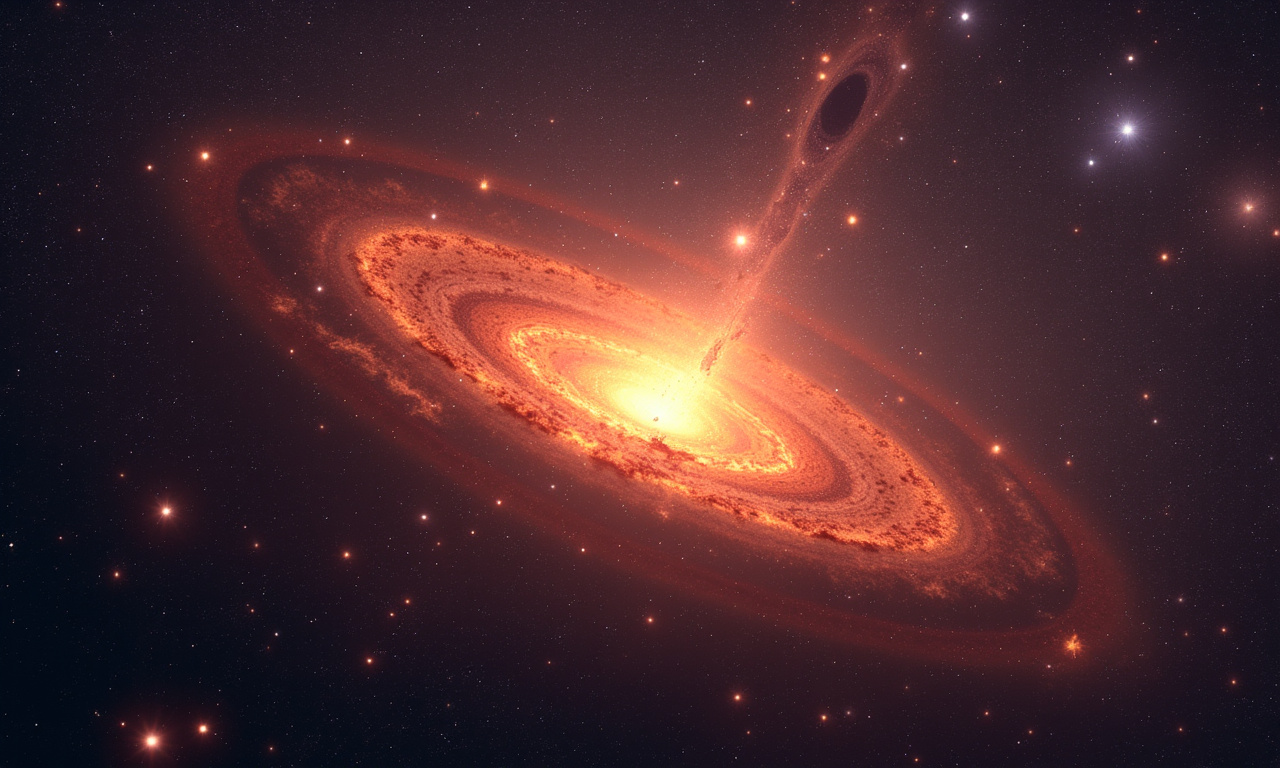

Just 1.4 billion years after the Big Bang, when large galaxy clusters were theoretically just beginning to form, an object known as SPT2349−56 already appeared “mature.” Scientists discovered that the gas among its galaxies is heated at least five times more than expected, and the total thermal energy is about ten times greater than what gravity alone could provide. SPT2349−56 is about 12 billion light-years away. In these early epochs, clusters typically represent scattered and relatively cold systems, where matter is still gathering. However, measurements here painted a completely different picture.
According to Dazhi Zhou, a graduate student at the University of British Columbia and lead researcher, he initially doubted the results: the signal was too strong. After months of verification, the team confirmed that the gas was indeed much hotter than models suggest and is comparable to material in mature clusters of the modern universe.
The temperature of the gas was measured using the ALMA radio telescope array in Chile, capturing the Sunyaev–Zel’dovich effect. This occurs when high-energy electrons in hot gas transfer a portion of their energy to the cosmic microwave background radiation, leaving a measurable trace. This signal revealed that the intergalactic environment of the cluster was already in a state characteristic of much later evolutionary stages.
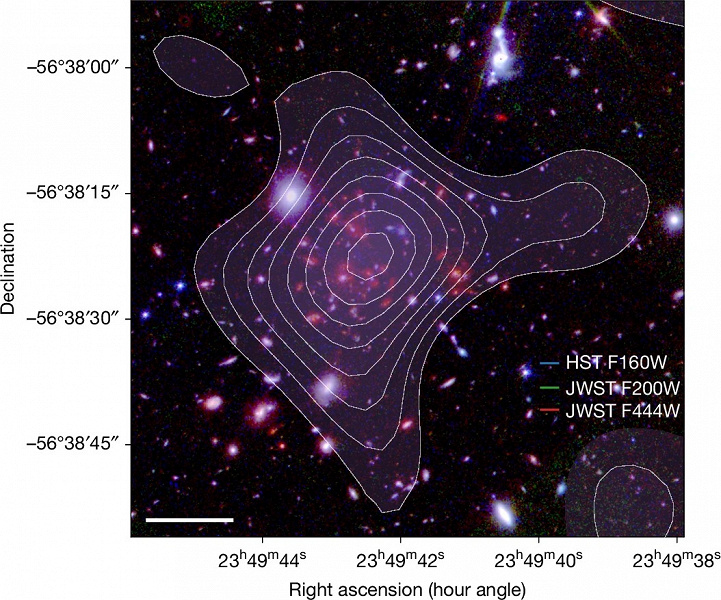
Moreover, SPT2349−56 not only stands out for its high temperatures. In its central region, about 500,000 light-years in diameter – comparable to the size of the Milky Way’s halo – there are more than 30 concentrated galaxies. Their combined star formation rate is approximately 5,000 times that of our galaxy. Within this dense system, at least three supermassive black holes are actively absorbing surrounding matter.
In contemporary clusters, most of the ordinary matter is not in stars but in the form of diffuse plasma between galaxies. This heats up to tens of millions of degrees as the cluster slowly contracts under its own gravity. For young clusters, this stage should occur much later. SPT2349−56, according to the authors, seems to have “skipped” this stage. Scientists link this anomalous heating specifically to the activity of supermassive black holes. The energy emissions and flows generated as they grow could not effectively dissipate in the dense environment of the early universe. As a result, the energy remained within the system, overheating the gas, creating what researchers termed a “cosmic pressure cooker.”
This discovery questions one of the basic assumptions of cosmology – that the heating of intergalactic gas within clusters occurs gradually and follows the growth of their mass. If black holes can dominate the energy balance at such early stages, then the evolution of clusters may involve short but extremely intense phases not yet accounted for in models. It remains unclear whether SPT2349−56 is a rare exception or an example of a widespread but previously elusive stage in the formation of the universe’s largest structures. The authors continue to study the object to understand how extreme star formation and black hole activity are related. Meanwhile, the findings indicate that some galaxy clusters “matured” much faster and under much harsher conditions than previously thought.