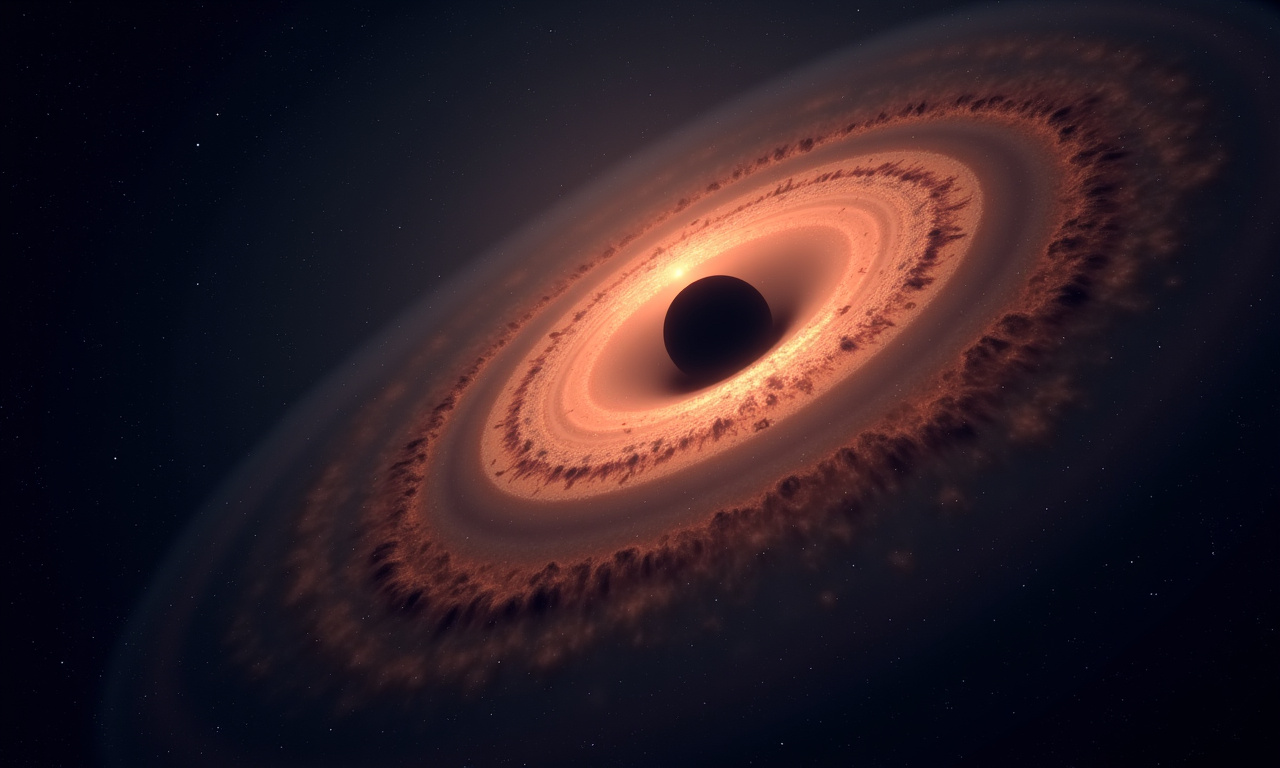

Astronomers studying the early Universe usually expect to see small galaxies, young stars, and black holes at initial growth stages. However, recent observations using the James Webb Space Telescope (JWST) revealed an unusual object – a giant black hole existing almost in solitude, surrounded by a minimal number of stars. This object was discovered in the galaxy Abell 2744-QSO1, which existed just 700 million years after the Big Bang. The black hole’s mass was already approximately 50 million solar masses at that time. The redshift of Abell 2744-QSO1 is 6.82, corresponding to the era of reionization – a period in the Universe’s history when neutral hydrogen began ionizing under the influence of radiation from the first stars and galaxies.
The existence of such an object in this early era challenges fundamental notions about black hole formation and suggests the possibility that some might have formed even before the first stars appeared. According to the standard astrophysical model, black holes and stars are closely linked. Stars form from collapsing gas clouds, while black holes appear much later when the most massive stars exhaust their fuel. Over time, black holes grow by consuming gas and merging with other black holes. This process takes time, making the appearance of supermassive black holes so early in the Universe’s history difficult for astronomers to explain.
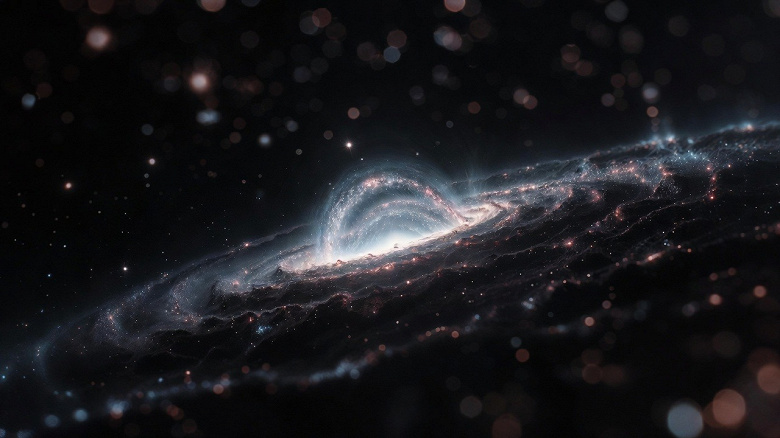
The challenge is compounded by the fact that the galaxy QSO1 contains very little stellar mass – not enough to account for such a large black hole’s presence. The authors of the study believe this creates a fundamental contradiction: the black hole seems to have reached a large size without forming a full-fledged galaxy around it.
To explain this phenomenon, scientists turned to the hypothesis of primordial black holes (PBHs), proposed in the 1970s by Stephen Hawking and Bernard Carr. Unlike black holes formed from stars, primordial black holes might have arisen directly from extreme density fluctuations in the early Universe, soon after the Big Bang. Most of these black holes, if formed, should have been tiny and short-lived.
Boyuan Liu’s team from Cambridge University conducted new, more complex simulations to test if some primordial black holes could “survive” and grow rapidly under certain conditions. The simulations considered gas behavior around a primordial black hole, nearby star formation, and matter returning to the black hole from stellar explosions.
The simulation results align well with JWST data obtained for the QSO1 galaxy, not only in terms of the black hole’s final mass but also in terms of the small number of stars and chemical composition (typical primordial black hole formation simulations rarely lead to the formation of objects with more than a million solar masses, significantly less than the QSO1 black hole’s mass).
The results do not prove that the black hole in QSO1 formed as a primordial black hole, but they show that such an origin is consistent with observations. Going forward, scientists plan to refine their simulations and compare them with JWST discoveries. Finding more galaxies like QSO1 could become important evidence that some of the largest black holes in the Universe are not the end product of stellar evolution but emerged at the dawn of the Universe. However, several questions need to be resolved to confirm this hypothesis, such as explaining how primordial black holes could grow to such sizes.