


Analysts at Tom’s Hardware have examined the European DDR5 memory market, noting a recent downward trend in prices.  This comes as a welcome, albeit modest, relief for PC builders after a period of extreme price inflation that saw costs for some memory kits increase by over 400% since last autumn.
A Volatile Market
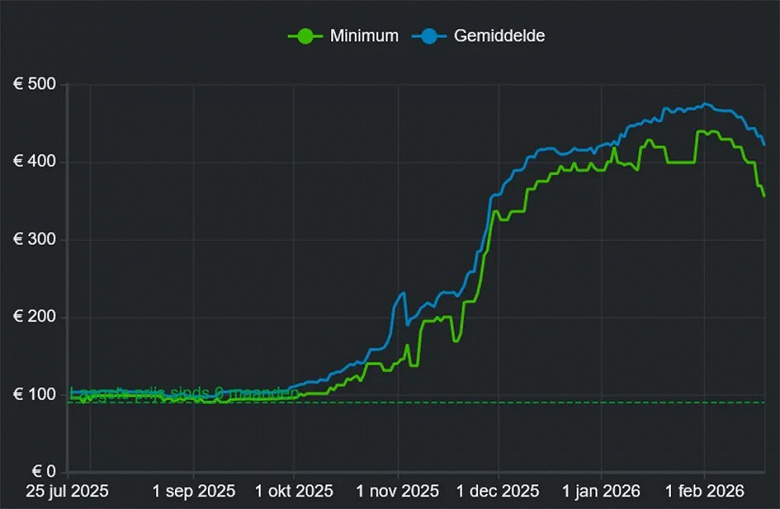
A chart from the PC Master Race community on Reddit illustrates the dramatic price fluctuations for an average 32GB DDR5 memory kit across the European Union. The data, spanning from late July 2025 to February 2026, shows a sharp, multi-fold price increase peaking in early February, followed by a noticeable decline this month.
To verify this trend with more specific data, Tom’s Hardware tracked the prices of popular memory kits. For example, specific 32GB kits from Corsair and Kingston, which were tested by the publication, saw their prices drop significantly. The Corsair kit fell from approximately 480 EUR ($518) in early February to 425 EUR ($459), while the Kingston kit decreased from a high of 550 EUR ($594) in early January to its current price of 465 EUR ($502).
Context and Future Outlook
While this reduction is substantial, it’s crucial to remember the broader context. 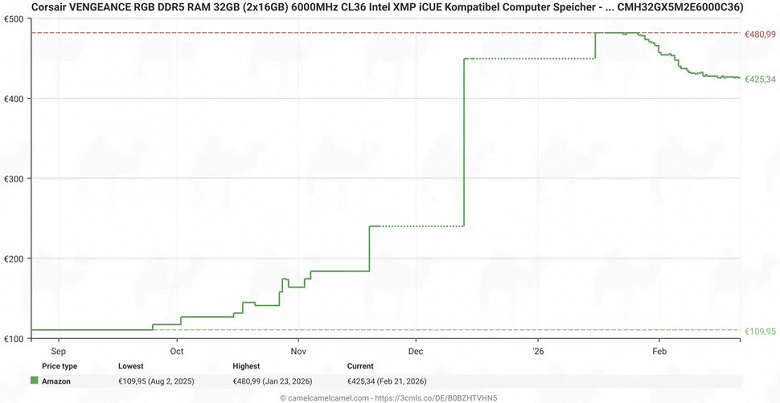 In the autumn of 2025, these same 32GB DDR5 kits were available for around 100 EUR ($108), and sometimes even less. The current prices, though lower than their recent peaks, are still far from what consumers would consider normal.
The primary driver for the initial price explosion has been the massive demand for high-bandwidth memory (HBM) for AI servers, which has cannibalized production capacity for consumer-grade DDR5. This has created a significant supply-demand imbalance, leading to the record-high prices seen over the past several months.
It remains uncertain how significant the current price correction will be or how long it will last. Most industry analysts are cautious, suggesting that substantial improvements are not expected for the remainder of the year. New DRAM production facilities are not expected to come online until late 2026 or 2027, meaning the supply constraints are likely to persist. Therefore, while the recent dip offers a glimmer of hope, the era of highly-priced DDR5 memory is likely to continue for the foreseeable future.