Scientists from Aarhus University (Denmark) have overturned previous assumptions about the scenarios of complex organic molecule formation, finding that protein building blocks can spontaneously form in interstellar dust. Sergio Ioppolo and Alfred Thomas Hopkinson recreated the conditions present in giant dust clouds in the laboratory of the HUN-REN Atomki scientific center in Hungary. In a special chamber, a temperature of -260°C and ultra-high vacuum, simulating the interstellar environment, were maintained. Under these conditions, researchers observed particle reactions to radiation.
During the experiments, scientists placed glycine – the simplest amino acid – in the chamber and irradiated it with cosmic ray analogs produced by an ion accelerator. Analysis showed that glycine molecules began interacting with each other, forming peptides and water. When peptides combine, proteins necessary for life are generated.
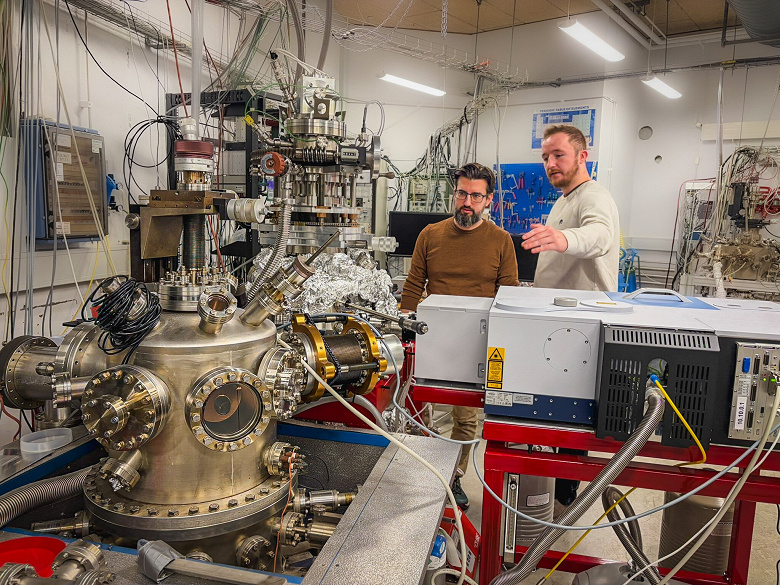
“We already knew from previous experiments that simple amino acids, like glycine, form in interstellar space. But we were curious to learn if more complex molecules, like peptides, naturally form on the surface of dust grains before they participate in star and planet formation,” Ioppolo explained. The results suggest that a similar process occurs in interstellar space, significantly increasing the likelihood of extraterrestrial life discovery. Previously, it was thought that complex molecules formed much later, when a disk begins to form from which a star eventually forms.
“In the end, these gas clouds collapse into stars and planets. Gradually, these tiny building blocks fall onto rocky planets in the formed solar system. If these planets are in the habitable zone, there is a real possibility of life emerging,” noted Ioppolo. Although glycine was used in the experiment, the chemical process of amino acid binding is universal. This suggests that similar reactions may occur with other, more complex amino acids, forming various peptides in interstellar space. Scientists plan to continue research in this direction.