



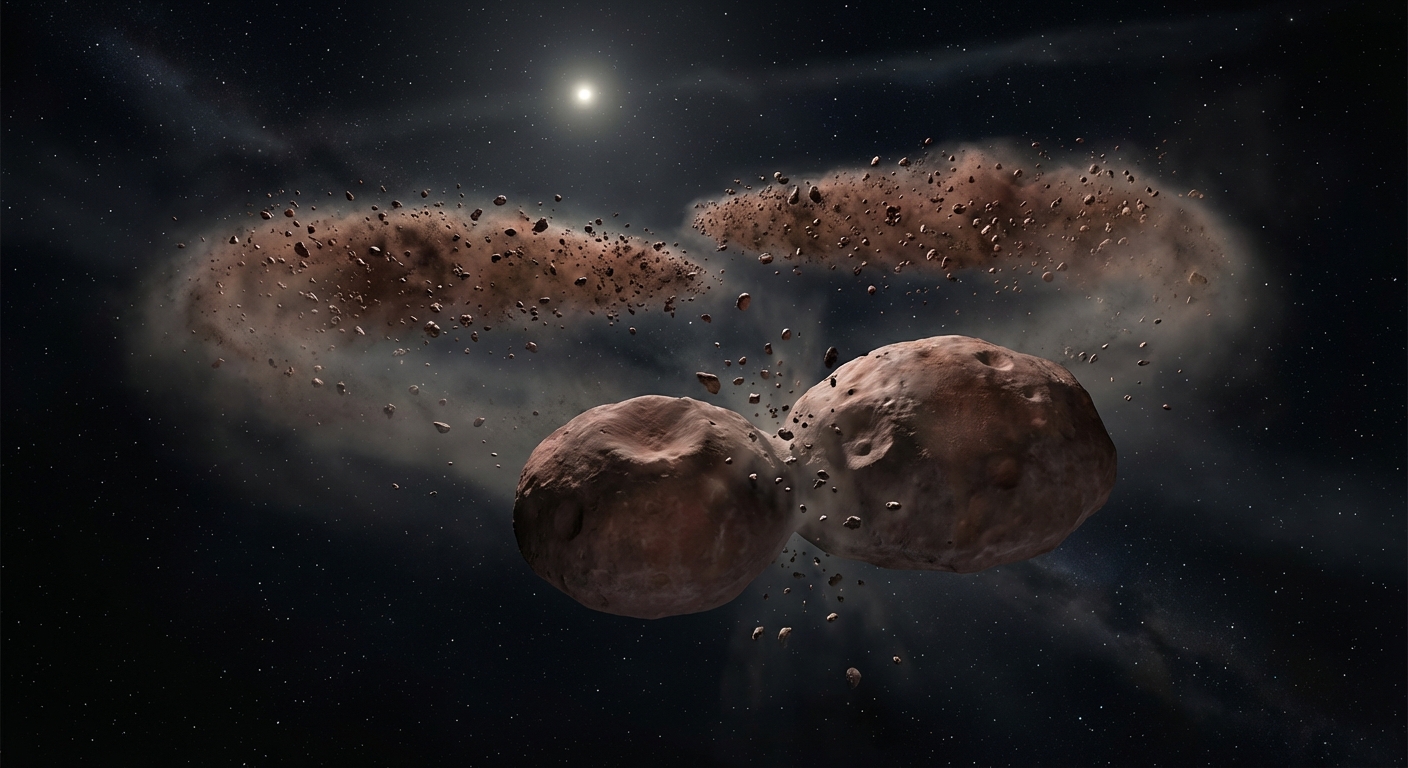

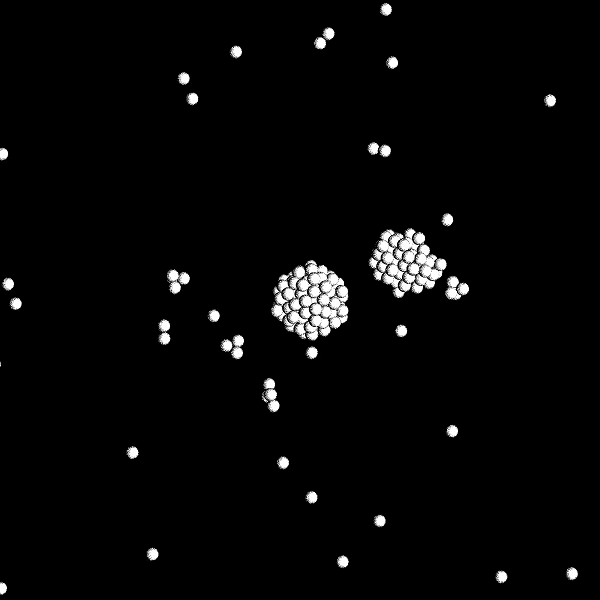
Astronomers are closing in on the origin of the unusual “snowman” at the edge of the Solar System – the object Arrokoth, which has maintained its shape of two fused bodies for over four billion years. New research confirms that this object most likely formed through a gentle gravitational collapse of “cosmic pebbles” during the earliest stages of the planetary system’s history. Arrokoth became famous after the NASA New Horizons probe flew by it in 2019. Images revealed that the object consists of two elongated “lobes.” Analysis of the data showed that both parts have nearly identical chemical compositions, a similar amount of volatile ices, and craters of a similar age. This indicates they formed simultaneously, in the same place, and under the same conditions.
The Genesis of a Contact Binary
The story of its origin has long been a subject of debate. One group of scientists hypothesized that the two parts initially existed separately and slowly converged over millions of years due to gravitational perturbations. Another group believed they formed almost simultaneously from the compression of a rotating cloud of solid particles. To test these hypotheses, researchers conducted a series of detailed computer simulations.
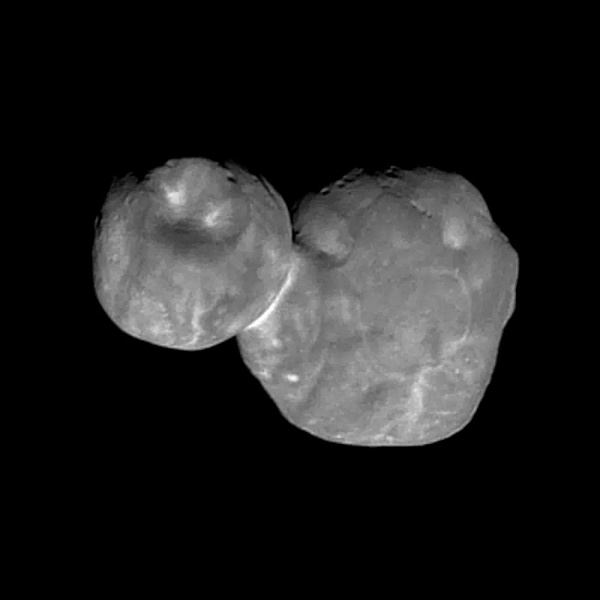
The team performed 54 numerical experiments using the soft-sphere discrete element method (SSDEM), which allows for the modeling of particle collisions as they occur in reality-with sticking, friction, and the formation of fractions. In each simulation, a cloud of 100,000 fragments with a radius of about two kilometers (1.2 miles) was considered, with a total mass comparable to an object roughly 100 kilometers (62 miles) in size. Such clouds, according to current understanding, filled the outer regions of the young Solar System.
A Gentle Cosmic Kiss
As the clouds gravitationally compressed, they began to rotate faster. Due to this rapid rotation, they often broke apart into several fragments. In most cases, single bodies or wide binary systems were formed. However, in about 3% of cases, contact “twins” emerged. In total, the calculations produced 834 protoplanetary bodies, of which 29 became binary objects. Initially, they existed as a pair of bodies bound by gravity, orbiting each other. Over time, flybys of other objects stripped them of their orbital energy, and the pair gradually drew closer until their parts touched. These collisions were exceptionally gentle. Almost all occurred at speeds ranging from 0.4 to 5.8 meters per second (1 to 13 mph). These values precisely match the estimates of Arrokoth’s surface strength obtained from New Horizons data. Faster impacts would have caused destruction not observed on the object.
A Time Capsule from the Dawn of the Solar System
The shape of the simulated bodies also matched the real object: elongated, asymmetrical “double” structures characteristic not only of Arrokoth but also of some asteroids and comets. The rotation speed in the models ranged from 2.1 to 3 rotations per day-faster than Arrokoth’s current rotation of about 1.51 rotations per day. The authors suggest that the object could have slowed down over billions of years due to weak impacts from other small bodies.
The location of Arrokoth is of particular importance-the so-called “cold classical Kuiper Belt,” a remote region almost untouched by the gravity of the giant planets. In such conditions, objects retain their original structure from the time of the Solar System’s formation. This makes Arrokoth a kind of “time capsule,” preserving information about the early stages of planet formation. The authors conclude that contact binary bodies can form directly from the gravitational collapse of solid particle clouds. Moreover, some such systems in the models had their own satellites, forming miniature multi-component structures-similar to those observed beyond Neptune’s orbit. At the same time, scientists emphasize that not all contact objects formed in the same way. Near the Sun, many asteroids and comets likely formed as a result of collisions or disintegration from rapid rotation. But Arrokoth was in an environment where the initial formation mechanism was preserved almost without distortion. As a result, its shape, rotation, and chemical composition serve as direct evidence of how the “assembly of planets” began more than four billion years ago. Two clumps of cosmic “pebbles,” formed side by side, slowly drew together and merged-thereby preserving one of the most vivid traces of the early history of the Solar System.