
Stellar Runaways: Uncovering the Origins of Galactic Orphans
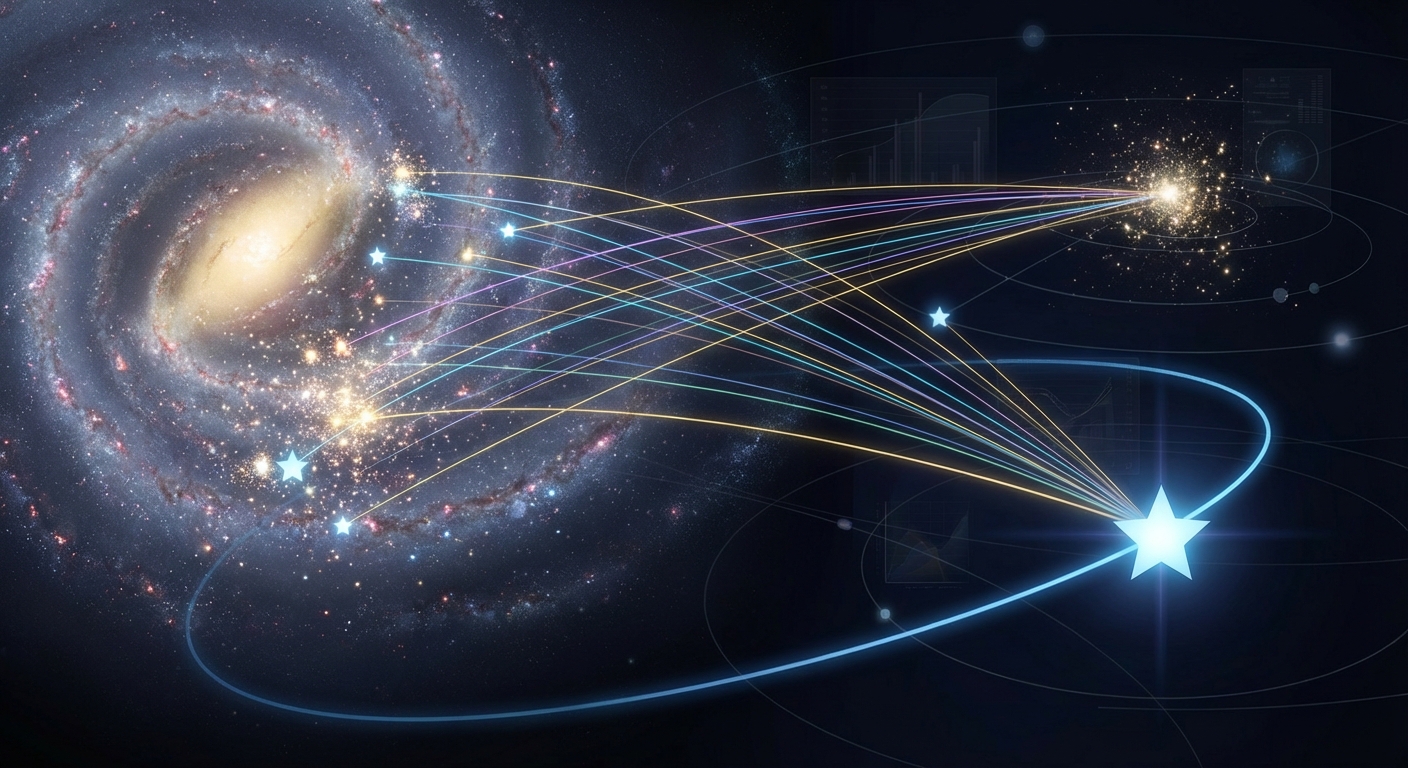
In a fascinating piece of cosmic detective work, astronomers have conducted “stellar paternity tests” for 39 B-type stars, massive and hot stars that have been ejected from their birthplaces in the Milky Way’s open clusters. These stellar runaways now travel at high galactic latitudes, far from the galactic disk where they formed. Using the unprecedented precision of the Gaia DR3 survey and advanced models of the galaxy’s gravitational potential, researchers have managed to rewind the cosmic clock, tracing the trajectories of these stars and 447 open clusters to identify their potential parent clusters.
The Mechanics of a Cosmic Investigation
The process of identifying a star’s origin is meticulous. After finding potential intersections in the past trajectories of a star and a cluster, scientists confirm the relationship by comparing their ages using color-magnitude diagrams. Further analysis of the cluster’s core parameters, such as density and radius, helps determine the likely ejection mechanism. This allows researchers to distinguish between two primary scenarios: the Dynamical Ejection Scenario (DES), where gravitational interactions in a dense stellar core fling a star outwards, and the Binary Supernova Scenario (BSS), where the explosion of a star in a binary system kicks its companion into high-velocity exile. Studies suggest that the dynamical ejection scenario is the more common of the two.
Key Findings and Extreme Velocities
This groundbreaking research has successfully identified five unique B-type stars with 16 potential parent clusters. For these matches, the team calculated both the travel time from their birthplace and their incredible ejection speeds, which range from 38 km/s (approximately 85,000 mph) to a staggering 160 km/s (approximately 358,000 mph). One particular object, EC 05438-4741, stands out due to its extreme distance from the galactic disk, leading to speculation that it may have been launched on its journey more than 100 million years ago.
The Future of Stellar Archeology
The authors emphasize that the “stellar paternity test” technique holds immense promise for understanding the evolution of stars and the clusters they form in. However, the method’s current accuracy is limited by the precision of radial velocity measurements. As observational technologies and data from missions like Gaia continue to improve, astronomers will be able to more accurately pinpoint the origins of these ejected suns. This will not only refine our understanding of the violent mechanisms that shape stellar clusters but also provide deeper insights into the life cycle of stars throughout our galaxy.