






Ancient Impact, Modern Galaxy
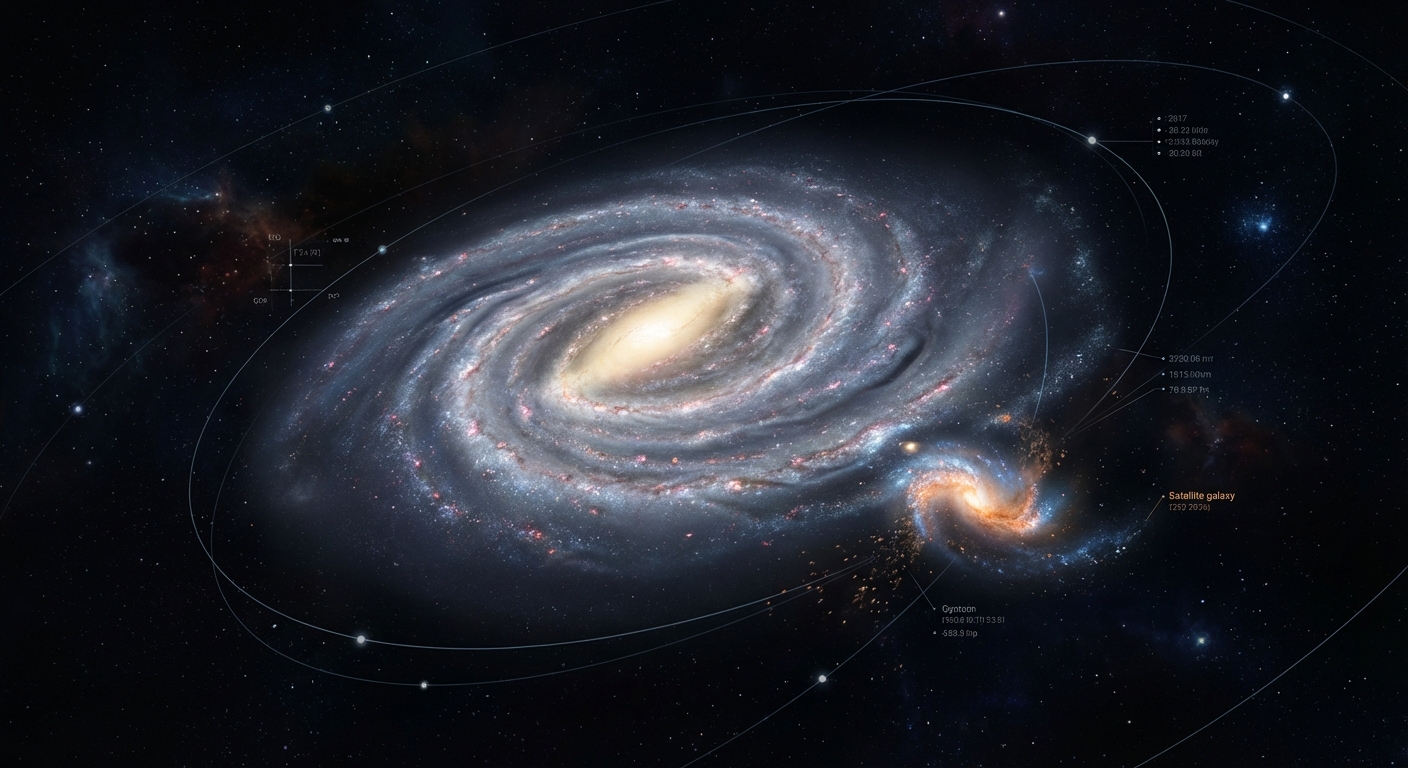
Scientists have long known that the Milky Way’s disk is not a perfectly flat structure. It features waves, spiral arms, and mysterious “ripples” and vertical oscillations. However, the cause of these large-scale disturbances has remained a subject of debate. A new study by Australian astronomers offers a compelling answer: a long-ago collision with the Sagittarius dwarf galaxy is the primary culprit. Using supercomputer simulations, researchers modeled how the massive satellite galaxy, passing through the Milky Way’s disk, could have triggered a whole series of effects.
The Sagittarius Effect: A Galactic Architect
It turns out that even a single powerful “punch” is capable of generating spiral arms, characteristic waves, and even the famous phase spiral-a special structure recently discovered by the Gaia satellite. In their work, the scientists compared the simulation results with actual observations. They found that many features-such as segments of spiral arms and local waves in the disk-can indeed be explained by a single event: the passage of the Sagittarius galaxy through the Milky Way’s disk approximately 1 billion years ago. Some research even suggests that multiple collisions with Sagittarius, one 1.9 billion years ago and another 900 million years ago, were instrumental in forming our galaxy’s current spiral shape.
Cosmic Ripples and Unsolved Mysteries
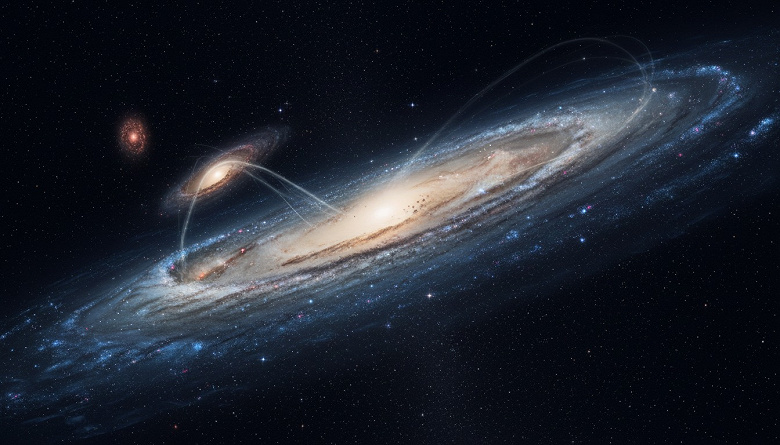
Special attention was paid to so-called corrugations-wave-like oscillations of the disk’s plane. These “ripples” were observed in data from the Gaia mission and other surveys, but their origin remained a mystery. The simulation showed that such waves arise naturally after a collision and persist for hundreds of millions of years. The European Space Agency’s Gaia mission, launched in 2013, has been crucial in mapping the positions and movements of nearly two billion stars, providing an unprecedentedly detailed 3D map of our galaxy and revealing these ancient structural oscillations.
However, not all mysteries have been solved. For instance, some inner arms, complex waves, and stellar velocities require additional factors-perhaps the influence of the galactic bar or other satellite galaxies. Furthermore, adding gas and star formation processes to the model makes the disk’s structure less stable and more “blurred,” complicating the precise reproduction of observed features.
A Lasting Legacy
Nevertheless, the study demonstrates how profoundly even a single major collision can influence the evolution of an entire galaxy. The Milky Way, it turns out, is still “responding” to this ancient cosmic impact, and its spiral arms and waves are a kind of seismic echo of that event. This research opens new avenues for understanding our galaxy’s history and shows that even isolated, catastrophic events can shape its appearance for billions of years to come. The Sagittarius galaxy itself has been significantly weakened by these encounters, losing much of its dark matter to the Milky Way, but the process of absorption continues today.