



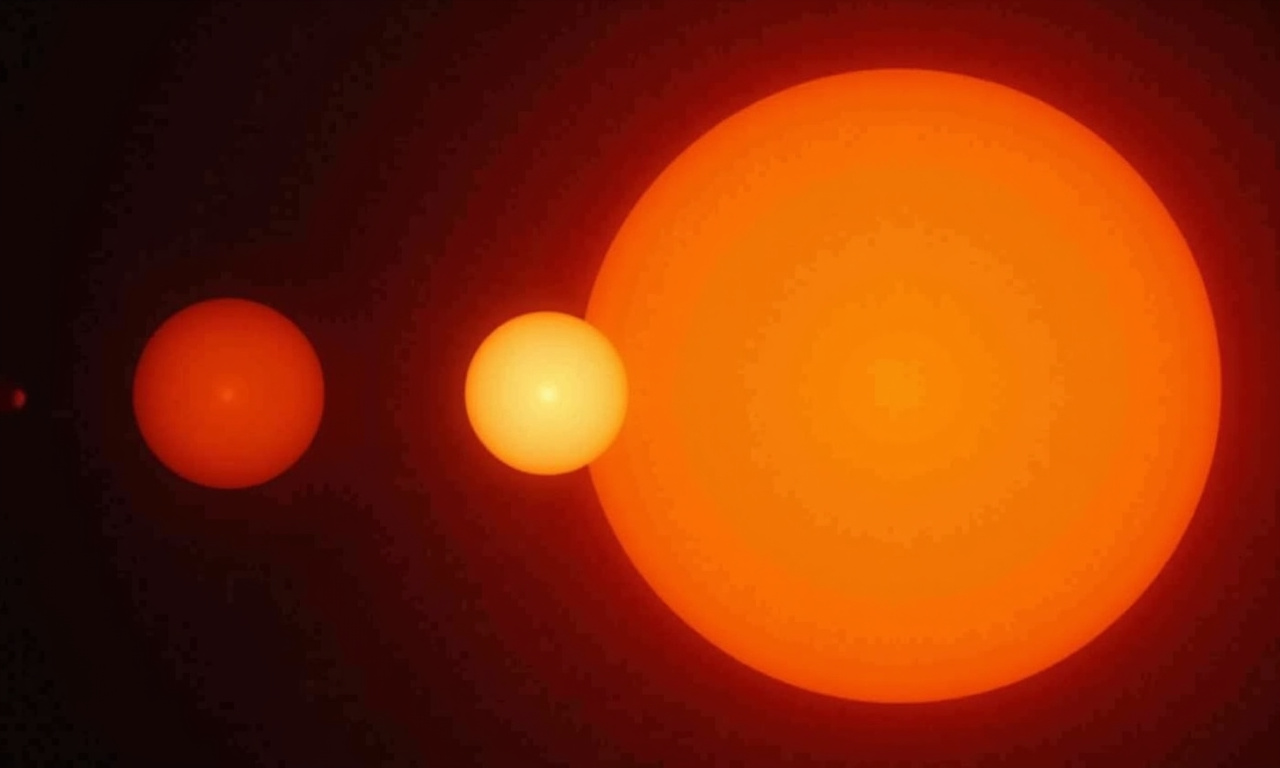

In space, a rare astronomical event was recorded: Venus and Mars aligned with the Sun. The LASCO coronagraphs on the SOHO spacecraft captured this “Christmas conjunction,” which will only be repeated in the second half of the 23rd century. For several months, the planets gradually converged, and on the night of conjunction, their lines in the sky were about one degree apart. Now Venus is beginning to shift to the left of the solar disk and by March will be visible from Earth as an evening star, while Mars moves to the right and will appear as a morning star at dawn in the spring.

The reason the planets didn’t completely align with the Sun lies in the tilt of their orbits relative to Earth: Venus’s is about 3.5°, and Mars’s is about 2°. Sometimes, Venus can pass directly across the solar disk; the last time was in 2012, and the next transit will be on December 11, 2117. Mars, on the other hand, can never be projected onto the Sun due to its outer orbit. At the time of conjunction, Venus was at a distance of 256 million km, and Mars at 360 million km on the opposite side of the Sun from Earth.
Adding to the astronomical intrigue, recent studies indicate that 2026 will witness several celestial phenomena, including a total lunar eclipse expected in May, attracting enthusiasts and scientists alike to further explore the mysteries of space. Concurrently, the advancement of the SOHO spacecraft, equipped with enhanced instruments, allows astronomers to monitor solar activities with unprecedented precision, thereby contributing vital data on cosmic alignments like the current Venus-Mars-Sun triad.
Such technological advancements not only assist in observing rare events but also pave the way for future space explorations. As experts celebrate these innovations, the world eagerly anticipates more breathtaking celestial events, reminding humanity of space’s boundless wonders.