

Chinese astronaut corps has concluded a month-long underground training course in caves, simulating conditions of future manned lunar missions. The training, held in the mountainous region of Chongqing municipality in the southwest of the country, involved 28 astronauts. They were divided into 4 groups, each spending 6 days and 5 nights in cold and damp underground conditions. The intensive program was designed to closely match the demands of real missions and expand the training system for Chinese astronauts.
It included environmental monitoring, cave mapping, simulation of “space-to-ground” communication, as well as psychological and behavioral training. Scientific projects focused on studying human interaction with extreme environments. Instructors also conducted unexpected evacuations to test the teams’ ability to respond to emergencies and problem-solve group challenges. “These data will become important support for creating psychological support systems for astronauts participating in long-term missions on the space station and manned missions to the Moon,” said Jiang Yuan, an instructor from the China Astronaut Research and Training Center.
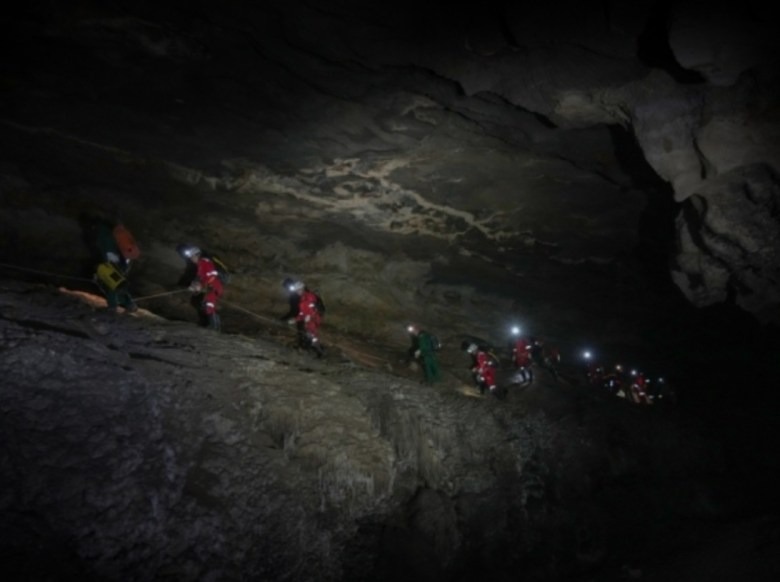
The program, organized by the China Astronaut Research and Training Center, marked the first experience of such training in China, similar to the European Space Agency’s (ESA) Cooperative Adventure for Valuing and Exercising human behavior and performance Skills (CAVES) program. In addition to underground training, each group underwent a two-day jungle survival course.
The completion of the program was announced on January 5, the 28th anniversary of the founding of the Chinese astronaut corps. One of the program’s leaders was Ye Guangfu, a veteran of the “Shenzhou-13” and “Shenzhou-18” missions to the “Tiangong” space station and participant of the ESA CAVES program in 2016, which also included NASA astronauts. According to Ye Guangfu, external support from the cave was minimized to have astronauts rely on their own strengths and reveal their potential.
Zhu Yangzhu, China’s first engineer-astronaut who flew on the “Shenzhou-16”, noted that “the sealed cave with its complex terrain, darkness, and humidity recreated the loneliness and unknown of deep space, challenging astronauts’ physical and mental limits.”
The cave training is part of China’s preparations for manned lunar operations, the first of which is planned before 2030. In 2025, the country conducted a series of tests including a static fire test of the “Changzheng-10” rocket engine, designed for manned lunar flights, an abort system test for the “Mengzhou” crewed spacecraft, and a takeoff and landing test of the “Lanyue” lunar lander. The first flight of the “Changzheng-10A” rocket, possibly integrated with the “Mengzhou” spacecraft, is scheduled for 2026 after an in-flight abort system test at maximum dynamic pressure for “Mengzhou”. China plans to send two astronauts to the lunar surface by the end of the decade as part of a short-term mission.
This mission will require two separate launches of the “Changzheng-10” rocket carrying the crewed spacecraft and the lunar lander. They will dock in lunar orbit before descending to the Moon’s surface. The country also plans to build the International Lunar Research Station (ILRS) in the 2030s.
NASA aims to return astronauts to the Moon for the first time in over 50 years in 2026 as part of the Artemis 2 mission. A crewed landing as part of the Artemis 3 mission is planned for 2028. The China’s recent long-duration training and testing phases demonstrate their commitment and preparations towards upcoming lunar missions, mirroring efforts such as those underway in NASA’s Neutral Buoyancy Lab and ESA’s CAVES, albeit with a distinctive focus on isolation and extreme environment coping strategies.