






On December 17, China Rocket announced that it is preparing to launch a reusable liquid rocket with a diameter of 5 meters in the first half of 2026. Based on available information, the carrier utilizes developments from the Long March 10A rocket, which CALT is developing for launches of the new manned spacecraft “Mengzhou” to the “Tiangong” orbital station in low Earth orbit. China Rocket is a subsidiary of the China Academy of Launch Vehicle Technology (CALT), which is part of the China Aerospace Science and Technology Corporation (CASC). The Long March 10A is also set to launch for the first time in 2026 and is considered a key step in China’s preparation for manned lunar missions. In the future, a version of the Long March 10 with a three-module design is planned, intended for the launch of crews and landing modules to the Moon. The entire program relies on the technological base of the Long March 5 rocket, first launched in 2016.
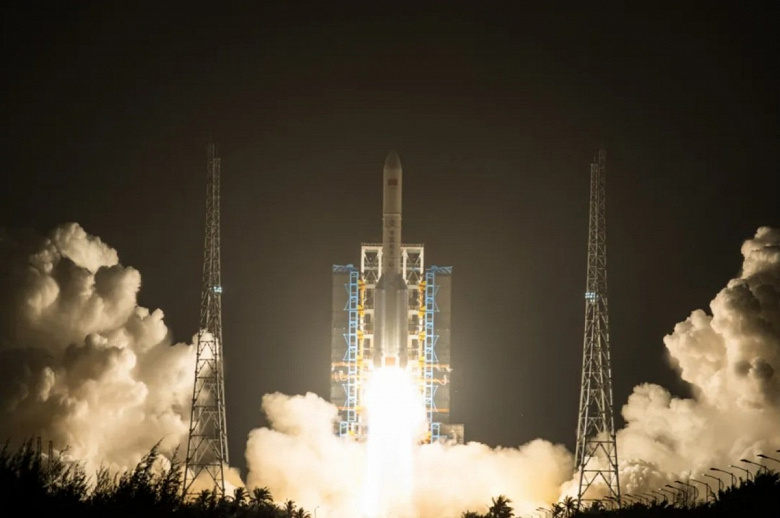
Additional information was presented in a report by a China Rocket representative at the Wenchang International Aviation and Aerospace Forum 2025. According to this data, the rocket, designated Long March 10B, will be able to deliver up to 11,000 kg of payload to an orbit about 900 km high with an inclination of 50°. These parameters indicate the carrier’s orientation towards supporting the construction of the national broadband satellite megaconstellation Guowang. The presentation also noted that the new rocket may receive a second stage with methane and liquid oxygen, which will develop the scheme with kerosene engines used in other variants of Long March 10. The launch is planned from the coastal Wenchang spaceport.
In November, CALT introduced a step recovery vessel equipped with a capture system. The development of reusable launches will allow China to further increase the launch rate. If information about Long March 10B is confirmed, this carrier could secure the first successful orbital landing of a recoverable booster in the history of Chinese astronautics. Work on reusable systems is also being carried out in other industry structures. The Shanghai Academy of Space Technology (SAST) previously put Long March 12A into orbit, but an attempt to vertically land the stage ended unsuccessfully. Simultaneously, a version of Long March 12B is being developed. Commercial companies are also actively joining the race: LandSpace made the first attempt in the country for an orbital return of a stage in early December – the orbit was successful, but the landing ended unsuccessfully. In 2026, the first launches could happen with potentially reusable rockets Pallas-1, Kinetica-2, Tianlong-3, and the significantly smaller Nebula-1; other systems are scheduled for debut throughout the year.