






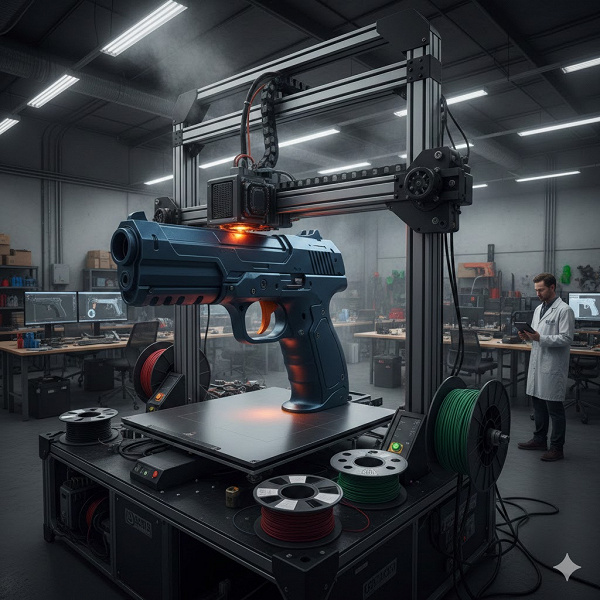
California is proposing what could become the most stringent regulation of 3D printers in the United States, aiming to combat the proliferation of homemade, untraceable firearms known as “ghost guns.” A new bill, AB-2047, not only mirrors recent legislative efforts in New York and Washington but takes a significant step further by proposing a state-managed registry of approved 3D printers. If passed, this legislation would effectively ban the sale of any 3D printer not officially certified by the state.
The Heart of the Bill: A State-Controlled Registry
The proposed “California Firearm Printing Prevention Act” would prohibit the sale or transfer of any 3D printer unless it is included on a roster of approved makes and models maintained by the California Department of Justice (DOJ). The bill outlines a multi-year implementation timeline:
- July 2027: The DOJ must publish guidance on performance standards for certifying 3D printers and their software, which would need to include “firearm blocking technology.”
- January 2028: The state will begin accepting applications from manufacturers for certification.
- July 2028: Companies intending to sell 3D printers in California must formally attest that their products meet the state’s standards.
- September 2028: The DOJ will publish the inaugural list of approved 3D printers, which will be updated quarterly.
- March 1, 2029: The ban on selling or transferring uncertified 3D printers in California will take full effect.
Furthermore, the bill would make it a misdemeanor to knowingly disable or circumvent the mandated firearm-blocking software with the intent to manufacture a firearm.
The “Ghost Gun” Epidemic in California
The legislation is a direct response to the surge in ghost guns recovered from crime scenes. These privately assembled, unserialized firearms pose a significant challenge to law enforcement because they are nearly impossible to trace. Between 2017 and 2021, California accounted for 53% of all ghost guns recovered in the United States. The number of recoveries in the state skyrocketed from 1,572 in 2019 to a peak of 10,877 in 2021. While recent data shows a 23% decrease from that peak by 2023, proponents of the bill argue that stronger measures are needed to close the technological loopholes that allow prohibited individuals to access firearms.
A National Trend with a Californian Twist
California’s proposal is part of a broader trend. Lawmakers in Washington and New York have introduced similar bills (HB 2321 and S9005/A10005, respectively) that would require 3D printers to be equipped with technology to detect and block the printing of firearm components. However, California’s AB-2047 is unique in its creation of what some critics call a “certification bureaucracy.” Instead of only mandating the technology, it puts the state in the position of actively approving specific hardware models, a more centralized and restrictive approach.
The Debate: Public Safety vs. Technological Freedom
Supporters of the bill, including law enforcement and gun control advocates, see it as a necessary step to keep pace with technology that enables criminals to bypass background checks. They argue it targets the source of untraceable weapons favored by those who are legally barred from owning guns.
However, the bill has drawn sharp criticism from 3D printing enthusiasts, open-source advocates, and civil liberties groups. Opponents argue that the core concept is technically flawed, as identifying a firearm component based on its geometric shape alone is incredibly difficult and prone to error. Many benign mechanical parts can resemble firearm components, potentially disrupting legitimate use in education, prototyping, and small businesses.
Regulating general-purpose machines is another. AB-2047 would require 3D printers to run state-approved surveillance software and criminalize modifying your own hardware.
Critics also point out that most desktop 3D printers run on open-source firmware, making any software block “trivially easy to bypass” for anyone with moderate technical skill. This, they argue, means the law would inconvenience law-abiding hobbyists and professionals without effectively stopping criminals.
The Road Ahead: A Precedent for a Regulated Future?
If AB-2047 becomes law, it could set a new national precedent for regulating general-purpose technology to prevent its misuse. The outcome of this legislative effort will be closely watched as a test case for how governments attempt to balance public safety with the principles of technological freedom and innovation. The central question remains whether such a system can be effectively implemented and enforced or if it will simply drive the underground manufacturing of firearms further into the shadows.