
Introduction to Bolt Graphics and ZEUS
The American startup Bolt Graphics from Sunnyvale, California, unveiled details of its all-new ZEUS graphics accelerator architecture at CES 2026. The accelerator supports classic 3D graphics rasterization, ray tracing, and path tracing. The core of this technology is a proprietary SIMD architecture, managed by a RISC-V based processor that also functions as a CPU.
Technical Specifications of ZEUS
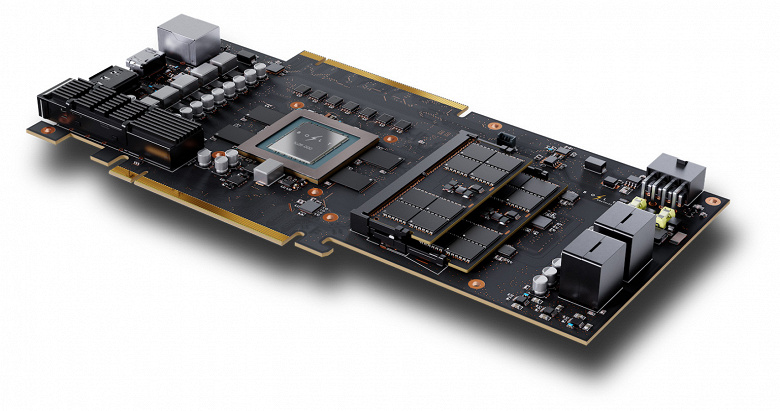
Back in March 2025, Bolt Graphics introduced the first GPUs of the ZEUS series. A key feature is its high performance in path tracing and FP64 calculations, though it currently lags behind competitors in FP32 and FP16. The ZEUS graphics card prototype employs a PCI Express 5.0 x16 interface and LPDDR5X memory. DDR5 SO-DIMM slots are assigned for the RISC-V processor, supporting a maximum memory capacity of 384 GB, making the card apt for processing large data volumes. Furthermore, it is equipped with a 400 or 800 Gbps network interface and a comprehensive BMC/IPMI system for centralized management in server racks. Energy consumption is claimed to be just 225W, powered through a single 8-pin connector.
Performance Benchmarks and Claims
Bolt Graphics has published several impressive statistics: in FP64 electromagnetic simulation tests, the ZEUS 4C purportedly runs 300 times faster than the NVIDIA B200 Blackwell; in another FP64 benchmark, ZEUS 1C exceeds the GeForce RTX 5090 by 3 times; in path tracing, ZEUS 1C is 2.5 times faster than the RTX 5090, ZEUS 2C is faster by five times, and ZEUS 4C by 10 times.
Industry Implications and Future Prospects
During the CES presentation, the company declared that the ZEUS 1C is “the fastest graphics processor in history,” attributing this to a complete rethinking of the traditional graphics pipeline. Bolt Graphics also offers a full software stack, including Vulkan and DirectX 12, Unreal Engine and Unity support, and a specialized computational pipeline for path tracing. It’s undeniable that if these claims hold true, the industry might be staring down a new reality.
However, the reality of these claims is uncertain: timelines for the release of commercial products and plans for mass production are still shrouded in mystery. Nonetheless, Bolt Graphics is already positioning itself as a potential new competitor to Nvidia.
Comparisons with NVIDIA’s Advancements
Bolt Graphics’ entry into the high-performance GPU market coincides with advancements from competitors like NVIDIA. With NVIDIA’s upcoming line, which promises improvements in ray tracing and AI computation, Bolt Graphics might need to demonstrate practical efficiency in benchmark settings to prove its competitive edge beyond theoretical claims.
This could pave the way for a significant shift in the GPU industry dynamics, with potential benefits including more choices for consumers and accelerated innovation across the sector.