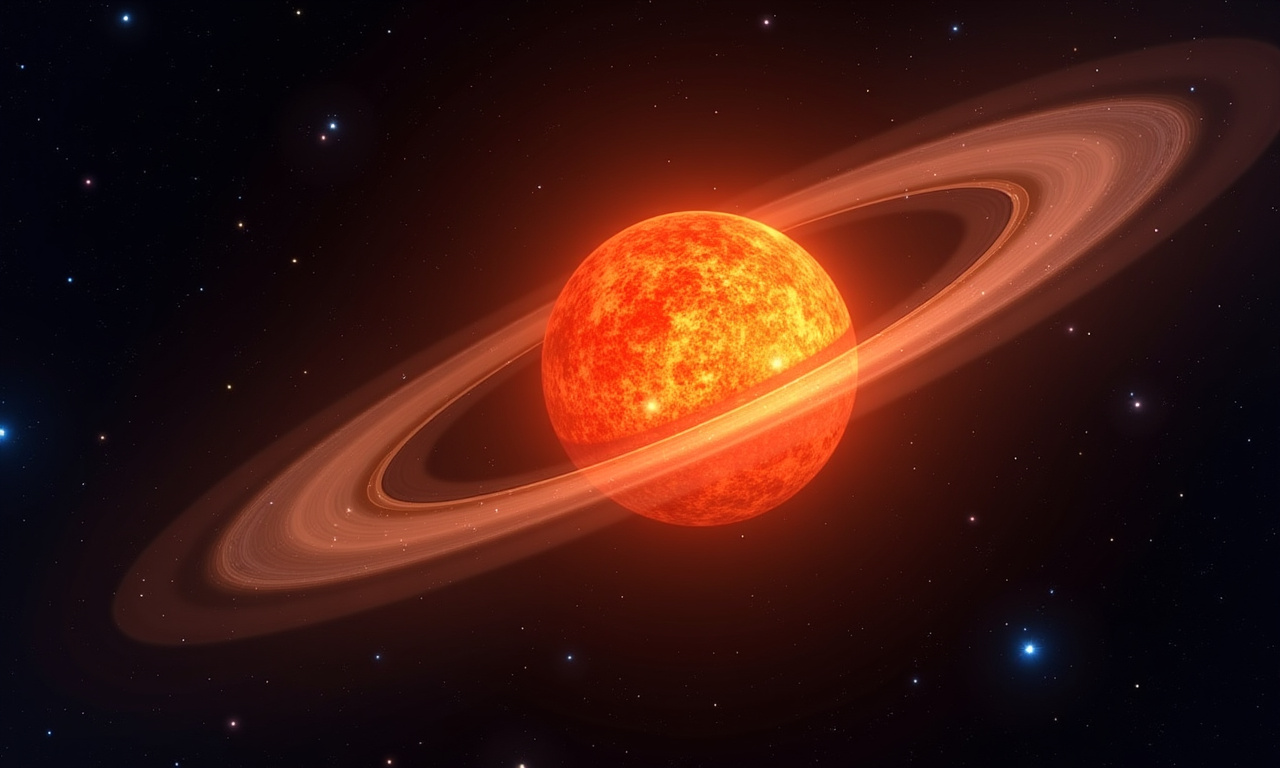

Astronomers have, for the first time, obtained direct observational evidence of a companion star influencing the structure and behavior of Betelgeuse’s extensive atmosphere. Analyzing data from the Hubble Space Telescope and ground-based observatories, they detected a dense gas trail caused by the movement of the companion-named Sivarcha-through the outer layers of the red supergiant. According to the study’s authors, this effect explains Betelgeuse’s long-term and unusual brightness and spectrum changes. Scientists tracked the star’s radiation evolution over nearly 8 years, recording systematic changes that coincide with the companion passing through Betelgeuse’s outer atmosphere.
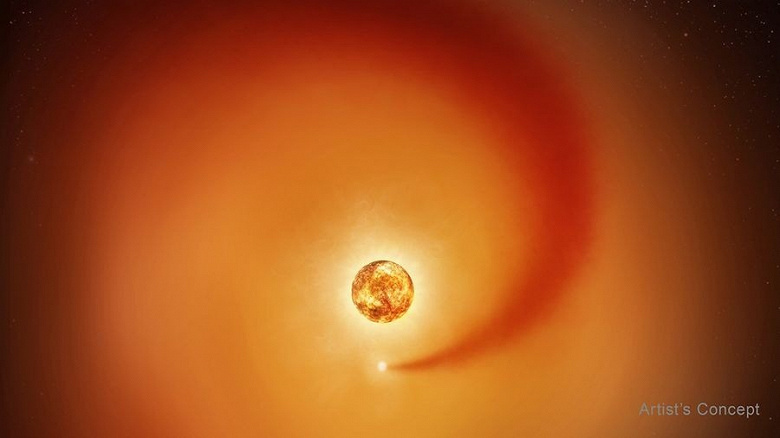
Using data from Hubble, as well as observations from observatories in Arizona and the Canary Islands, researchers discovered changes in Betelgeuse’s spectrum and gas velocities in its outer atmosphere. These effects form a dense “trail”-a region of increased material density-arising immediately after the companion passes in front of the star’s disc. This “trail” appears immediately after the companion passes Betelgeuse, aligning well with theoretical models of the satellite’s movement within the giant’s diluted but extensive atmosphere.
Interest in Betelgeuse’s behavior spiked following its dramatic brightness dip in 2020, when the star unexpectedly dimmed. For decades, astronomers recorded two characteristic variation periods: a short one, about 400 days, linked to the star’s pulsations, and a longer one-around 2100 days-whose nature remained unclear. Various explanations were considered, including giant convective cells, emissions, and magnetic activity, but increasing data pointed to the possible presence of a hidden companion. Now, with the direct detection of the gas trail, this hypothesis has received reliable confirmation.
The authors suggest that observing Betelgeuse’s interaction with its satellite offers better understanding of how massive stars lose material, change atmospheric structures, and approach the final stage of their evolution-a supernova explosion. Betelgeuse is approximately 650 light-years away from Earth in the constellation Orion and belongs to the class of red supergiants. Its radius is so large that it could contain hundreds of millions of Suns within it. Due to Betelgeuse’s relative proximity, it’s one of the few objects where astronomers can directly observe both its photosphere and extensive gaseous envelope, making it a crucial object for studying late stages of massive star evolution. Currently, Betelgeuse eclipses its companion, but astronomers are already planning new observations timed for its next appearance in 2027. The results are expected to help interpret similar mysterious variations in other giant and supergiant stars.