
For a long time, it was known that charged particles colliding with Earth’s atmosphere create the glow of the aurora, but it remained unclear how the electric fields that speed them up are maintained without quickly fading. Now, thanks to data from NASA spacecraft, scientists have been able to identify the mechanism providing a constant energy supply. A research team from the University of Hong Kong (HKU) and the University of California, Los Angeles (UCLA) determined that Alfvén waves, spreading along Earth’s magnetic field lines, act as a “cosmic battery.” Alfvén waves are a type of plasma wave that transport energy through the magnetic field, playing a key role in plasma dynamics in space and laboratories. They continuously supply energy to the particle acceleration region necessary to sustain the aurora.
Previously, scientists observed electric fields accelerating particles toward Earth, but the source of their energy was questioned. Without continuous feeding, such fields would have to decay within seconds. The authors, relying on their experience studying the magnetospheres of Jupiter and Saturn, applied a “planetary approach” to investigating Earth’s magnetosphere.
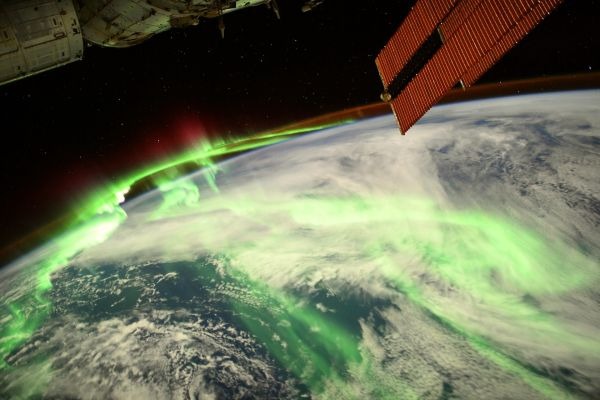 ” />
” />Analyzing particle motion in different regions of space showed that Alfvén waves function as natural particle accelerators. They deliver energy needed for charged particles to penetrate Earth’s atmosphere, causing chemical reactions leading to the glow. To verify their theory, scientists used data collected by NASA’s Van Allen Probes and the THEMIS mission. These data confirmed that Alfvén waves not only pass through space but actively and continuously replenish energy in the “auroral acceleration zone.” This constant replenishment prevents the collapse of electric fields, ensuring the prolonged glow of the aurora.
In recent scientific explorations, research into Whistler-mode chorus waves revealed further insights into particle behaviors in the magnetosphere, complementing Alfvén wave studies. Recent missions, including new instruments and probes launched since 2025, continue to enhance our understanding of magnetospheric plasma dynamics, applying these learnings to broader planetary sciences. “The discovery not only provides a definitive answer to the physics of Earth’s aurora but also offers a universal model applicable to other planets in our solar system and beyond,” noted Professor Zhonghua Yao from HKU.