







ASUS unveiled its ROG Strix LC IV series liquid cooling systems at CES 2026, proudly presenting the world’s first wireless liquid cooling solutions. However, using these innovations wirelessly requires a special motherboard from ASUS itself. Rather than relying on traditional cabling, the cooler connects to the motherboard through an AIO Q-Connector. Located near the processor socket, this connector is specifically designed for such systems.
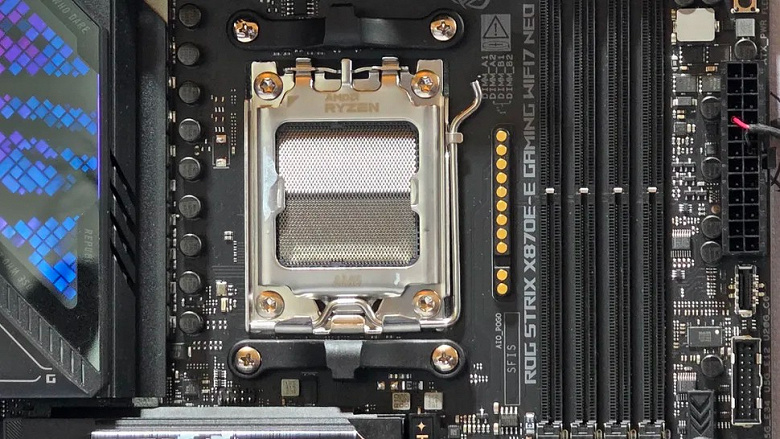
The AIO Q-Connector features 11 spring-loaded pin contacts grouped into two sets: nine for core connections and two for additional control elements. These connectors allow the ROG Strix LC IV models to receive power and control signals for the pump, lighting, and in some cases, an integrated 5-inch display. Significantly, users don’t need to connect cables to the radiator fans either, as the AIO Q-Connector transmits PWM and lighting signals via a cable hidden inside the cooler’s braided tube.
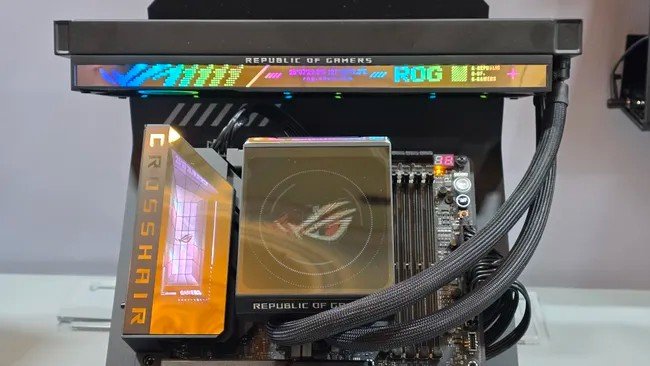
Currently, only four motherboard models boast this new connector: the ROG Crosshair X870E Glacial, ROG Crosshair X870E Dark Hero, ROG Strix X870E-E Gaming WiFi7 Neo, and ROG Strix X870E-A Gaming WiFi7 Neo. All of these are top-tier and rather pricey, and as the name suggests, they are exclusively designed for AMD processors. At least for now, ASUS only offers these.

Regarding cooling system models, there are three: ROG Strix SLC IV 360 ARGB LCD, ROG Strix LC IV 360 ARGB LCD, and ROG Strix LC IV 360 ARGB. The key difference between the ROG Strix SLC IV 360 ARGB LCD and the ROG Strix LC IV 360 ARGB LCD is the tube length, with the SLC model having shorter tubes. The ROG Strix LC IV 360 ARGB doesn’t feature a display.
This breakthrough reflects Asus’s relentless push towards cutting-edge innovation, prompting industry experts to speculate about a future where wireless cooling becomes a new standard. Competitors will likely follow ASUS’s footsteps, aiming to integrate similar technology. Meanwhile, consumers can expect enhanced performance and aesthetic enhancement in PC building.