






Arctic has unveiled its new thermal paste, the MX-7. According to the manufacturer, this thermal interface took three years to develop. In its description of the new product, the company highlights two main features: lower thermal resistance and higher cohesiveness.
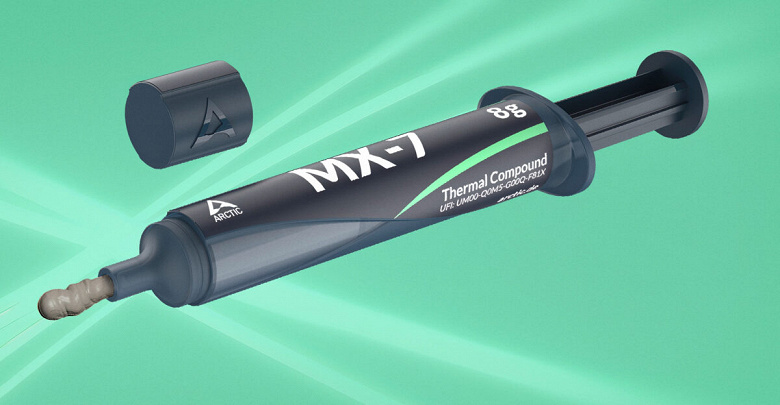
Unlike other pastes, Arctic advises against spreading the MX-7 across the surface after applying due to its low adhesiveness and high viscosity. Instead, it is recommended to simply apply it in a cross pattern. The viscosity of this new thermal paste is about 35-38 thousand poise, and its density is 2.9 g/cm³. It has an operational temperature range from -50 to 250 degrees Celsius (-58 to 482 degrees Fahrenheit).
Regarding its electrical properties, the specific resistance is 1.7×10¹² Ohm·cm, and the breakdown voltage is 4.2 kV/mm (106,600 V/inch).
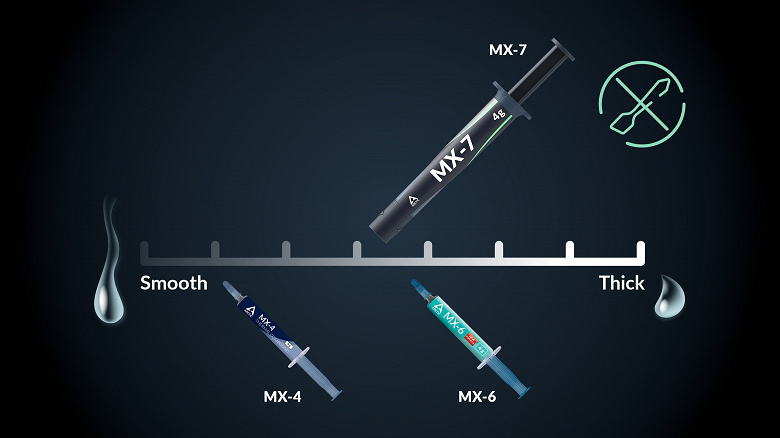
If we believe the tests, the MX-7 under similar conditions provides temperatures a few degrees lower than the MX-6, with a four-degree difference compared to the MX-4. Let’s recall, in a recent Tom’s Hardware test, the MX-6 paste ranked second overall and best for price and efficiency.
New Developments & Alternatives
Recently, there have been several advancements in the thermal paste industry. Companies are focusing on formulations that not only boost thermal performance but also offer environmental benefits, like reduced carbon footprint. Gelid GC-Extreme and Noctua NT-H2 are among the products providing fierce competition, boasting impressive thermal conductivity and ease of application.
Performance Analysis
When comparing the utility and performance data, Arctic MX-7 stands out remarkably for its unique formulation. Its cohesive property ensures better longevity and maintains consistent thermal performance over time, setting it apart from its predecessors like MX-6 and MX-4. Such properties make it a prudent choice for overclocking enthusiasts who demand top performance.