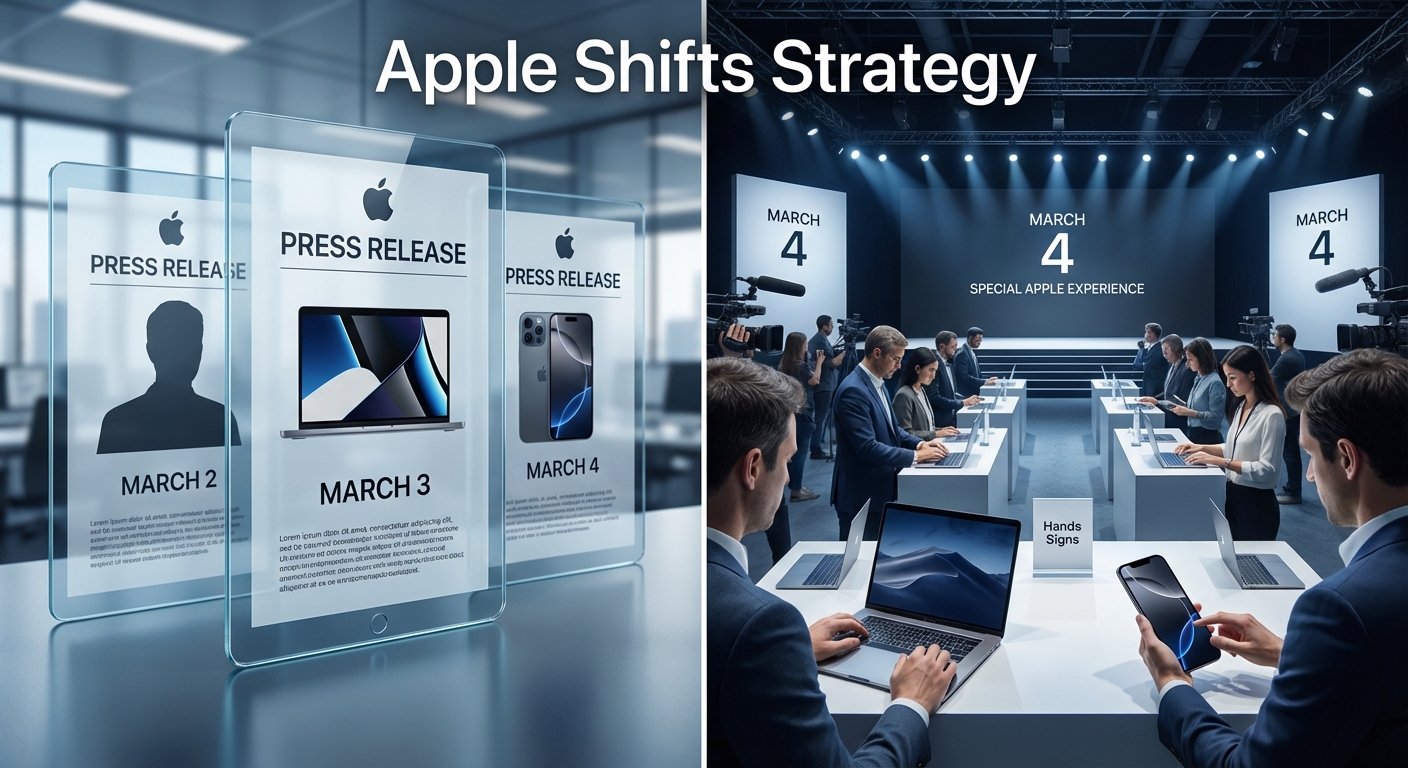

Apple has scheduled its next media gathering for March 4, but the company may be altering its traditional launch playbook. According to respected insiders John Gruber of Daring Fireball and Mark Gurman of Bloomberg, Apple plans to announce its highly anticipated new products-including new MacBooks and the iPhone 17e-through a series of press releases in the days leading up to the event, from March 2 to March 4. This suggests the March 4 “Special Apple Experience,” held in New York, London, and Shanghai, will focus more on hands-on demos for the media rather than a traditional keynote presentation.
A New Launch Strategy: Quiet Confidence
This press-release-first approach is not unprecedented for Apple, which has previously used this method for iterative updates to products like the iPad and Mac mini. The strategy allows the company to manage the narrative, providing detailed specifications for journalists to digest ahead of time. The in-person “experience” can then be dedicated to showcasing how these new products work, perhaps focusing on software and ecosystem integrations that benefit from live demonstrations. This multi-day rollout could see different product categories announced on consecutive days, building momentum towards the March 4 gathering.
What’s on the Menu? A Full Slate of New Hardware
The list of expected products is extensive, targeting multiple segments of Apple’s user base. Here’s a breakdown of the rumored announcements:
Next-Generation MacBooks
The Mac lineup is poised for a significant refresh with the introduction of the M5 family of chips. The new MacBook Air and MacBook Pro models are expected to feature chips ranging from the base M5 to the high-performance M5 Pro and M5 Max. Built on an advanced 3-nanometer process, the M5 chip is anticipated to deliver a 10-15% jump in CPU speeds and notable improvements in graphics performance and power efficiency, potentially leading to even longer battery life. Perhaps the most intriguing rumor is a new, lower-cost MacBook powered by an A18 Pro chip, the same family of processors found in iPhones. This device would target the entry-level market, competing with Chromebooks and budget Windows laptops by offering exceptional battery life and performance for everyday tasks like web browsing and document editing.
iPhone 17e and New iPads
Following the release of the iPhone 16e, Apple is expected to unveil the iPhone 17e. Rumors suggest it will receive a significant performance boost from the A19 chip, the same processor expected in the standard iPhone 17. Other potential upgrades include the addition of the Dynamic Island and MagSafe support, bringing premium features to a more affordable price point. The iPad lineup is also due for an update, with a new iPad Air potentially moving to an M4 chip and the base iPad receiving an A18 chip.
The Competitive Landscape
Apple’s strategic product-line expansion comes as the PC market sees renewed competition. Windows laptops powered by ARM-based chips from Qualcomm are gaining traction, challenging the performance-per-watt dominance Apple has enjoyed with its custom silicon. By introducing a budget-friendly MacBook with an A-series chip, Apple could create a new market segment and fortify its position against competitors like the HP Pavilion, ASUS ZenBook, and Microsoft Surface Laptop. Meanwhile, high-end MacBook Pro alternatives from Razer, Lenovo, and ASUS continue to push the boundaries of performance, particularly in gaming and graphics-intensive tasks, underscoring the need for Apple’s M5 Pro and M5 Max chips to deliver substantial gains.
A Look to the Future: Evolving the Apple Event
This potential shift in launch strategy could signal a new chapter for Apple’s marketing machine. By separating product announcements from its keynote events, the company can dedicate its stage time to more transformative technologies and software innovations. Major, revolutionary products like the Vision Pro or significant iOS updates would command the spotlight at large-scale events, while iterative hardware updates are handled more efficiently through press releases and curated media experiences. This approach would make Apple’s product pipeline more flexible and allow each announcement to receive its due attention without being overshadowed in a crowded keynote.