





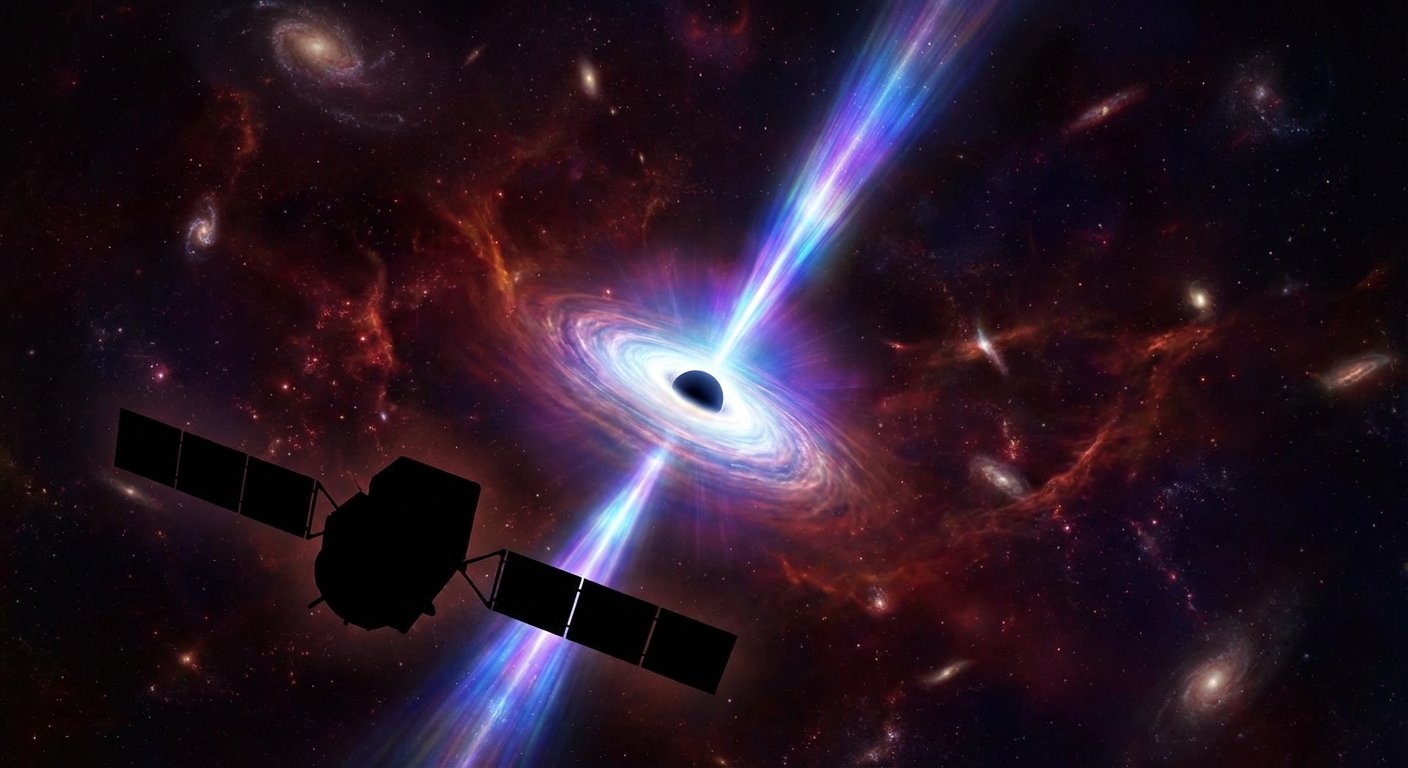

Astronomers using data from the Fermi-LAT space telescope have, for the first time, reliably detected gamma-ray emissions from B3 1239+376, a blazar so distant its light has traveled for nearly 12 billion years to reach us. This discovery places the object, a radio quasar with a redshift of z = 3.82, in the era when the universe was less than two billion years old. The finding makes B3 1239+376 the third most distant gamma-ray-emitting blazar ever found and provides a crucial probe into the conditions of the early cosmos, challenging existing models of black hole formation and galaxy evolution.
A Flare from the Cosmic Dawn
The breakthrough came in 2025, when a significant gamma-ray flare was detected from the direction of B3 1239+376. The event was recorded with a high statistical significance of 7.7σ and a 91% probability of being associated with the quasar, confirming the detection. This high-energy event was not an isolated phenomenon. A comprehensive analysis of multi-year, multi-wavelength observations revealed that the gamma-ray activity was accompanied by a synchronous increase in the object’s infrared emissions, observed by the WISE and SPHEREx telescopes. This temporal coincidence provides decisive evidence linking the gamma-ray source to the blazar. Further observations from the Chandra X-ray Observatory confirmed the source’s hard spectrum, while radio telescopes noted an increased brightness in its compact core.
What is a Blazar and Why Does It Matter?
Blazars are a special class of active galactic nuclei (AGNs), which are the incredibly luminous centers of some distant galaxies. These cosmic engines are powered by supermassive black holes actively feeding on surrounding gas and dust. A fraction of this material is channeled into powerful relativistic jets that blast outward at nearly the speed of light. When one of these jets happens to be pointed almost directly at Earth, the object is classified as a blazar. This alignment makes them appear exceptionally bright, like a cosmic flashlight aimed at our eyes, allowing them to be seen across vast cosmological distances. Their rarity is a key part of their importance; for every blazar we see, there must be hundreds more with similar properties whose jets are pointing in other directions.

The blazar’s spectral energy is explained by a classic model where a compact cloud of relativistic electrons spiraling in a magnetic field produces radiation. During high-flux states, the synchrotron peak shifts to the infrared, while the inverse Compton peak moves into the gamma-ray range, consistent with the recent observations of B3 1239+376.
A Rare Member of an Exclusive Club
The detection of gamma rays from B3 1239+376 makes it an exceptionally rare object. Out of the thousands of known extragalactic gamma-ray sources, only a handful have a redshift greater than 3. This discovery officially makes it the third most distant gamma-ray blazar, surpassed only by B3 1428+422 (z = 4.72) and GB 1508+5714 (z = 4.3). Such objects are vital for understanding the universe during the epoch of reionization, a period when the first stars and galaxies were forming and lighting up the cosmos after the cosmic ‘Dark Ages’.
A Challenge to Cosmological Models
The existence of such powerful blazars so early in the universe’s history poses a significant puzzle for astrophysicists. These objects are powered by supermassive black holes that are estimated to be a billion times the mass of our sun, or even more. A central question that emerges from these discoveries is how such massive black holes could have formed and grown so rapidly in a young universe. The presence of these cosmic behemoths challenges the conventional understanding of black hole growth, suggesting that the mechanisms for their rapid development are not yet fully understood.
Future Outlook: Peering Deeper into the Past
The discovery of gamma-ray emissions from B3 1239+376 opens a unique window into the physics of jets and the growth of black holes during the era of first-galaxy formation. Further observations are crucial. Prompt follow-up studies, particularly using radio interferometry, could catch the potential ejection of new material from the jet, providing invaluable data on its kinematics and structure. Continued monitoring across the electromagnetic spectrum will not only help refine models of blazar emissions but also deepen our understanding of how the most powerful objects in the universe evolved at vast cosmological distances.