



The Race Against Nvidia Just Got Steeper
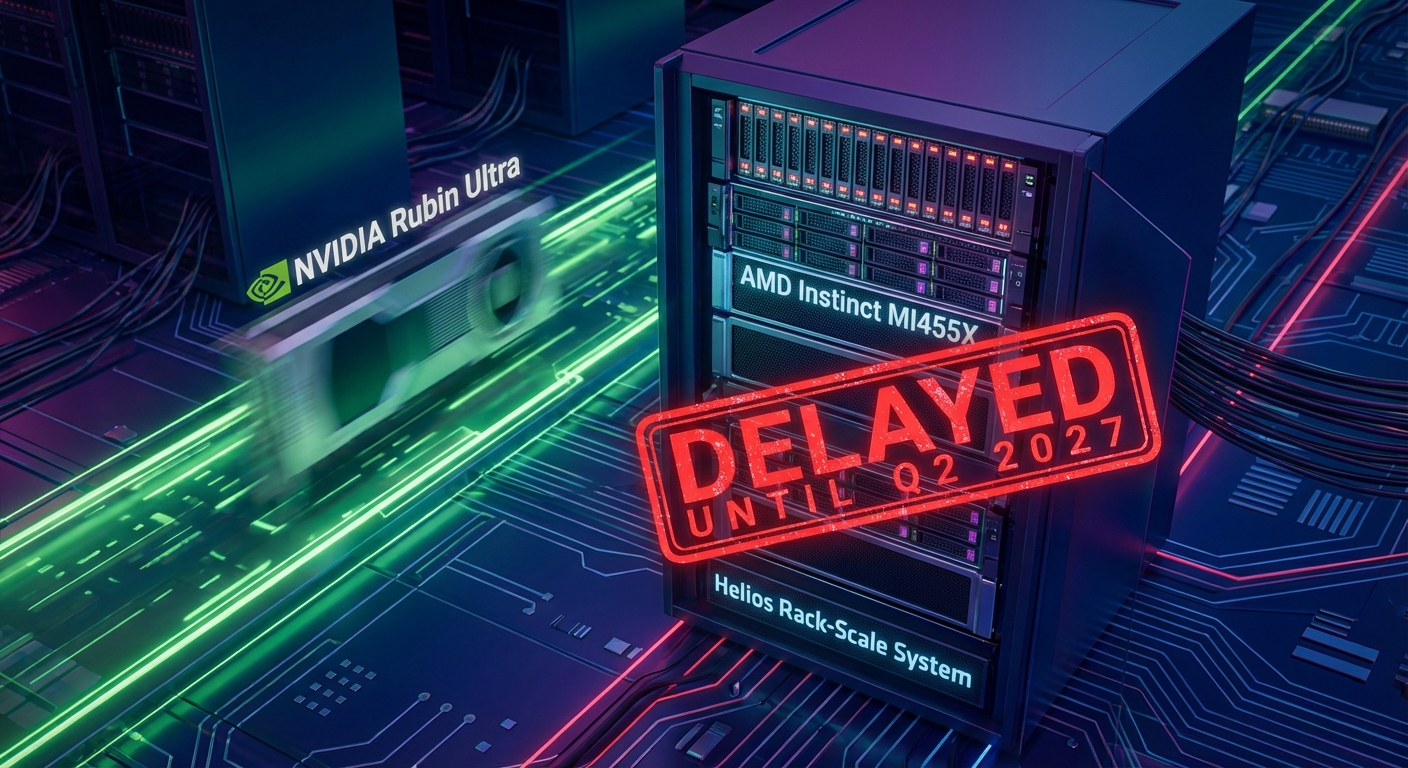
In the high-stakes race to compete with Nvidia in the AI accelerator market, AMD appears to be facing a significant setback. According to a report from industry resource SemiAnalysis, the company’s next-generation Instinct MI455X accelerators are experiencing manufacturing difficulties, pushing their mass-market availability into the second quarter of 2027. This delay could give rival Nvidia an even wider lead in the rapidly expanding AI hardware sector.
The report indicates that while low-volume production of the first rack-scale system, the MI455X UALoE72, is expected to begin in the second half of 2026, customers will only start receiving the powerful new hardware in Q2 2027. This timeline is critical, as it means AMD’s latest technology will be competing with what is expected to be Nvidia’s next-next-generation “Rubin Ultra” platform.
A Leap in Technology, A Challenge in Execution
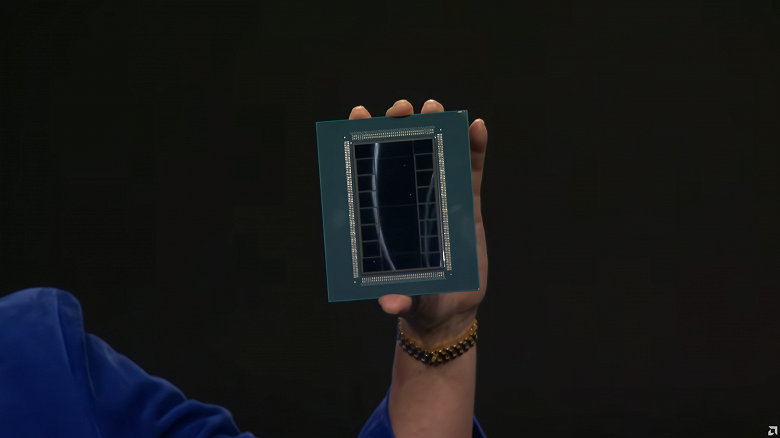
Announced at CES 2026, the Instinct MI455X represents a monumental leap for AMD. The accelerator boasts impressive specifications, including 40 PFLOPS of FP4 and 20 PFLOPS of FP8 compute performance, and will be equipped with 432 GB of next-generation HBM4 memory. However, the root of the delay may lie not in the chip itself, but in the ambitious architecture surrounding it. The MI455X is the cornerstone of AMD’s first complete rack-scale solution, codenamed “Helios.” This system integrates 72 MI455X GPUs with 6th Gen AMD EPYC “Venice” CPUs into a single, massive computational unit.
This shift from selling individual accelerator cards to fully integrated, pre-configured servers is a complex engineering and logistical challenge. Developing a cohesive system that manages the power, cooling, and high-speed interconnects for such a dense configuration is a formidable task, and some manufacturing issues were to be expected for the company’s first foray into this domain.

Nvidia’s Relentless Pace Widens the Gap
The delay is particularly concerning when viewed against Nvidia’s aggressive roadmap. Nvidia has adopted an annual refresh cycle for its AI platforms. By the time AMD’s Helios racks reach customers in mid-2027, Nvidia’s “Rubin” platform, slated for late 2026, will already be in the market, and its successor, “Rubin Ultra,” will be on the horizon for 2027. This puts the MI455X in the difficult position of competing with a product a full generation ahead, potentially ceding a significant performance advantage to Nvidia from day one.
Implications for the AI Market
While this delay is a blow to AMD’s ambitions, the company is not standing still. Its current generation of MI300 series accelerators continues to gain traction, with major cloud providers like Microsoft, Oracle, and Meta adopting AMD’s AI solutions to diversify their infrastructure and challenge Nvidia’s market dominance. However, the delay of the MI455X could cause potential large-scale customers to hesitate and stick with Nvidia’s established ecosystem rather than wait for AMD’s next offering.
The coming year will be crucial for AMD. The company must navigate the complexities of its rack-scale production ramp while continuing to build out its software ecosystem (ROCm) to be a viable, open alternative to Nvidia’s CUDA. The success or failure of the Helios platform’s launch will significantly impact the competitive landscape, determining whether the AI accelerator market remains a near-monopoly or evolves into a true duopoly.