





A Silent End to a Stellar Giant
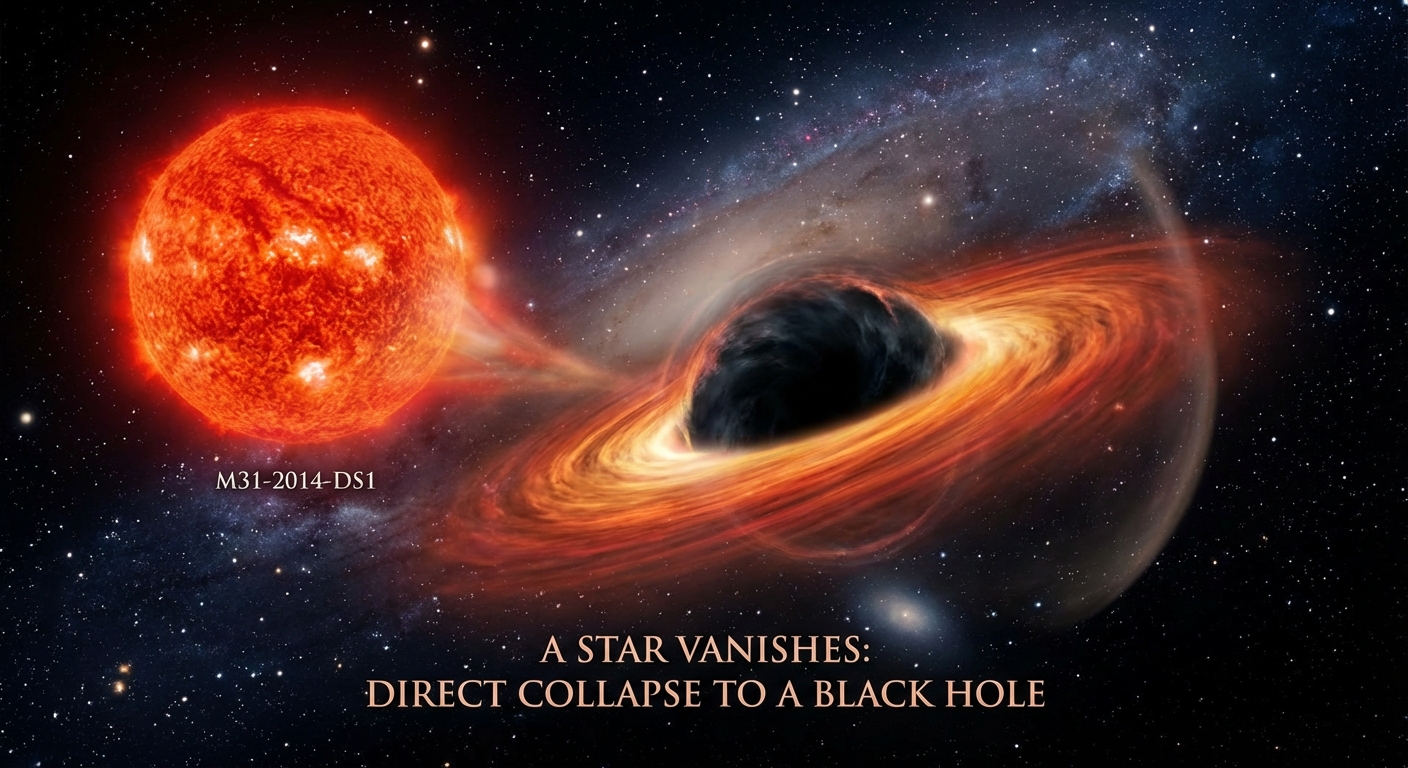
Astronomers have captured the most complete set of observations to date of a massive star ending its life not with a cataclysmic supernova explosion, but by collapsing directly into a black hole. Instead of a powerful blast, the star’s core imploded while its outer layers were slowly shed. The subject of this landmark study is the star M31-2014-DS1, located in the neighboring Andromeda galaxy, approximately 2.5 million light-years from Earth.
A team of astronomers, led by Kishalay De of Columbia University, analyzed data collected from 2005 to 2023 by a suite of ground- and space-based telescopes, including NASA’s NEOWISE mission. They discovered that in 2014, the star’s infrared emission began to intensify. Then, in 2016, its brightness plummeted dramatically in just one year, falling far below its previous level. Observations in 2022 and 2023 confirmed the star had all but vanished in visible and near-infrared light, fading to 1/10,000th of its former strength. Now, its remnant is only detectable in mid-infrared light, glowing at about one-tenth of its prior luminosity.
«This star used to be one of the most luminous stars in the Andromeda Galaxy, and now it was nowhere to be seen. Imagine if the star Betelgeuse suddenly disappeared. Everybody would lose their minds,» explains lead researcher Kishalay De. He notes that something of a comparable scale was happening in our galactic neighbor.
The Physics of a Failed Supernova
By comparing these extensive observations with theoretical models, the authors concluded that this profound fading is best explained by the star’s core collapsing to form a black hole without a supernova. This phenomenon, known as a “failed supernova” or “direct collapse,” occurs when the shockwave generated by the core’s collapse is not strong enough to blow away the star’s outer layers. This research has provided crucial insights into what happens to these outer layers. A key factor, the authors demonstrated, is convection-the movement of gas driven by the temperature difference between the hot core and the cooler envelope.
Even after the core collapses, this churning gas continues to mix and rotate. The team’s models show that this material doesn’t fall directly into the black hole. Instead, it forms a rotating disk that gradually ejects a portion of the matter outward. As this material travels away, it cools and forms dust, which absorbs the radiation from the hot gas and re-emits it in the infrared spectrum.
Co-author Andrea Antoni explains: «The rate of material falling in is much slower than if the star imploded directly. This convective material has angular momentum, so it circularizes around the black hole. Instead of taking months or a year to fall in, it’s taking decades.»
This process results in a source that remains visible in infrared light for an extended period. The authors estimate that only about 1% of the gas from the star’s outer shell ultimately falls into the black hole. It is this accreting matter that sustains the faint infrared glow, which could be observed for decades with instruments like the James Webb Space Telescope.
A New Class of Stellar Death
The detailed analysis of M31-2014-DS1 has also provided a new lens through which to view earlier observations of a similar object, NGC 6946-BH1, which was categorized as a failed supernova candidate about a decade ago. Both objects are now seen as members of a distinct class of “failed supernovae.” This discovery helps address the “missing supernova problem,” where the observed number of supernovae is lower than predicted by star formation rates, suggesting that a significant fraction of massive stars may end their lives quietly. These events provide a new, observable pathway for the formation of stellar-mass black holes, challenging previous assumptions that all stars of this mass must explode.