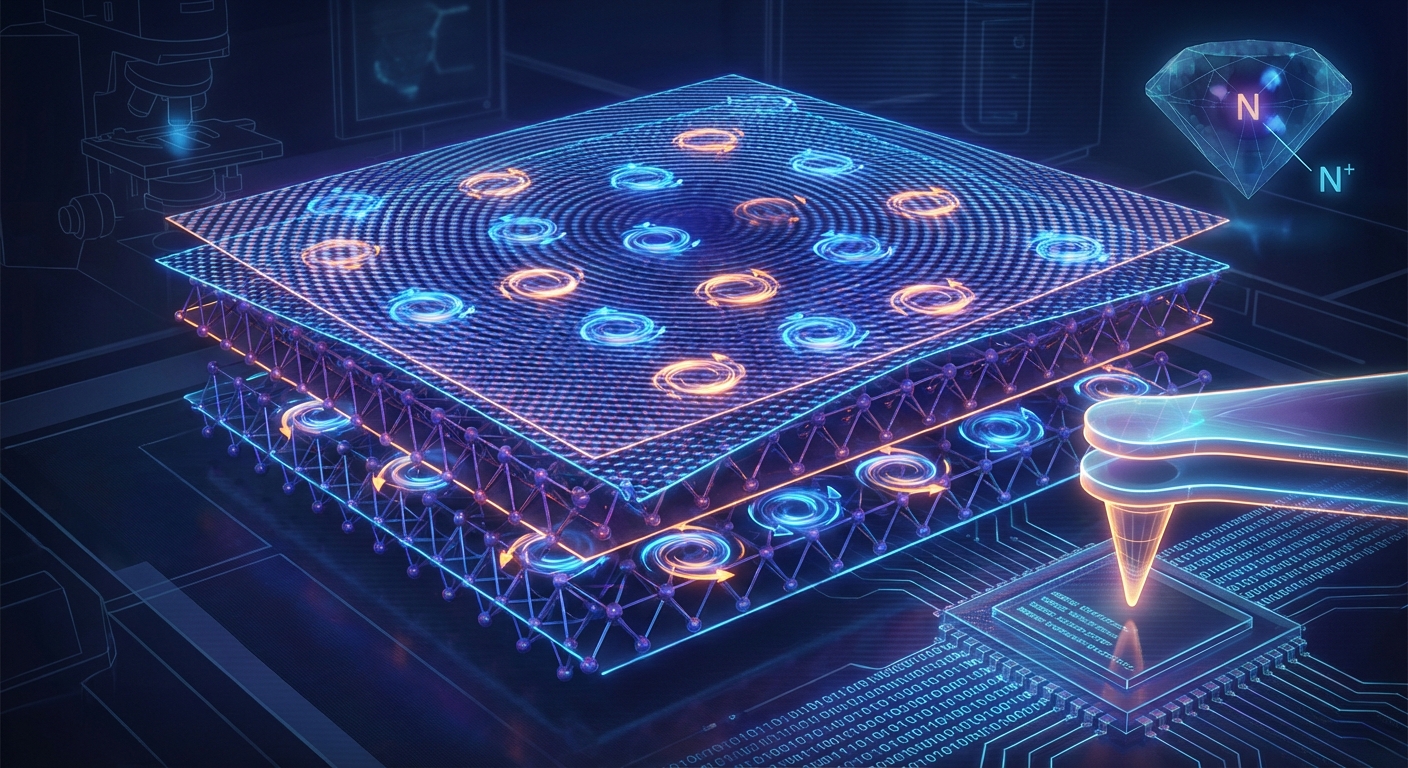

Scientists at the University of Stuttgart have discovered a new magnetic regime in a four-layer chromium iodide (CrI3) material, enabling the creation of exceptionally small and stable magnetic vortices known as skyrmions. These topologically protected structures are capable of storing information at the nanometer level and exhibit remarkable stability, paving the way for ultra-dense and energy-efficient data storage technologies. The breakthrough, achieved by slightly rotating two pairs of CrI3 layers against each other, could redefine the future of information carriers.
The Moiré Magic: Engineering Magnetism with a Twist
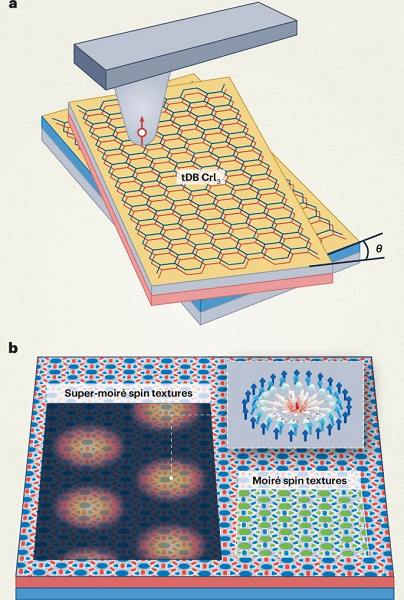
The experiment involved a subtle yet transformative manipulation of the material’s structure. Researchers took a four-layer stack of CrI3, an archetypal 2D magnetic material, and introduced a slight twist between the top and bottom bilayers. This rotation creates what is known as a moiré superlattice, an interference pattern that fundamentally alters the interactions between the magnetic layers. This unique configuration, unlike its untwisted counterpart, gives rise to a distinct magnetic field and demonstrates robust resistance to external disturbances. The result is the spontaneous formation of skyrmions-whirl-like spin textures that behave like particles and are topologically protected, meaning they cannot be easily undone without a significant energy input.
Quantum Microscopy Reveals the Unseen
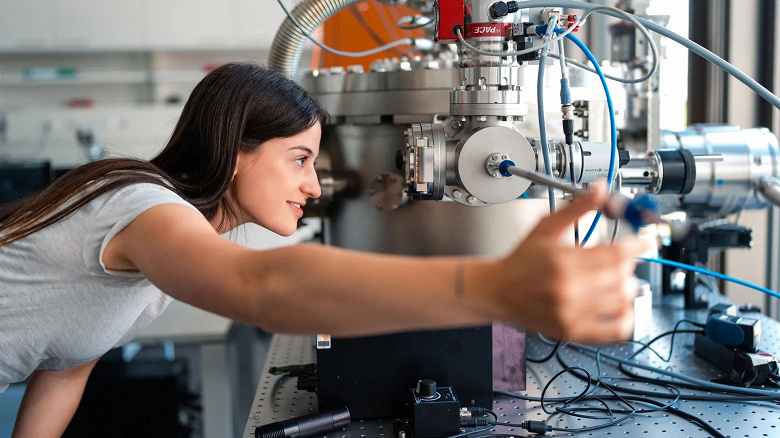
Observing these faint magnetic signals required cutting-edge technology. The team employed a quantum microscope utilizing nitrogen-vacancy (NV) centers in diamond, a highly sensitive technique developed and perfected over the last two decades at the Center for Applied Quantum Technologies (ZAQuant). This advanced microscopy allowed for the direct visualization of the nanoscale skyrmions, confirming their existence and stability with unprecedented clarity. The NV center acts as an atomic-sized magnetic sensor, capable of mapping minute magnetic fields with nanoscale resolution without disturbing the delicate magnetic structures being observed.
A Paradigm Shift for Physics and Technology
This discovery has profound implications. On a practical level, skyrmions in twisted 2D magnets could become the foundation for future information storage devices, offering record-breaking data density and reliability. Their small size and the low energy required to manipulate them make them ideal candidates for next-generation, low-power spintronic applications that could surpass the limitations of current SSD and HDD technologies. From a fundamental physics perspective, the findings challenge and expand existing theoretical models of collective electron behavior in 2D magnetic systems. The international collaboration, with experimental work in Stuttgart, modeling in Edinburgh, and contributions from scientists in Japan, the USA, and Canada, highlights the global effort to unlock the potential of quantum materials.
The Future is Twisted: A New Horizon for Data
Looking ahead, the ability to create and control skyrmions simply by adjusting the geometry of atomic layers opens a new frontier in materials science. This method of “twist engineering” provides a powerful tool to design and manipulate magnetic properties without complex chemical alterations. As the demand for data storage continues to explode, the stable, ultra-small skyrmions generated in twisted chromium iodide represent a critical step toward developing non-volatile, high-capacity, and highly efficient memory technologies that will power the computing of tomorrow.