






Scientists from the European Southern Observatory (ESO) have proposed a novel method for finding exomoons-moons orbiting planets beyond our solar system. The authors of this new study claim that the lack of detected exomoons is due not to their absence, but to the limitations of existing technologies. The suggested tool, a kilometer-baseline interferometer, will be able to detect Earth-sized exomoons at distances up to 200 parsecs (652 light years). Interferometry is a method that uses wave interference to increase measurement accuracy. In this case, combining data from several telescopes located far apart will allow for higher resolution.
Existing methods, such as the transit method (observing the dimming of a star’s brightness when a planet or moon passes in front of it), prove ineffective for finding exomoons. The transit method requires almost perfect alignment of Earth, the star, the planet, and its moon, and works best for planets close to their stars. However, such planets poorly retain their moons due to a reduced Hill sphere (the area around a celestial body where its gravitational influence dominates). An alternative method-astrometry-measures the wobble of an astronomical object. For exoplanet detection, astronomers observe the movement of the star, but for finding exomoons, it’s necessary to observe the movement of the planets themselves.
Existing telescopes, such as the VLTI in Chile, can resolve fluctuations around 50 microarcseconds (µas). To detect Earth-sized exomoons requires a resolution of about 1 µas.
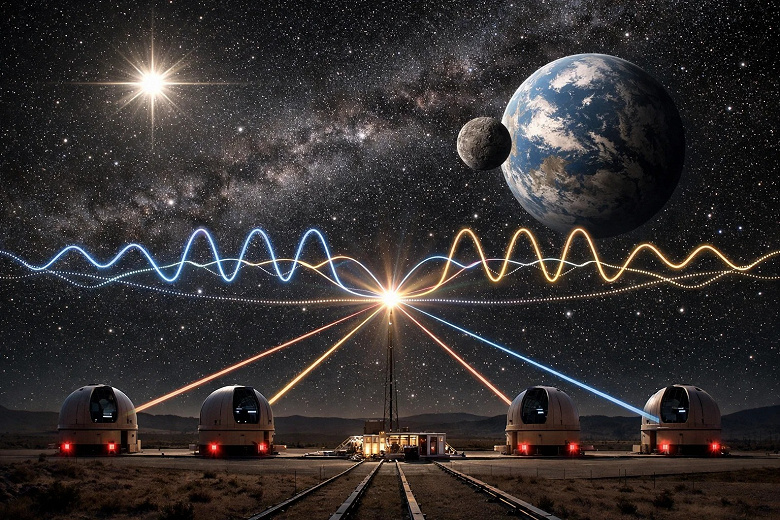
Achieving such a resolution will require significantly increasing the interferometer’s baseline-to several kilometers. Scientists suggest using the new interferometer in conjunction with the Extremely Large Telescope (ELT), which will be operational in 2028. With a mirror diameter of 39 meters, the ELT will enable direct imaging of faint planets, and the new interferometer will track their movements caused by the presence of moons.
The new method could prove especially effective for finding potentially habitable exomoons since ‘habitable zones’ for moons around gas giants are typically farther from the star. Unlike Earth, where life is supported by the Sun’s energy, exomoons like Europa or Enceladus (moons of Jupiter and Saturn with subsurface oceans) could support life through tidal heating caused by gravitational interaction with their giant planet. Implementing the project will require significant investments-around several billion dollars ($). Nonetheless, constructing such an interferometer may be a logical next step following the completion of the ELT and could finally allow astronomers to discover the first exomoons, and possibly even find a potentially habitable exoworld.