





Astronomers have discovered a distant planetary system that challenges long-held beliefs about how planets form. The arrangement of the system around the red dwarf star LHS 1903 does not fit the classic “rocky planets inside, gas giants outside” model observed in most known systems, including our own Solar System. This discovery forces a re-evaluation of the conditions and timelines necessary for the birth of worlds.
A System That Breaks the Rules
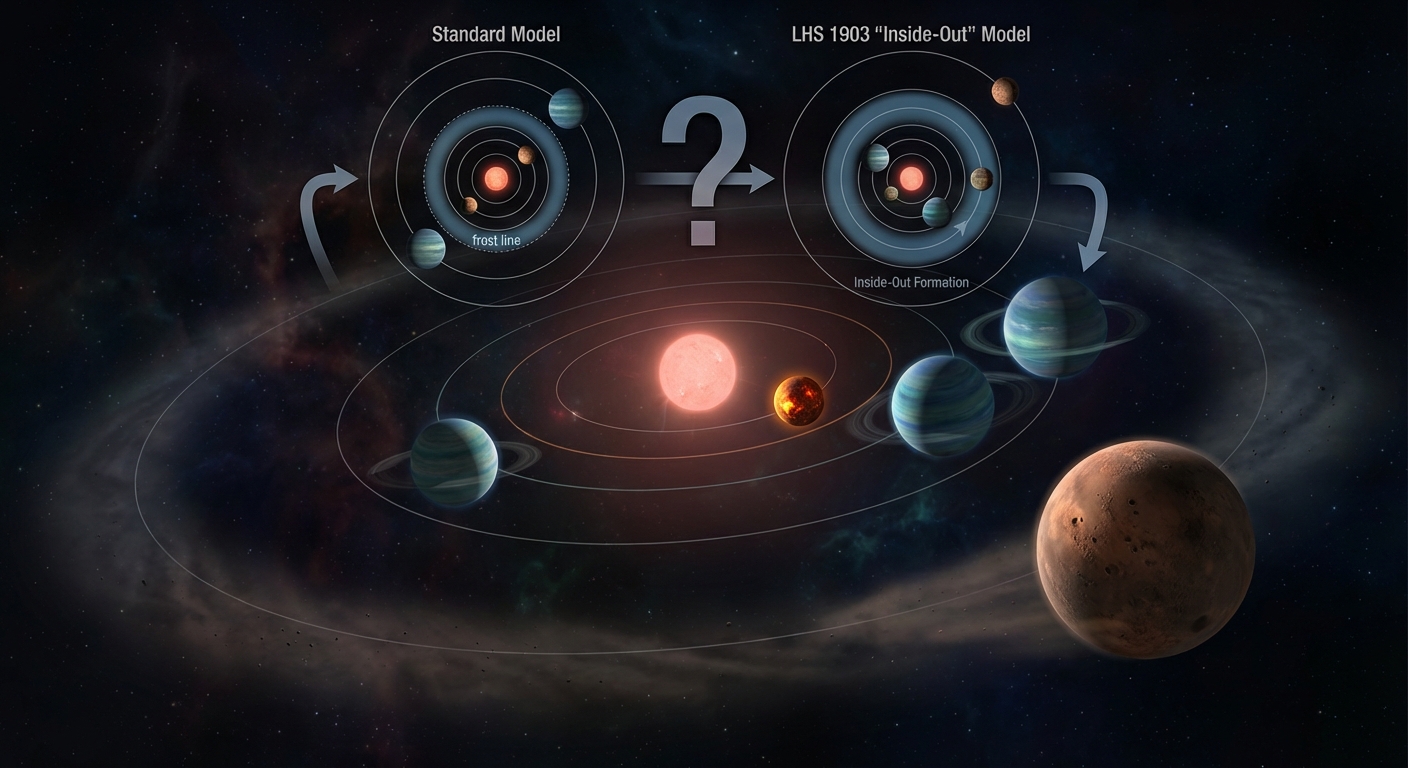
Typically, in planetary systems, the planets nearest to the star are composed mainly of rock and metal, while those farther out are gaseous. This structure is explained by the intense radiation from a young star, which “blows away” gas from the inner planets, leaving only a solid core. In the colder outer regions, massive atmospheres can form and be retained. However, the system around LHS 1903, a cool, faint red dwarf star, violates this rule.
An international team of scientists, led by researchers from McMaster University and the University of Warwick, used data from both ground-based and space telescopes to study the planets in this system. Initially, three planets were found around LHS 1903: one rocky planet in the inner part of the system and two gas-rich planets, similar to smaller versions of Neptune. This configuration was perfectly in line with astronomers’ expectations.
CHEOPS Reveals a Rocky Outsider
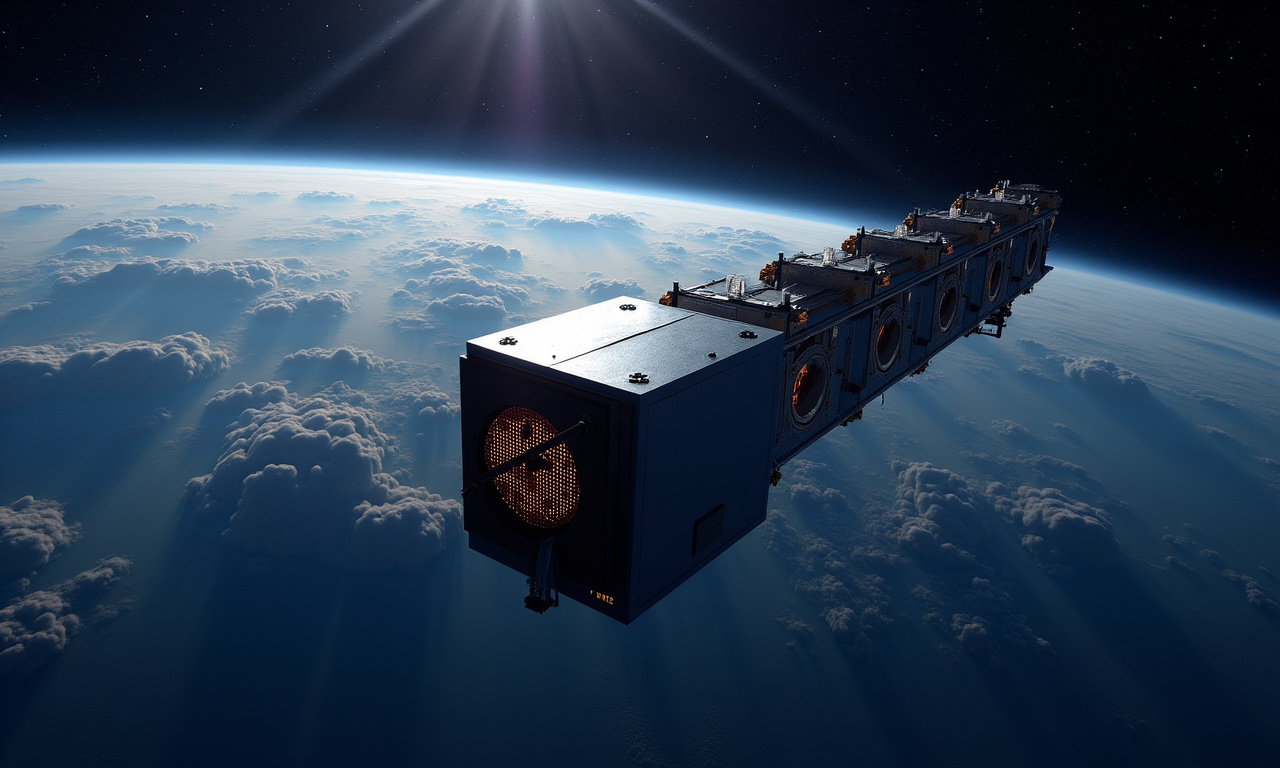
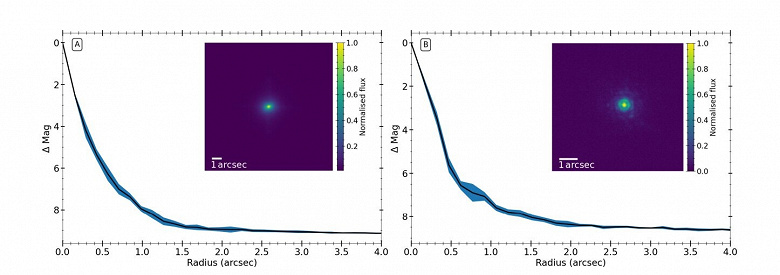
The situation changed after analyzing data from the European Space Agency’s CHEOPS (CHaracterising ExOPlanet Satellite). The observations revealed the presence of a fourth planet, LHS 1903 e, the most distant from the star. To the surprise of the scientific team, it was determined that this outermost planet is also likely rocky. This finding makes LHS 1903 a unique “inside-out” system.
“We see the same picture-rocky planets inside and gas giants outside-in hundreds of systems. Therefore, the discovery of a rocky planet on the periphery forces us to reconsider the conditions and timelines of their formation,” explains study leader Ryan Cloutier from McMaster University.
A New Theory: “Inside-Out” Formation
Scientists tested several possible explanations. They considered a scenario where the planet might have lost its atmosphere after a powerful collision, as well as the possibility of a past orbital rearrangement. However, numerical models and analysis of the planets’ motion showed these versions to be unlikely.
The most compelling explanation proved to be different: the planets in the LHS 1903 system likely did not form simultaneously, but sequentially, during different periods of the protoplanetary disk’s evolution. According to standard models, planets emerge almost concurrently in the gas-and-dust disk around a young star. In this disk, planetary embryos form and gradually accumulate mass and atmospheres, resulting in bodies of various sizes and compositions.
However, the architecture of LHS 1903 points to an alternative scenario-“inside-out formation.” In this case, planets appear sequentially as conditions within the disk change. Their composition is determined by how much gas and dust was available when their growth concluded. According to the study’s authors, by the time the planet LHS 1903 e began to form, the surrounding disk might have already been severely depleted of gas. As a result, it did not develop a dense atmosphere and remained rocky.
“It’s astonishing to see a rocky object in conditions that should not have been conducive to it. This questions many of the assumptions in our models,” notes Cloutier.
A Glimpse into a More Diverse Universe
Scientists emphasize that it is unclear whether LHS 1903 is a rare exception or an example of a more common, yet poorly understood, mechanism of planet formation. As telescopes and observation methods advance, astronomers are increasingly finding systems that do not resemble our Solar System and do not fit into conventional frameworks. This growing picture of planetary diversity forces scientists to constantly rethink the processes that shape worlds across the galaxy.