




The Path to the Planets is Paved with Reusability
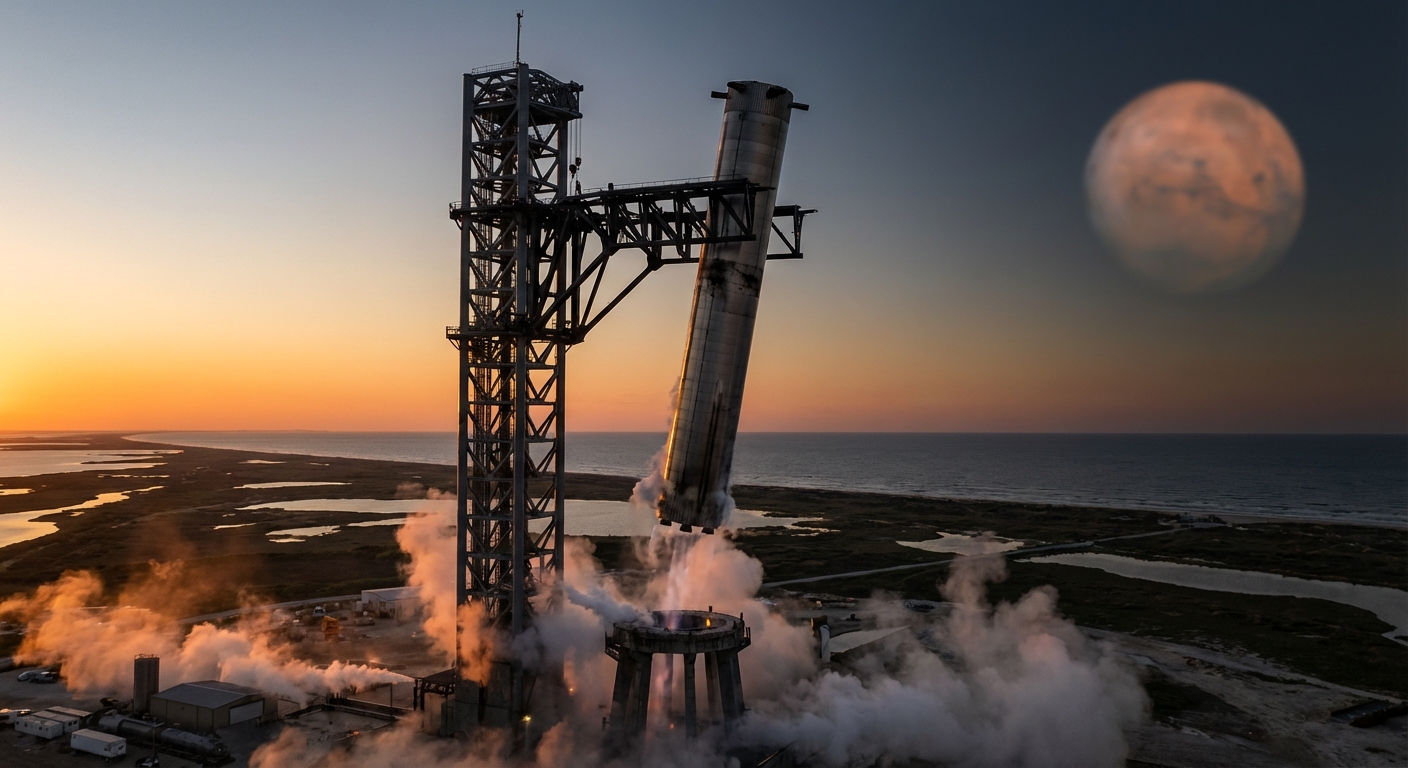
Elon Musk adheres to the “four R’s” concept, which he believes will unlock the path to colonizing other planets: Rapidly Reusable Reliable Rockets. A key element of this philosophy is the technology for returning the Super Heavy booster using the giant manipulator arms of the launch towers, known as “Mechazilla.” The tower, which initially assembles the rocket, is designed to catch the Super Heavy booster in mid-air after its flight and immediately place it back on the launch mount. This ambitious goal is not just an engineering novelty; it is the cornerstone of a strategy aimed at radically reducing the cost of space access, making a city on Mars economically feasible.
How the “Chopsticks” System Works
The Mechazilla system is an audacious piece of engineering. After stage separation, the Super Heavy booster performs a boostback burn to return to the launch site. As it descends, it must precisely position itself between Mechazilla’s large, adjustable arms, often called “chopsticks.” The system then clamps onto the booster just below its grid fins, absorbing the momentum of the massive rocket and carefully lowering it onto the launch pad. This maneuver, which takes about five to six minutes from launch, eliminates the need for landing legs, reduces the booster’s weight, and minimizes the time between flights. Following a successful catch, refueling and reintegrating the Starship upper stage could take as little as 30-40 minutes, theoretically enabling the entire system to launch every one to two hours.
The Economic Imperative of Rapid Reuse
The primary driver behind this complex system is economics. Historically, spaceflight has been incredibly expensive because rockets are traditionally single-use. The cost of a Falcon 9 launch, which only reuses its first stage, is around $67 million, bringing the price per kilogram to orbit down to approximately $2,720 from the Space Shuttle’s $25,000. With full and rapid reusability, where no hardware is lost, SpaceX projects the cost of a Starship launch could eventually fall to as little as $2 million to $3 million. This would slash the cost per kilogram to under $200, representing a potential cost reduction of over 100-fold compared to expendable rockets and making access to space cheaper than air cargo.
Recent Progress and Future Challenges
SpaceX has made significant strides in proving the viability of this concept. On October 13, 2024, during Starship’s fifth test flight, the Mechazilla system successfully caught a returning Super Heavy booster for the first time, a moment hailed as a historic achievement in space engineering. This marked a critical step toward routine reuse. The next major challenge is to apply the same catch technique to the Starship upper stage, a more complex task due to the vehicle’s design and reentry profile. SpaceX anticipates attempting the first catch of a Starship upper stage in the near future, a milestone that would close the loop on full reusability and bring the system closer to aircraft-like operations.
The Competitive Landscape
While SpaceX is the clear leader in the pursuit of full and rapid reusability, other players are entering the field. Blue Origin is developing its New Glenn rocket with a reusable first stage. United Launch Alliance (ULA) is working on the Vulcan rocket, which aims for partial reuse of its engine section. In the small launch market, Rocket Lab is developing the fully reusable Neutron rocket. Furthermore, several Chinese companies are also developing reusable rocket technology, with at least one planning a similar “chopstick clamp” recovery system for its first stage. However, none are as close to achieving the scale and turnaround speed that SpaceX is targeting with Starship and Mechazilla.
A Gateway to a Multi-Planetary Future
Ultimately, the success of Mechazilla is inextricably linked to Elon Musk’s long-term vision of establishing a self-sustaining city on Mars. Such an undertaking would require thousands of launches to transport the necessary cargo, infrastructure, and people. The extreme cost reduction and high launch frequency promised by the Starship system are not just improvements-they are fundamental requirements for making humanity a multi-planetary species. By turning a rocket into a reusable vehicle with an hourly launch cadence, SpaceX aims to transform the economics of space travel and open a new era of exploration and settlement beyond Earth.