





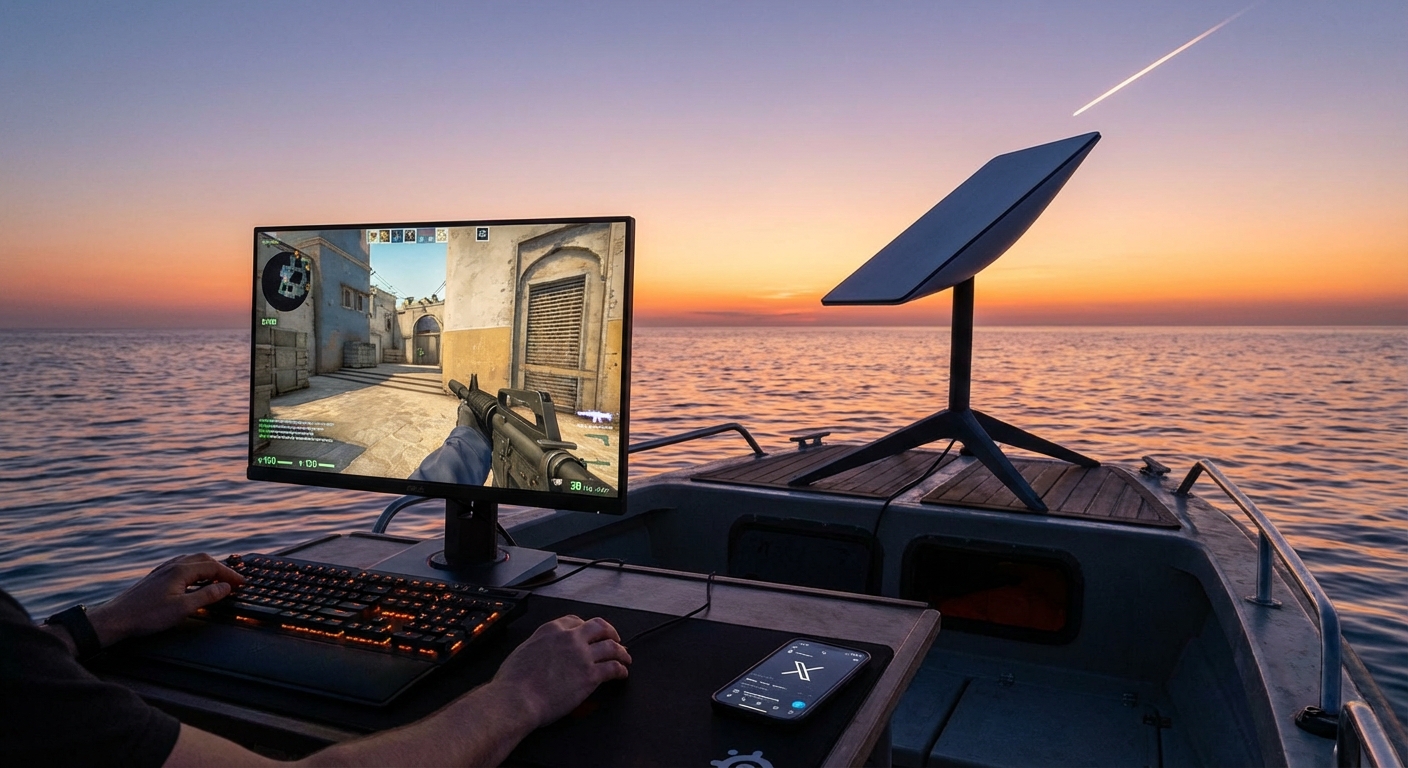

A video that recently went viral on the social network X showed an enthusiast testing Starlink’s satellite internet by playing a competitive match of Counter-Strike 2 on a small boat in the middle of the ocean. The connection proved to be remarkably stable, with a near-perfect ping that allowed for smooth, lag-free gameplay. This impressive demonstration of low-latency internet far from shore is more than just a novelty; it showcases the disruptive potential of low-Earth orbit (LEO) satellite constellations in the maritime communications sector.

The Viral Test and Musk’s Reaction
The video quickly captured widespread attention, including that of SpaceX CEO Elon Musk. His response was concise, simply reminding his followers that the equipment is available for order on the official Starlink website-a subtle but effective use of user-generated marketing. The test is significant because fast-paced online games like Counter-Strike 2 are highly sensitive to latency, and a stable experience at sea has historically been unattainable with traditional satellite internet. For gaming, a ping below 50ms is considered excellent, and Starlink’s LEO constellation, orbiting at just 550 kilometers, makes such performance possible, unlike geostationary satellites which orbit much farther away.
Beyond Gaming: The Reality of Starlink at Sea
While the gaming demonstration is impressive, the practical applications for robust, low-latency internet at sea are vast. Starlink offers dedicated “Maritime” and “Mobility” plans designed for vessels ranging from small recreational boats to large merchant ships. These plans provide download speeds that can exceed 200 Mbps, a revolutionary leap from the 5-10 Mbps links common with legacy systems. However, this performance comes at a premium. The high-performance hardware required for in-motion use costs $2,500, and monthly service plans for maritime use start at around $250 for 50GB of priority data, scaling up to several thousand dollars for higher data needs. This technology is transforming connectivity for commercial shipping, luxury yachts, and remote scientific expeditions.
The Competitive Landscape
For decades, the maritime satellite market has been dominated by companies like Inmarsat (now part of Viasat) and Iridium, which rely on geostationary (GEO) or different LEO satellites. While known for reliability, these services typically offer slower speeds and much higher latency. Starlink’s primary advantage is its massive and rapidly growing LEO constellation, which already consists of over 9,000 satellites. This scale allows for lower latency and greater capacity. However, new competition is emerging, most notably from Amazon’s Project Kuiper (rebranded as Amazon Leo), which plans to launch its own LEO constellation and begin commercial service in early 2026.
A Future Sky Full of Satellites
The viral video offers a glimpse into SpaceX’s ambitious future. The company has stated its intention to grow the Starlink constellation to well over 10,000 satellites. Elon Musk has clarified the scale of these plans, noting that the next-generation Starship rocket will be the key enabler. While the Falcon 9 has been the workhorse for deployments so far, Starship’s massive payload capacity is essential for launching the larger, more capable V3 Starlink satellites. Musk has indicated that Starship could eventually deploy over 10,000 satellites annually, paving the way for a mega-constellation that could ultimately include nearly 30,000 satellites. This will lead to near-total global coverage, enhanced network performance, and a future where high-speed, low-latency internet is truly ubiquitous-even in the middle of the ocean.