



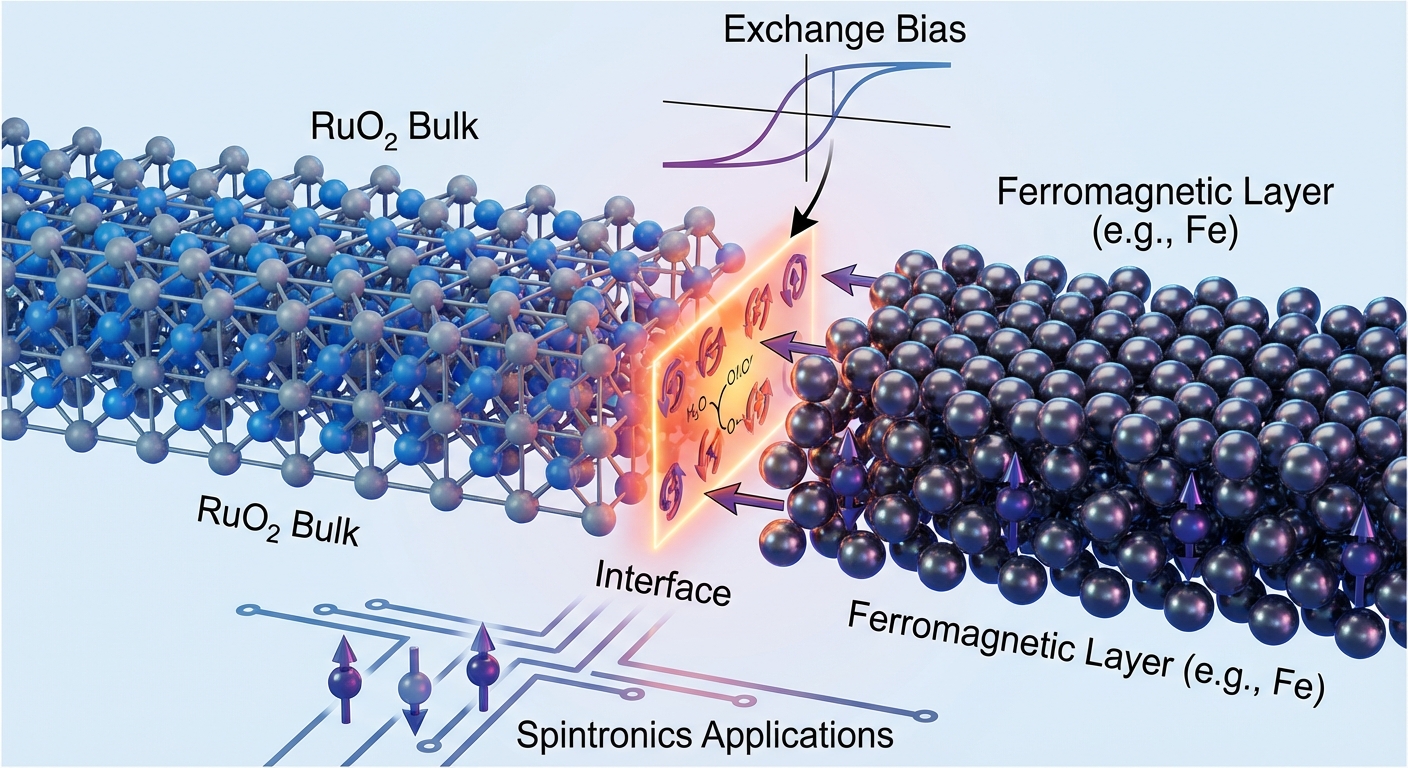

A recent study by the U.S. Naval Research Laboratory (NRL) has brought new clarity to the burgeoning field of altermagnetism, revealing that the magnetic effects observed in Ruthenium Dioxide (RuO2) originate from its interface with ferromagnetic materials, rather than from an intrinsic property of the material itself. This finding is a critical step in refining the search for new materials capable of powering faster, more energy-efficient computing technologies.
The Promise of Altermagnetism
Altermagnetism is a recently identified third class of magnetic material, joining ferromagnets and antiferromagnets. These materials are highly sought after because they combine the most desirable traits of the other two classes: like antiferromagnets, they have no net external magnetic field, which allows for denser component packing, but like ferromagnets, they exhibit strong spin-dependent effects, which are necessary for spintronic applications. This unique combination could lead to breakthroughs in high-speed, energy-efficient data storage and processing.
A Deeper Look into Ruthenium Dioxide
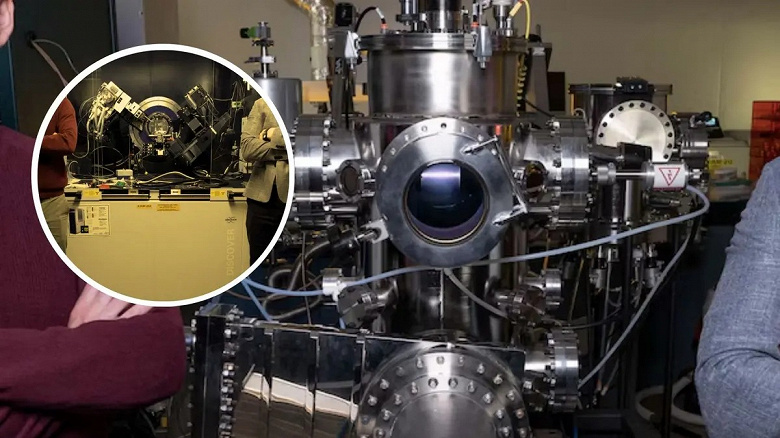
Ruthenium Dioxide (RuO2) has been a prominent candidate in the search for altermagnets, with early experiments suggesting it possessed the necessary properties. However, findings have been inconsistent, creating significant debate within the scientific community. To resolve this, NRL scientists conducted advanced experiments at the Oak Ridge National Laboratory (ORNL), which hosts some of the world’s most powerful neutron sources.
Advanced Techniques Reveal the Truth
The research team employed two powerful neutron scattering techniques. The first, polarized neutron reflectometry, allowed them to analyze the material’s magnetic properties layer by layer. The second, neutron diffraction, was used to search for magnetic ordering throughout the bulk of the material. The results were unambiguous: the experiments showed no evidence of intrinsic magnetic ordering within the RuO2 itself.
Instead, the magnetic effect known as “exchange bias,” previously cited as evidence for altermagnetism in RuO2, was found to be an interfacial phenomenon. When a thin layer of a ferromagnet like iron was deposited onto the RuO2, a chemical reaction occurred at the boundary, forming a thin layer of iron oxide. This newly formed layer was responsible for the observed magnetic behavior, which could not have been distinguished by simpler magnetometry methods alone.
Implications for Future Spintronics Research
This study clarifies that while RuO2 could potentially exhibit altermagnetism under specific conditions, such as epitaxial strain, the observation of exchange bias alone is not sufficient proof. The findings establish a more rigorous standard for identifying and verifying new altermagnetic materials, emphasizing the need to account for and rule out interface effects. By providing a clearer framework, this research prevents scientists from pursuing misleading leads and helps steer the focus toward more promising candidates and conditions. The continued investigation into materials like RuO2 and others, such as MnTe and Mn5Si3, remains a vital and exciting area of research that holds immense potential for the future of spintronics and next-generation computing.