



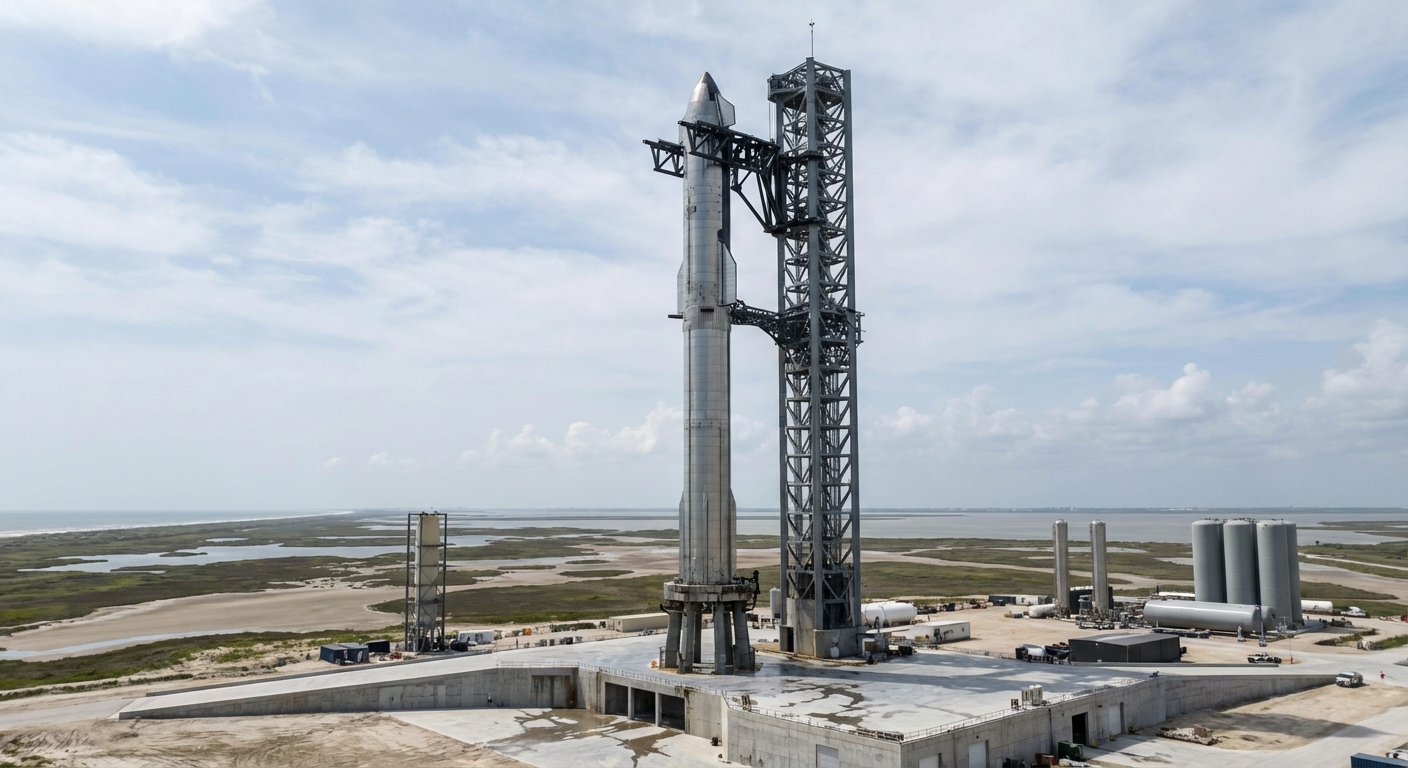

Elon Musk has announced that the first flight of the next-generation Starship V3 is scheduled for March of this year. The mission, designated Flight 12, will be the debut for the more powerful and advanced Block 3 architecture, a critical step in SpaceX’s plan to create a fully reusable space transportation system. The launch is slated to take place from the newly constructed second launch pad (OLP-2) at the company’s Starbase facility in Texas.
A New Generation of Hardware
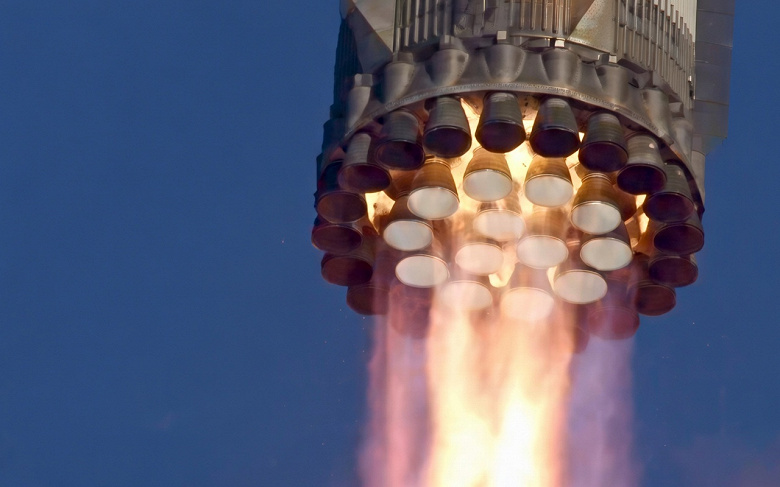
The upcoming flight will utilize the Booster 19 and Ship 39 vehicle combination. This pairing was prepared after the original booster for this mission, Booster 18, was damaged during ground testing in November 2025 and subsequently scrapped. The Starship V3 represents a significant evolution from previous iterations. It is approximately 5 feet (1.5 meters) taller, features larger propellant tanks, and is equipped with upgraded Raptor V3 engines that provide higher thrust while weighing less. These radical redesigns are aimed at improving performance and reliability for long-duration missions, including eventual trips to the Moon and Mars.
New Infrastructure for a Higher Cadence
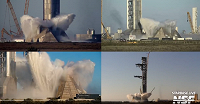
Flight 12 will be the first to lift off from Starbase’s new Orbital Launch Pad 2. This second pad is a crucial piece of infrastructure that will allow SpaceX to increase its launch frequency and conduct operations on one pad while the other is being prepared or upgraded. In fact, as Pad 2 nears completion, preliminary work to upgrade the original Pad 1 has already begun. The new pad features an advanced water deluge and flame diverter system, designed to withstand the immense power of the 33 Raptor engines and prevent the kind of damage seen in early Starship launches.
The Path to Full Reusability
The mission profile for Flight 12 is expected to follow that of previous tests, involving a suborbital trajectory with a controlled splashdown of the Ship in the ocean, without attempting to recover either the booster or the spacecraft. This conservative approach allows engineers to gather crucial data on the performance of the new Block 3 hardware before attempting the more complex recovery maneuvers. However, a major regulatory step has been cleared, as the Federal Aviation Administration (FAA) recently approved new flight paths for Starship, including a return-to-launch-site trajectory. This approval is essential for future missions where SpaceX will attempt to catch the returning booster and ship with the launch tower’s arms.
The Grand Vision: A 100-Fold Cost Reduction
Elon Musk has stated that a primary goal for this year is to “prove the full reusability of the Starship spacecraft.” He believes this will be a monumental achievement, potentially reducing the cost of accessing space by a factor of 100.
“Starship, the largest flying vehicle ever built, could reduce the cost of reaching space to 1% of current levels if it achieves full reusability, bringing the cost per pound below $100,” Musk stated at the World Economic Forum.
Such a dramatic cost reduction would revolutionize the space industry, making large-scale satellite constellations, lunar bases, and ultimately, the colonization of Mars, economically feasible. Starship is central to NASA’s Artemis program, which aims to return astronauts to the Moon.
A Look at the Future
A successful Flight 12 will pave the way for more ambitious milestones, including the first orbital flight, in-orbit refueling tests-a critical technology for interplanetary missions-and eventually, catching the booster and ship for rapid reuse. While SpaceX is pushing the boundaries of reusable rocket technology, competitors like ULA with its Vulcan rocket, Blue Origin’s New Glenn, and Arianespace’s Ariane 6 are also advancing their heavy-lift capabilities, though none are currently pursuing full, rapid reusability on the same scale as Starship. The upcoming launch in March will be a closely watched event, signaling the next major phase in the quest to make humanity a multi-planetary species.