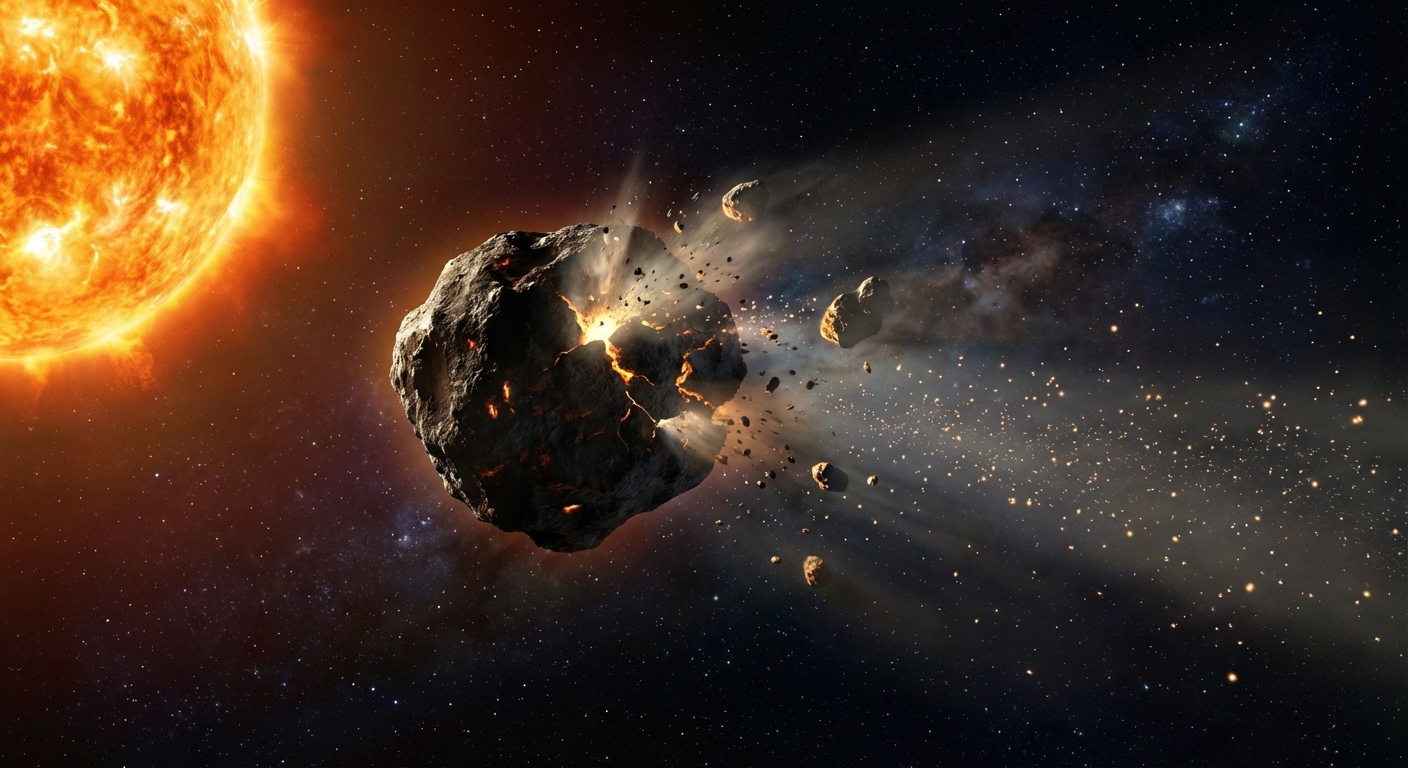

In a significant astronomical discovery, researchers have identified a new meteor stream, confirming that asteroids can shed material not just through collisions but also by being intensely heated by the Sun. A comprehensive analysis of over 235,000 meteor observations has revealed a previously unknown diffuse stream in the southern Virgo region, provisionally named M2026-A1. Its origin is traced back to a so-called “rock-comet” mechanism, where a near-Earth asteroid gradually disintegrated under extreme solar radiation.
A Global Hunt for Faint Trails
The discovery was made possible by combining data from four leading observational campaigns: the Global Meteor Network (GMN), CAMS, EDMOND, and SonotaCo. The GMN alone has collected data on millions of meteoroid orbits since its inception, creating a massive dataset for analysis. Scientists employed advanced statistical and clustering methods to sift through this vast amount of information, filtering out meteors of cometary origin and known streams. Their goal was to find localized excesses in orbital similarity-a tell-tale sign of a recent and concentrated release of material from a single parent body.
M2026-A1: Forged in Fire
The newly identified M2026-A1 stream stood out in the analysis. Its orbit, characterized by a very close approach to the Sun (perihelion at approximately 0.22 astronomical units) and an inclination of about 12 degrees, strongly points to an asteroid source. The physical properties of the detected meteoroids support the theory that they were ejected from a weak, near-Earth asteroid that underwent thermal fracturing and degassing. As the asteroid neared the Sun, the intense heat caused its surface to crack and release gas and dust, a process that gradually dismantled the parent body.
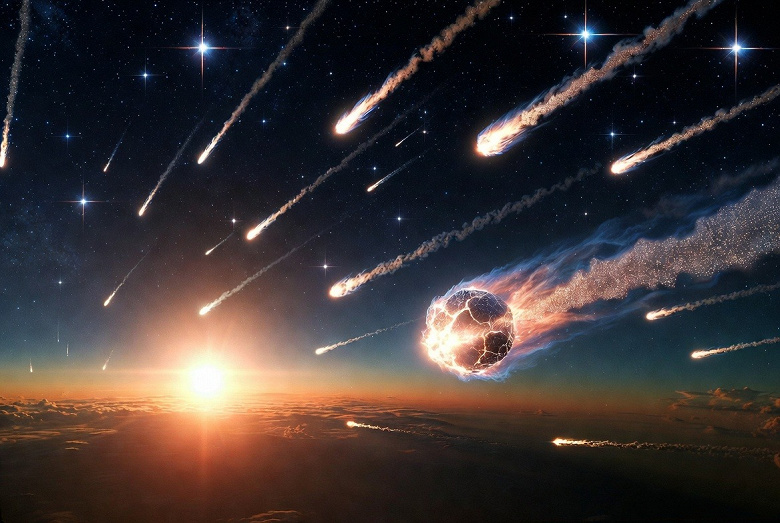
This “rock-comet” behavior has been previously theorized for other celestial objects, most notably for the asteroid (3200) Phaethon, which is the parent body of the well-known Geminid meteor shower. The confirmation of M2026-A1 provides more direct evidence of this important evolutionary pathway for small solar system bodies.
Other Cosmic Events Ruled Out
Interestingly, the study also investigated another potential source of meteoroid streams: the tidal disruption of asteroids passing close to Earth or Venus. The analysis concluded that such events are exceedingly rare, contributing no more than 0.02% to the overall meteor flux. This finding is consistent with the understanding that orbital families of fragments from such disruptions would disperse very quickly, making them difficult to detect as a coherent stream.
A Glimpse into the Future
While the M2026-A1 stream has been identified, its parent body remains elusive. Future missions are expected to shed more light on these processes. NASA’s upcoming Near-Earth Object (NEO) Surveyor mission, a space-based infrared telescope, is specifically designed to detect and characterize asteroids and comets, including those obscured by the Sun’s glare. Despite facing delays that have pushed its launch to no earlier than 2027, the NEO Surveyor will be instrumental in finding the parent bodies of streams like M2026-A1. Such discoveries will allow scientists to refine their understanding of the role thermal processes play in the evolution of small bodies within our solar system.