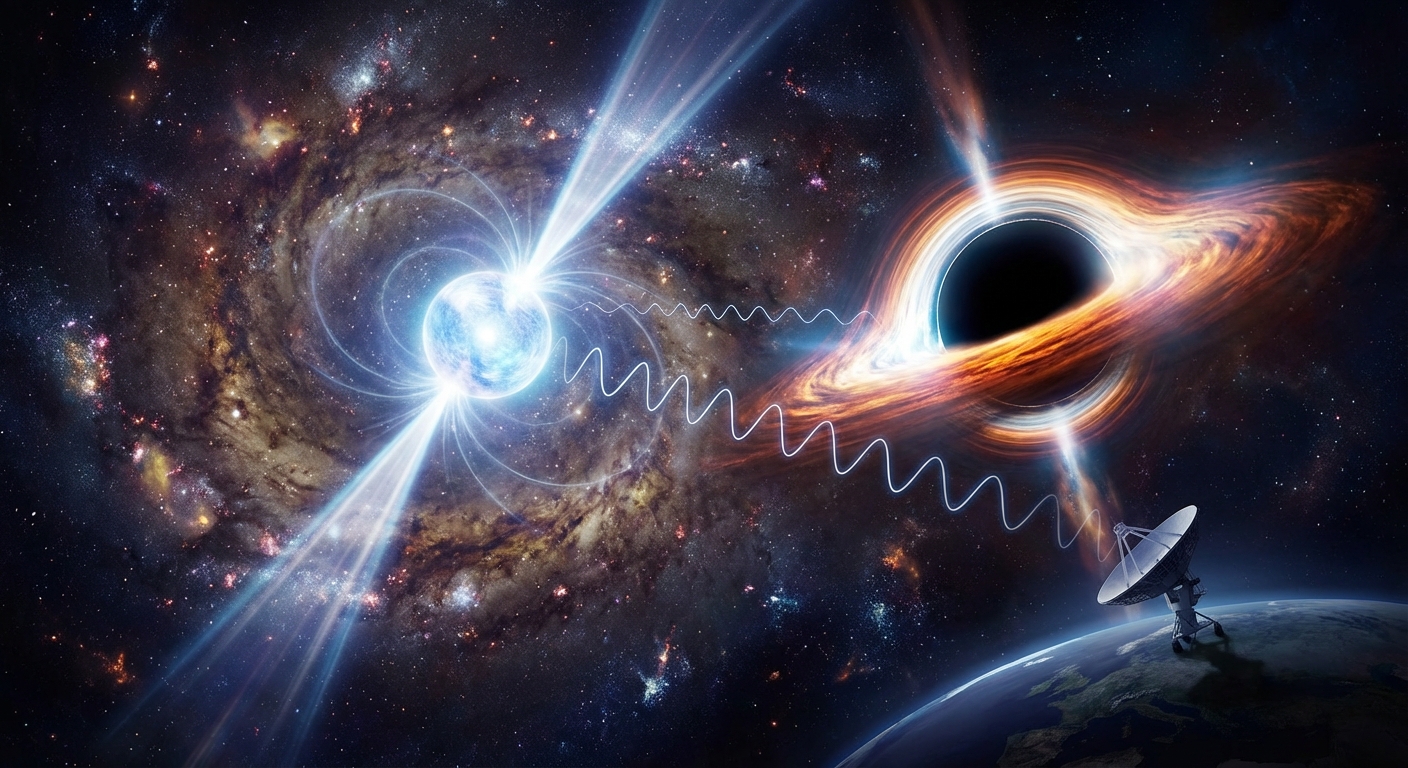

Scientists from Columbia University and the Breakthrough Listen project have announced the discovery of a promising millisecond pulsar candidate in the heart of the Milky Way. The object is located in close proximity to the supermassive black hole, Sagittarius A*. If confirmed, this discovery will be a landmark event for physics, providing scientists with an ultra-precise “cosmic instrument” capable of testing the theory of relativity under the most extreme conditions in the universe.
In Search of a Cosmic Beacon
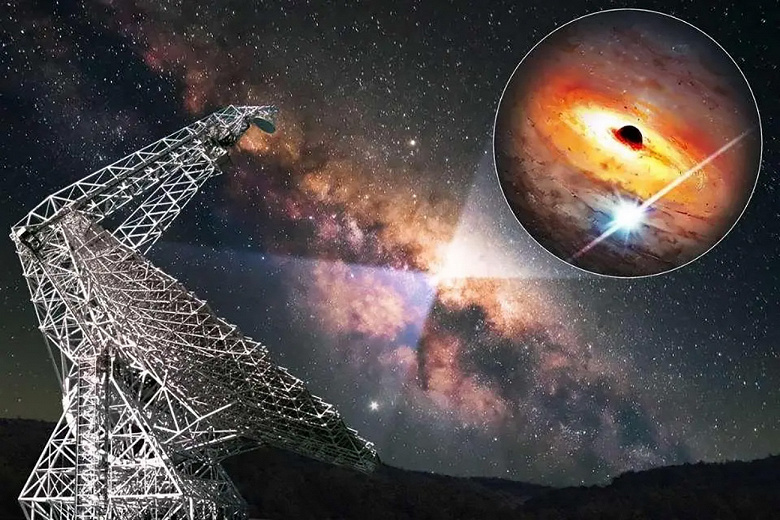
The team, led by Dr. Caren Pérez, a recent Ph.D. graduate from Columbia University, conducted one of the most sensitive pulsar searches ever aimed at the Galactic Center. Using the Green Bank Telescope in West Virginia, they spent more than 20 hours performing deep observations. Radio waves were chosen because they are the only type of radiation that can penetrate the dense clouds of dust and gas obscuring the galaxy’s core. The detected candidate, spinning at an incredible rate with a period of 8.19 milliseconds (about 122 times per second), is the first of its kind found in this turbulent region, despite long-standing predictions that thousands of pulsars should exist there.
A Unique Laboratory for Testing Einstein
Pulsars are rapidly rotating neutron stars that emit beams of radio waves with the precision of atomic clocks. Having such a “metronome” next to a black hole with a mass 4 million times that of the Sun offers a unique opportunity for scientists. As the pulsar’s signals travel past the black hole, they will be delayed and deflected by the warped spacetime.
“Any external influence on a pulsar, such as the gravitational pull of a massive object, would introduce anomalies in this steady arrival of pulses, which can be measured and modeled,” explained study co-author Slavko Bogdanov, a research scientist at the Columbia Astrophysics Laboratory.
Measuring these anomalies will allow for tests of the general theory of relativity with unprecedented accuracy. Additionally, the pulsar will help to “weigh” the black hole and study the dynamics of stars in its vicinity.
The “Missing Pulsar Problem” and Next Steps
The fact that this highly sensitive survey found only a single strong candidate deepens what astronomers call the “missing pulsar problem.” Theories suggest that strong scattering of radio signals by the interstellar medium or extreme orbital dynamics may be hiding the pulsar population from view. It is crucial to note that the object is still a candidate, and confirmation requires extensive follow-up observations to verify its nature and determine its orbit.
“We’re looking forward to what follow-up observations might reveal about this pulsar candidate,” Dr. Pérez stated. “If confirmed, it could help us better understand both our own Galaxy, and General Relativity as a whole.”
A Glimpse into the Future
If this discovery is confirmed, it will open a new chapter in fundamental physics. It would provide the first tool to precisely map the spacetime around a supermassive black hole, offering the most stringent tests of Einstein’s theories to date. Meanwhile, the search for the elusive pulsar population continues, with future facilities like the Square Kilometre Array (SKA) and the next-generation Very Large Array (ngVLA) expected to provide the sensitivity needed to finally uncover these hidden cosmic clocks.