




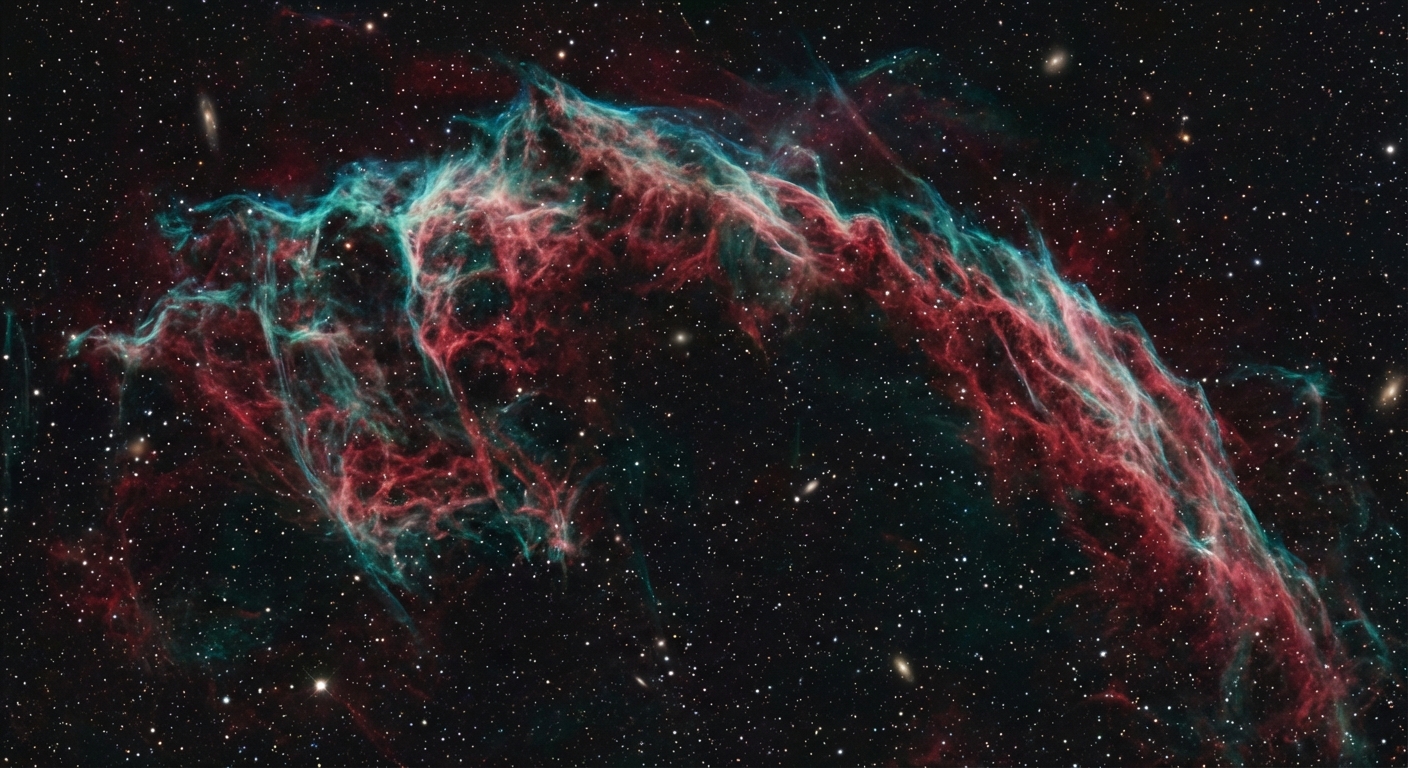

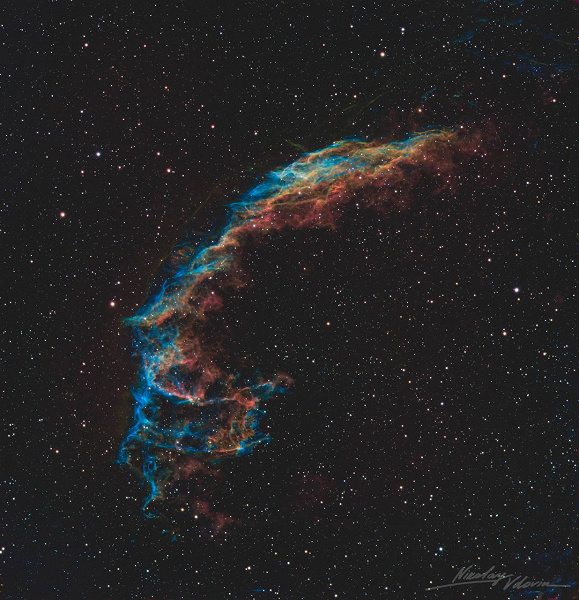
Roscosmos, via its Telegram channel, has published a spectacular image of the western part of the Veil Nebula, also known as the “Witch’s Broom.” This object in the constellation Cygnus is a prime example of a supernova remnant-a giant “graveyard” of a massive star that ended its life in a colossal explosion.
A Cosmic Drama in the Cygnus Constellation
Approximately 10,000 to 20,000 years ago, a star about 20 times more massive than our Sun exploded. This explosion generated a powerful shockwave that is still expanding through interstellar space. This event formed a delicate structure of ionized gas resembling a tattered curtain. Today, the diameter of this structure reaches about 100 to 120 light-years, and the nebula itself is located at a distance of roughly 2,100 to 2,400 light-years from Earth.
The Technology Behind the Image
To obtain such a detailed image, the photographer, Nikolay Vdovin, required nearly 9 hours of exposure. This means the camera collected the faint light from the nebula over an extended period to reveal its complex, fibrous structure. Professional equipment was used for the capture:
- Telescope: TS-Optics 80mm f/6
- Mount: Sky-Watcher Star Adventurer GTi
- Camera: ASI533MM Pro
This combination of technology and skill allowed for the capture of the finest gas filaments, which are impossible to see with the naked eye, and demonstrates the high level of modern astrophotography. The vibrant colors often seen in such images come from different elements; hydrogen typically emits red light, while oxygen glows in shades of teal or blue-green.
A Window into the Universe’s Evolution
The study of supernova remnants like the Veil Nebula is of immense scientific importance. These objects are the primary sources of heavy elements in the universe, which are necessary for the formation of planets and the emergence of life. By analyzing the structure and composition of these nebulae, astronomers can better understand the processes of stellar evolution and the dynamics of the interstellar medium. Images from space telescopes like Hubble complement ground-based observations, revealing even finer details of the shockwaves interacting with the surrounding gas.
What Comes Next?
In the long term, the Veil Nebula will continue to expand and will gradually dissipate into the interstellar medium over the next tens of thousands of years. However, the material it enriches will become part of new molecular clouds, from which new generations of stars and planetary systems will form in the future. Thus, this “stellar graveyard” is simultaneously a “cradle” for future worlds.