






A New Scale of Cosmic Influence
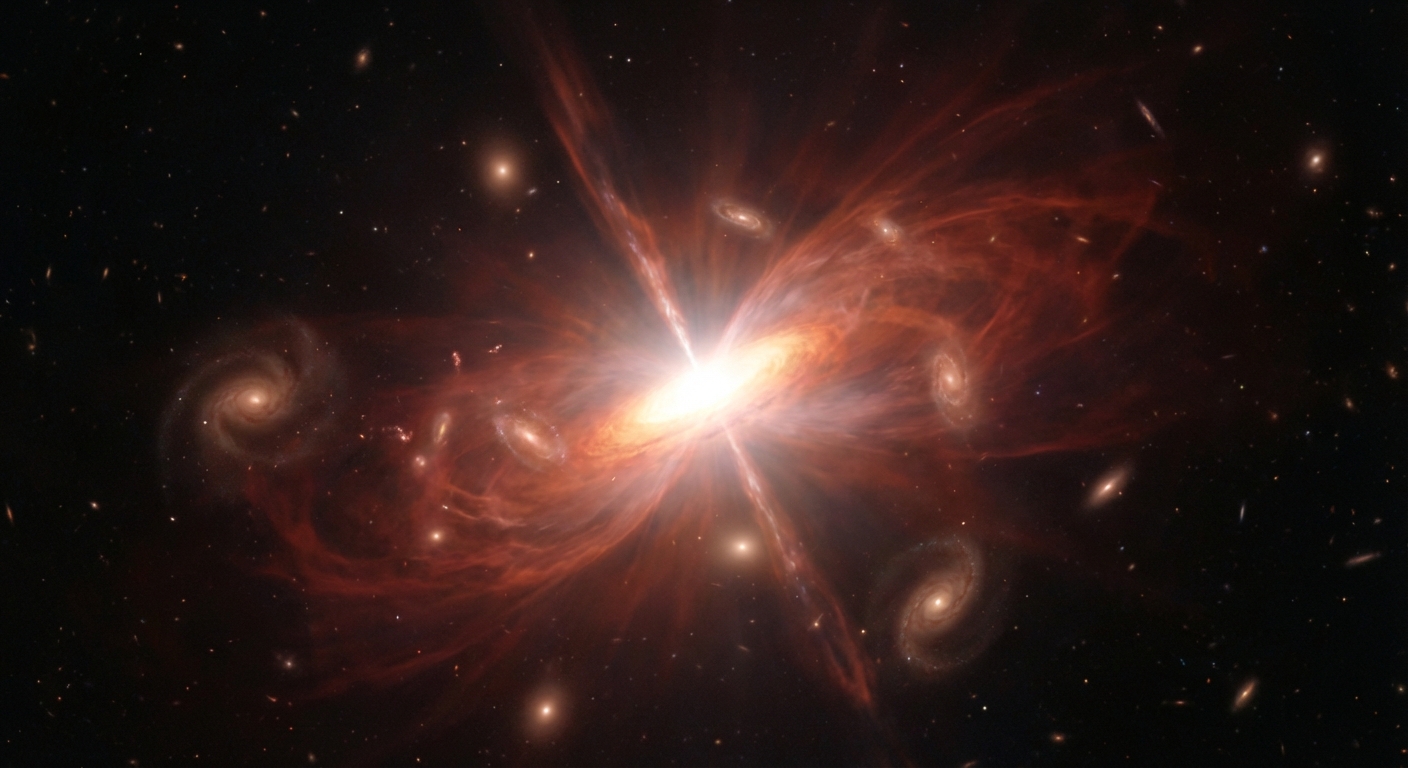
Supermassive black holes (SMBHs) at the centers of large galaxies have long been suspected of suppressing star formation in their own domains. However, recent observations from the James Webb Space Telescope (JWST) have unveiled a far more extensive picture: the most active of these cosmic giants, known as quasars, can halt the birth of new stars in neighboring galaxies as well, effectively sterilizing an entire “galactic neighborhood.” This discovery suggests that the evolution of galaxies is more of a collective process than previously understood.
The Mechanism of Suppression
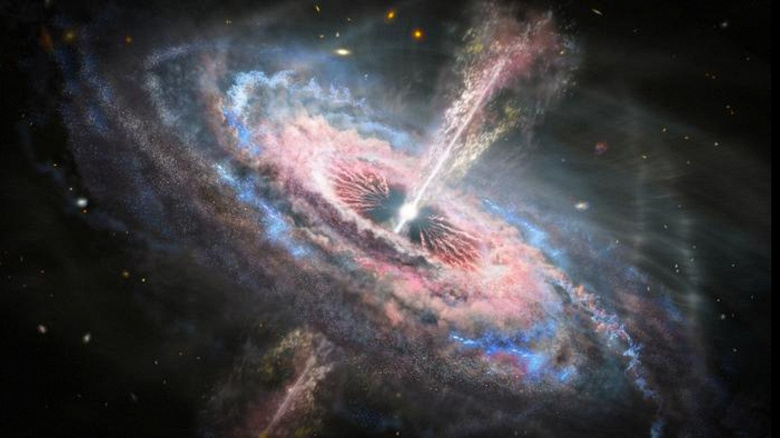
When a supermassive black hole actively feeds on surrounding gas and dust, it forms a swirling accretion disk. This process releases enormous amounts of energy, creating an Active Galactic Nucleus (AGN) that can outshine all the stars in its host galaxy. This energy manifests as powerful jets and intense radiation that not only pushes gas out of its home galaxy but also extends its influence across vast cosmic distances. The research indicates this zone of influence can reach up to a million light-years, impacting nearby galactic systems.
The Case of J0100+2802
The groundbreaking study focused on one of the most luminous quasars known, J0100+2802, which is powered by an SMBH about 12 billion times the mass of our Sun. Using the JWST, astronomers led by Yongda Zhu, a postdoctoral researcher at the University of Arizona, examined the galaxies surrounding this quasar. They measured the emissions of doubly-ionized oxygen ([O III]), a key tracer of very recent star formation. The team found that galaxies within a million-light-year radius of the quasar showed significantly weaker [O III] emissions compared to more distant galaxies, providing clear evidence of suppressed star formation.
“The intense heat and radiation split the molecular hydrogen that makes up vast, interstellar gas clouds, quenching its potential to accumulate and turn into new stars,” explained Zhu. “For the first time, we have evidence that this radiation impacts the universe on an intergalactic scale.”
A ‘Galactic Ecosystem’
This discovery solves a puzzle from earlier JWST observations, which showed surprisingly few galaxies around the most massive quasars in the early universe-a finding that contradicted theories, as large galaxies are expected to form in dense clusters. The new research suggests the galaxies are indeed there, but are difficult to detect because their star formation has been stifled by the quasar’s radiation. This interplay creates what researchers are calling a “galactic ecosystem,” where the actions of one dominant “predator”-the active black hole-can profoundly shape the evolution of its neighbors.
Future Implications
Understanding this large-scale AGN feedback is crucial for refining models of cosmic evolution. It helps explain how the structure and dynamics of galaxy clusters are formed and provides a deeper context for the development of our own galaxy, the Milky Way, which likely had an active quasar phase in its past. The team plans to extend their research to other quasar fields to determine how widespread this phenomenon is. These findings underscore the pivotal role supermassive black holes play not just as galactic anchors, but as active sculptors of the universe on a scale far grander than ever imagined.