





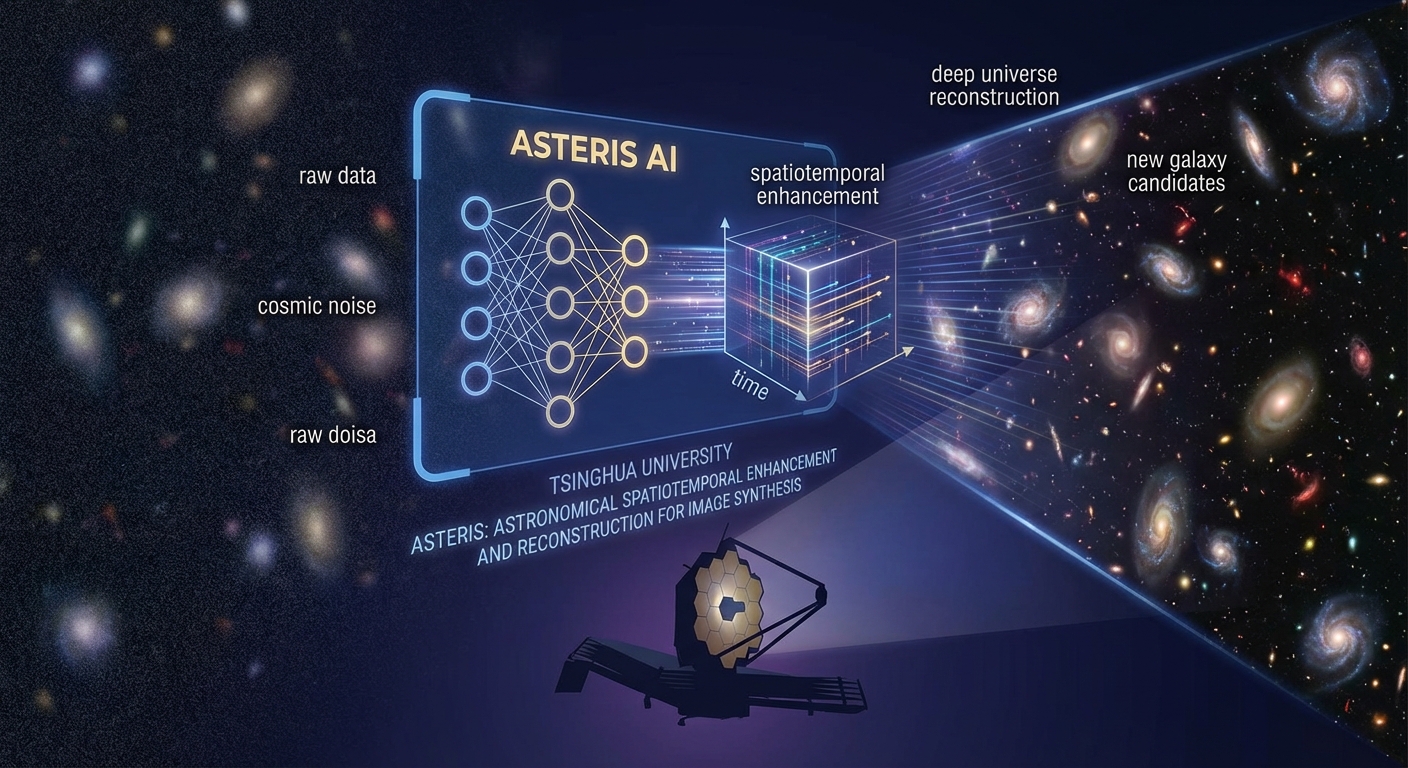

An interdisciplinary team from Tsinghua University has developed an artificial intelligence model named ASTERIS (Astronomical Spatiotemporal Enhancement and Reconstruction for Image Synthesis), which significantly expands the capabilities of astronomical observation. The model combines computational optics and advanced algorithms to extract ultra-faint signals, identify distant galaxies, and create the deepest images of the universe to date. This innovation has already led to the discovery of over 160 new galaxy candidates from the early universe, tripling the results of previous methods.
How ASTERIS Peeks Beyond the Visible Horizon
The Challenge of Cosmic Noise
A primary challenge for astronomers is that weak signals from distant celestial objects are often lost in a sea of noise, including background sky interference and thermal radiation from the telescopes themselves. This noise floor has traditionally limited how faint an object can be and still be reliably detected. ASTERIS was designed to overcome this fundamental limitation.
An Innovative Approach: Space + Time
ASTERIS employs a technique called “self-supervised spatiotemporal denoising.” Instead of analyzing a single static image, the AI model processes observational data as a three-dimensional volume, combining the two spatial dimensions with the dimension of time. This spatiotemporal filtering allows it to distinguish between the persistent, real signals of stars and galaxies and the random fluctuations of noise. This method increases the detection depth by 1.0 magnitude, enabling telescopes to see objects that are 2.5 times fainter than previously possible. The model’s effective range is also expanded, covering wavelengths from visible light (500 nm) to mid-infrared (5 µm).
Revolutionary Results and Practical Applications
Using ASTERIS, the research team has already identified more than 160 candidate galaxies from the “Cosmic Dawn” era, a period approximately 200 to 500 million years after the Big Bang. This number is triple what previous methods had found in the same datasets, showcasing a significant leap in analytical power. Furthermore, the model is compatible with various observation platforms, positioning it as a potential universal tool for enhancing data from space telescopes like the James Webb Space Telescope (JWST). ASTERIS also utilizes a “photometric adaptive mechanism” to intelligently differentiate the signatures of celestial objects from noise.
According to Professor Dai Qunhai, the technology allows for the high-fidelity reconstruction of objects that were previously hidden by light noise.
A Look to the Future: A New Era in Astronomy
The ASTERIS model is expected to be a crucial tool for next-generation telescopes. By providing clearer and deeper views of the cosmos, it will aid astronomers in tackling fundamental questions about dark energy, dark matter, the origins of the universe, and the search for exoplanets. This work is recognized as a significant contribution to the entire field of astronomy, opening new horizons for deep space exploration and maximizing the scientific return from our most advanced instruments.