
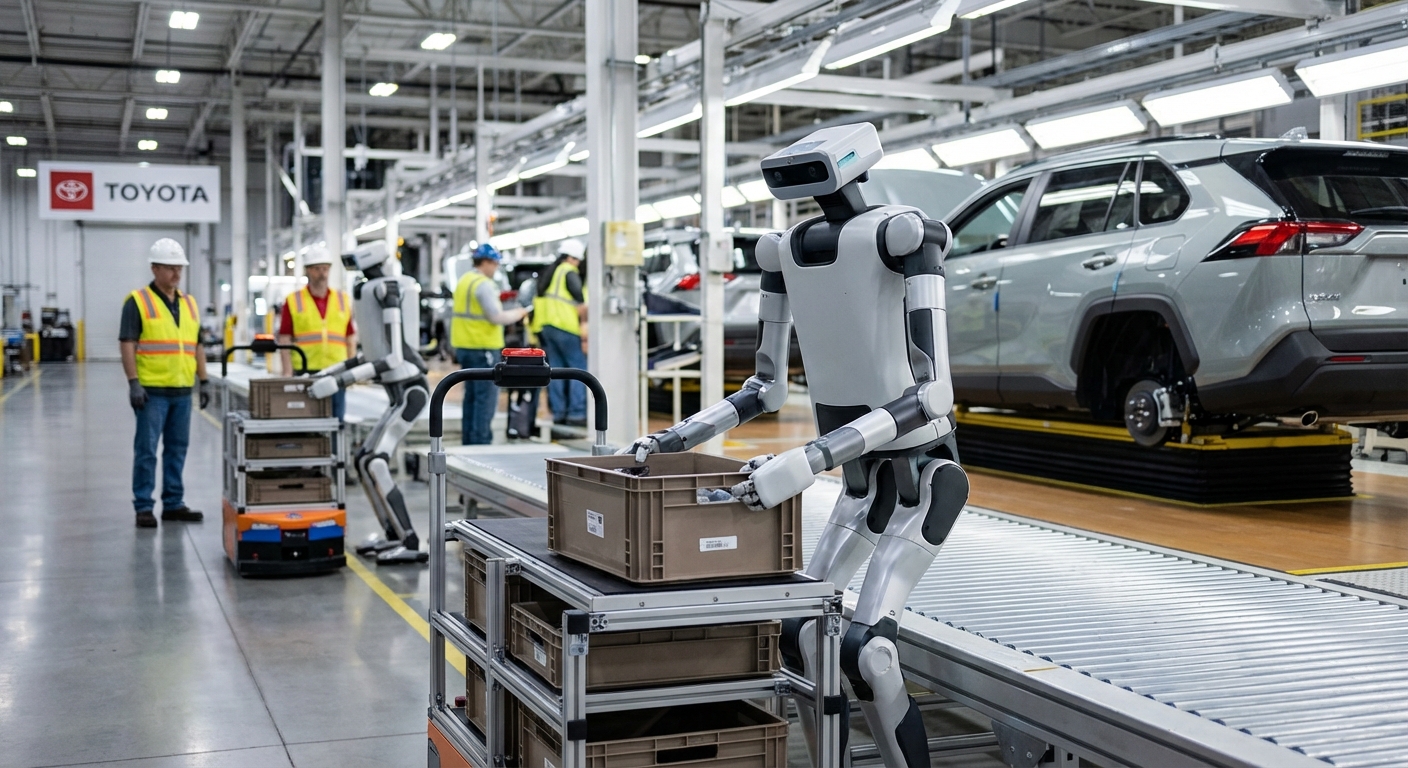

Toyota’s Canadian division has initiated the use of humanoid robots, signing a commercial agreement with developer Agility Robotics for the supply of Digit androids. This move signals a significant shift in the automotive industry, where general-purpose robots are beginning to work alongside humans in environments designed for people, heralding a new era of automation.
A Calculated Step After Rigorous Testing
The signing of the contract was preceded by a year-long cycle of testing three prototypes directly in the workshops of Toyota Motor Manufacturing Canada (TMMC), the company’s largest manufacturing operation outside of Japan. The successful pilot phase confirmed the robots’ ability to handle repetitive and physically demanding tasks, prompting Toyota to deploy an additional seven Digit units. These robots will initially be tasked with loading and unloading totes of automotive parts from an automated tugger, feeding the assembly line at the Woodstock, Ontario plant. “After evaluating a number of robots, we are excited to deploy Digit to improve the team member experience and further increase operational efficiency in our manufacturing facilities,” stated Tim Hollander, President of TMMC.
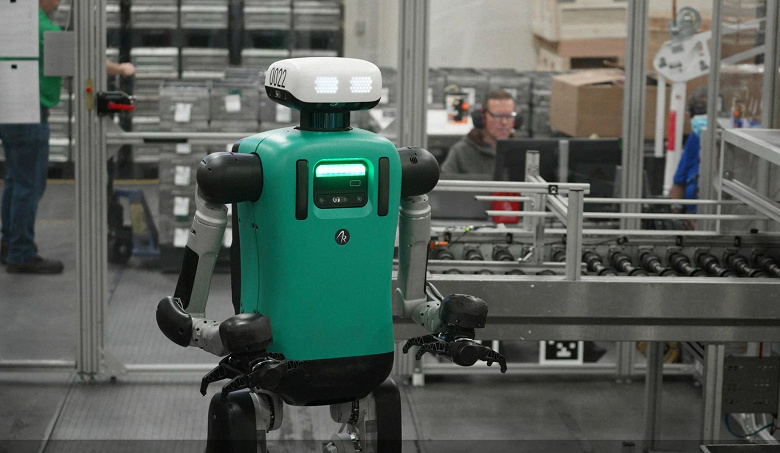
A key advantage of the Digit android is its human-like design. Standing at 5′ 9″ (approximately 1.75 m) and capable of carrying a payload of up to 35 lbs (about 16 kg), it can operate in spaces designed for humans. This eliminates the need for costly and disruptive retrofitting of conveyor lines, a major barrier for traditional automation. The robots are managed by Agility Arc, a cloud-based platform for deploying and managing entire fleets, allowing for seamless integration into existing workflows.
The Growing Humanoid Competition
Toyota is far from the first to explore the use of humanoid robots in car production. The move places it in a burgeoning field of automotive giants racing to integrate advanced robotics.
- Tesla’s Optimus: Elon Musk’s ambitious project, Optimus, is already being tested in Tesla factories for tasks like sorting battery cells. The Gen 2 version boasts significant improvements in speed and dexterity, with Musk envisioning the robot’s value could eventually surpass that of the company’s car business. Tesla aims for limited production in 2025, with a target price of under $30,000 for commercial sales.
- Hyundai and Boston Dynamics: Hyundai, through its subsidiary Boston Dynamics, is making substantial strides. The company plans to deploy the highly agile Atlas humanoid robot in its U.S. manufacturing facilities, starting with trials in 2025 and scaling up for more complex assembly tasks by 2028. Hyundai is investing heavily, with plans to produce up to 30,000 robots per year.
- BMW and Figure AI: BMW has partnered with startup Figure AI to deploy its Figure 02 robots at the Spartanburg, South Carolina plant. While the initial deployment is a cautious, phased approach focused on identifying use cases, it represents a landmark agreement for integrating general-purpose humanoids into a major automotive production facility.
A Look to the Future: The Software-Defined Factory
The integration of humanoids like Digit is more than just a solution for labor shortages; it’s a strategic step towards the “software-defined factory.” This new paradigm involves flexible, adaptable automation that can be quickly reprogrammed for new tasks, reducing downtime and increasing overall efficiency. By taking over the most strenuous and monotonous jobs, these robots can reduce physical strain on human employees, improve safety, and free them up for more value-added work requiring complex problem-solving and creativity. As Agility Robotics and its competitors refine their technology to be cooperatively safe for operation alongside people without physical barriers, the vision of a truly collaborative human-robot workforce in manufacturing is rapidly becoming a reality.