

The New Industrial Frontier: Britain’s Strategic Leap into Orbital Manufacturing
The UK Space Agency has awarded significant contracts to three British companies, positioning the United Kingdom at the forefront of the burgeoning in-orbit manufacturing sector. This strategic investment empowers BioOrbit, Space Forge, and OrbiSky to develop technologies for producing next-generation medicines, semiconductors, and optical fibers in space. By harnessing the unique microgravity and vacuum conditions of low Earth orbit, these firms aim to create materials with a level of quality and performance unattainable on Earth, heralding a new era for the pharmaceutical, electronics, and telecommunications industries.
This initiative is a core component of the UK’s national strategy, which identifies In-orbit Servicing, Assembly, and Manufacturing (ISAM) as a priority for driving economic growth and securing technological leadership. As Space Minister Liz Lloyd stated, “By investing in in-orbit manufacturing, we’re backing the jobs and industries of tomorrow while cementing the UK’s position as a global leader in the space economy.”
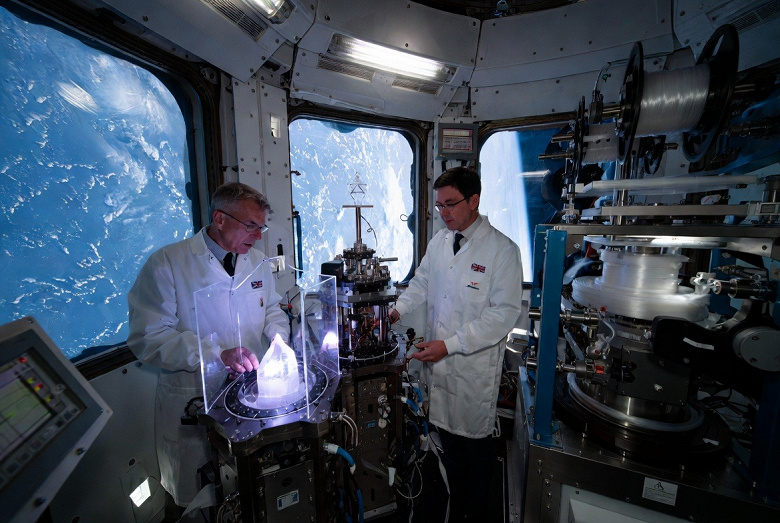
A Trio of Pioneers Set to Revolutionize High-Value Materials
The UK Space Agency’s investment is strategically distributed across three critical high-tech sectors, each with the potential for transformative impact.
BioOrbit: Engineering Drugs in Zero-G
BioOrbit has received funding for its PHARM study, which will design a mission to synthesize drugs in microgravity. On Earth, gravity can interfere with the formation of protein crystals, a key component in many advanced medicines. In space, the absence of sedimentation and convection allows for the growth of larger, more uniform, and perfect crystals. This could dramatically improve the efficacy of drugs, including antibody treatments for cancer, and enable new delivery methods, such as simple subcutaneous injections instead of lengthy intravenous infusions. BioOrbit is also proactively working with regulators to ensure that space-manufactured pharmaceuticals can be approved under the same frameworks as their terrestrial counterparts.
Space Forge: Forging Flawless Semiconductors
Cardiff-based Space Forge is tackling the semiconductor industry with its ‘2Forge2Furious’ project. The company aims to produce semiconductor seed crystals in orbit, leveraging the pristine vacuum and microgravity to create materials with far fewer defects than those grown on Earth. This leap in purity and quality could lead to more powerful, reliable, and energy-efficient electronic components for demanding applications like telecommunications, EV charging, data centers, and quantum computing. Space Forge has already achieved a major milestone by successfully generating plasma aboard its autonomous ForgeStar-1 satellite, a critical step for crystal growth and a world-first for a commercial in-space manufacturing platform.
OrbiSky: Weaving the Future of Communication
OrbiSky’s ‘SkyYield’ project is focused on producing ZBLAN optical fiber, a material with the potential to be up to 100 times more efficient at transmitting light than the conventional silica fiber used today. On Earth, gravity induces tiny imperfections in the glass that lead to signal loss. By manufacturing it in space, OrbiSky aims to create an ultra-low-loss fiber that could revolutionize long-distance communication and enhance high-quality medical imaging technologies. The project will define the necessary process controls and verification steps to ensure the quality and commercial viability of orbitally manufactured fiber.
The Global Race for Orbital Supremacy
The UK’s focused investment places it in a competitive global landscape. In the United States, companies like Varda Space Industries are making significant strides, particularly in pharmaceutical processing with their own reentry capsules designed to bring products back to Earth. Another major player, Redwire, operates a diverse portfolio of in-space manufacturing technologies on the ISS, including 3D printing and optical fiber production. The in-space manufacturing market is projected to grow exponentially, with some analyses suggesting it could reach over $62 billion by 2040. The UK’s strategy of nurturing a diverse ecosystem of specialized companies appears designed to capture a significant share of this high-value market across multiple fronts.
Forging a Path Forward: Challenges and Future Outlook
While the promise of in-orbit manufacturing is immense, significant challenges remain, including the high cost of launch, the need for reliable and reusable reentry vehicles, and the development of clear regulatory frameworks. The UK Space Agency’s program is designed to address these hurdles directly, fostering collaboration between innovators, regulators, and potential customers to pave a clear path to commercialization. The success of these initial studies could unlock a new industrial revolution, where Earth’s orbit becomes a vital extension of our high-tech manufacturing base. The ultimate goal is to create a sustainable, scalable orbital economy that delivers tangible benefits-from life-saving drugs to more powerful electronics-back to Earth.