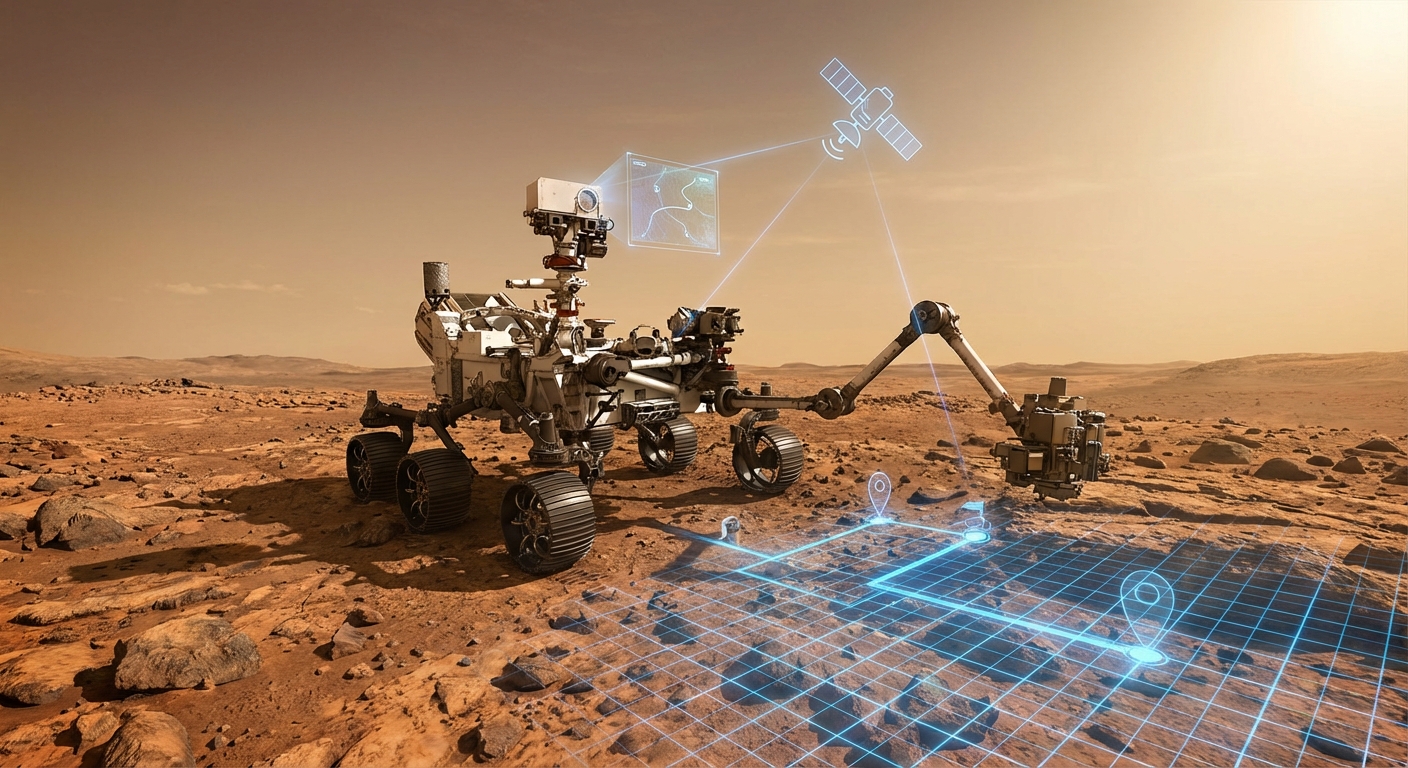

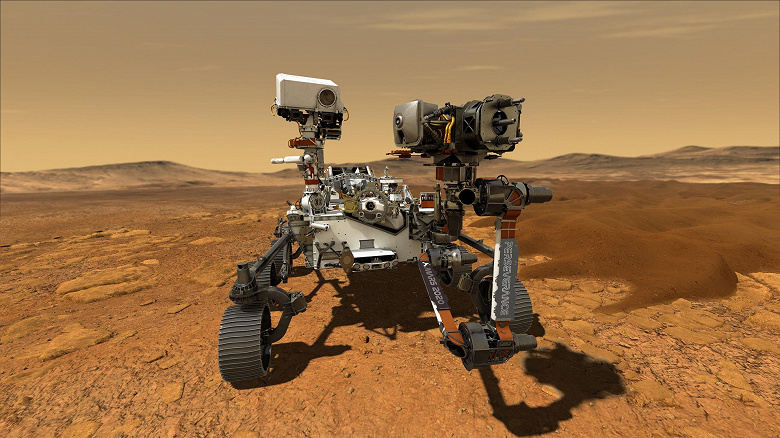
NASA’s Perseverance rover has achieved a significant milestone in planetary exploration by gaining a new level of autonomy, effectively learning to pinpoint its location on Mars with unprecedented accuracy. This breakthrough is powered by an advanced navigation system, analogous to Earth’s GPS, enabling the rover to operate more independently than ever before, according to a NASA press release. This new capability marks a pivotal shift from previous methods that required constant guidance from mission control on Earth, significantly accelerating the pace of exploration.
The Challenge of Martian Navigation
Previously, determining the rover’s precise location was a time-consuming process involving specialists on Earth who would manually compare the rover’s imagery with orbital maps. This dependency created delays, slowing down scientific operations. Now, Perseverance can self-correct its route and navigate around obstacles in near real-time. NASA officials likened the rover’s prior experience to a solo journey through a harsh, rocky desert without roads, a map, or GPS, and with only a single daily call to confirm its position. This limitation has been a major bottleneck since the rover’s landing five years ago in February 2021.
How “Mars Global Localization” Works
The new technology, developed at NASA’s Jet Propulsion Laboratory (JPL) in Southern California, is named Mars Global Localization (MGL). It employs a sophisticated algorithm that rapidly compares panoramic images from the rover’s navigation cameras against onboard orbital terrain maps from NASA’s Mars Reconnaissance Orbiter (MRO). The system runs on a processor originally used for communications with the Ingenuity Mars Helicopter, demonstrating an ingenious repurposing of existing hardware. This process allows the algorithm to determine the rover’s location with an accuracy of about 10 inches (25 centimeters) in approximately two minutes.
Following a recent software update, the rover successfully utilized the Mars Global Localization technology for the first time during a planned mission on February 2, 2026, and again on February 16.
A New Era of Exploration
Vandi Verma, the mission’s chief engineer for robotic operations at JPL, highlighted the significance of this advancement.
“This is kind of like giving the rover GPS. Now it can determine its own location on Mars,” Verma stated. “It means the rover will be able to drive for much longer distances autonomously, so we’ll explore more of the planet and get more science.”
This leap in autonomy builds upon Perseverance’s existing self-driving system, AutoNav, which has already enabled the rover to set speed and distance records by navigating complex terrain like boulder fields on its own. The integration of MGL with other AI-driven tools, such as those that recently planned drive routes for the first time, further minimizes the workload on the Earth-based team and maximizes scientific return.
Future Implications for Planetary Robotics
The success of Mars Global Localization has profound implications for the future of space exploration. According to Verma, this technology is versatile and could be adapted for virtually any other rover designed for rapid, long-distance travel on other worlds. As missions venture farther from Earth, such autonomous capabilities will become essential for building a sustained human presence on the Moon and for future crewed missions to Mars. This breakthrough represents a critical step toward a future where robotic explorers can operate with greater independence, making decisions on the fly and unlocking the secrets of the cosmos more efficiently than ever before.