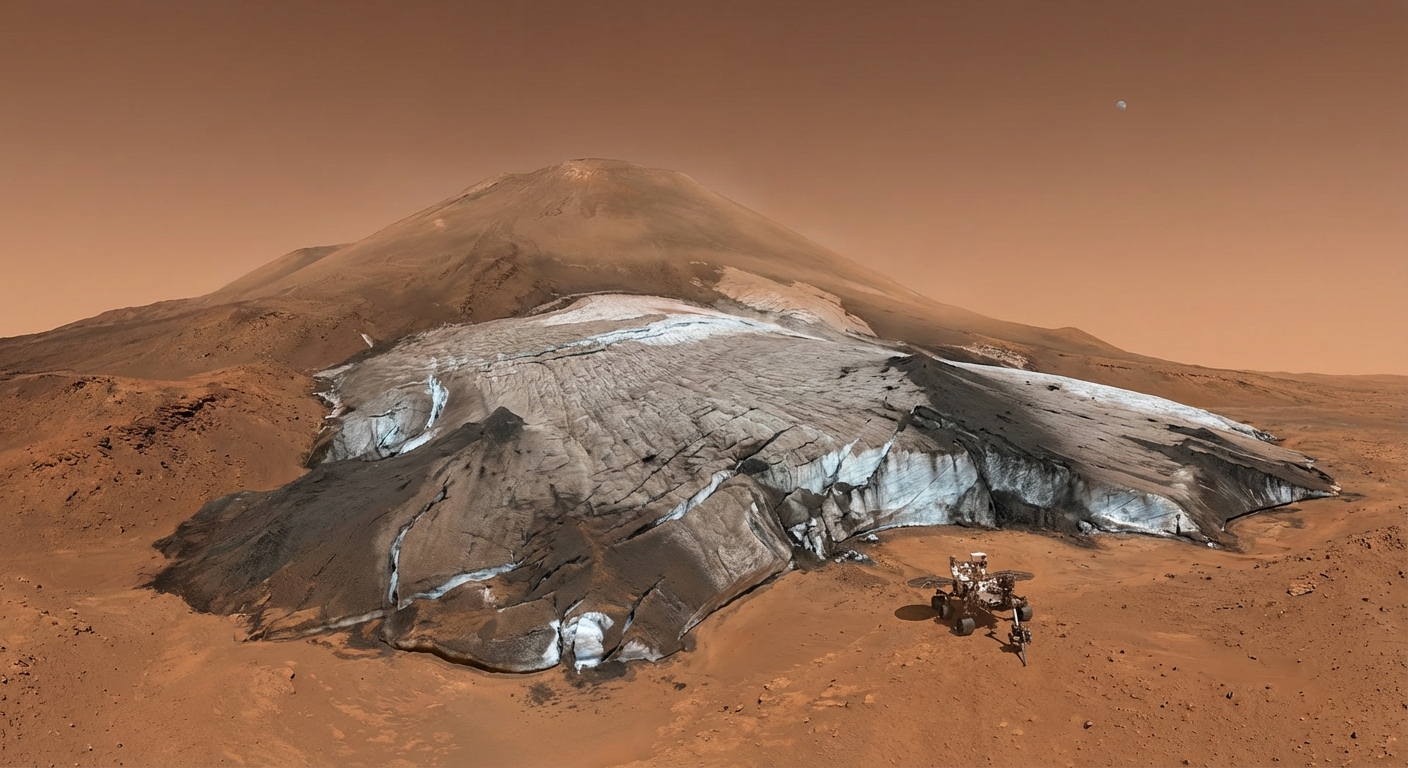

For decades, scientists have known about the vast water ice reserves at Mars’s polar caps. However, a growing body of evidence suggests significant ice deposits may be hiding much closer to the equator, buried beneath the planet’s red dust. A new study highlights the possibility that massive glaciers are preserved under a thick layer of volcanic ash on the slopes of Hecates Tholus, an ancient Martian volcano. This discovery could fundamentally change our understanding of water distribution on Mars and provide a critical resource for future human missions.
An Earthly Analog: The Key to the Discovery
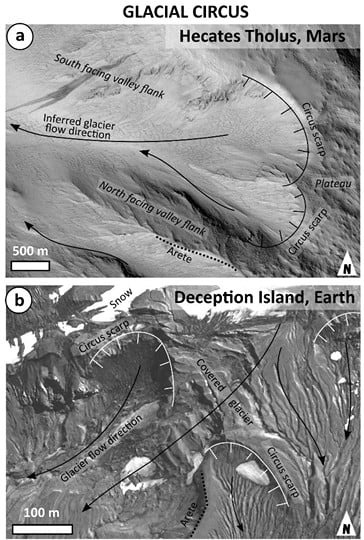
The breakthrough comes from comparing Martian geology to a terrestrial counterpart: Deception Island in Antarctica. This active volcanic island experienced eruptions in the 1960s and 70s that covered its glaciers with a substantial layer of ash. Today, satellite imagery of Deception Island reveals distinct geological features like crevasses, moraines, and bergschrunds-all tell-tale signs of moving ice beneath the surface. Scientists have now identified strikingly similar structures on the flanks of Hecates Tholus on Mars, leading to the hypothesis that a similar process of volcanic burial has preserved ancient glaciers there.
A Game-Changer for Martian Exploration
Finding accessible water ice near the Martian equator would be a monumental advantage for human exploration. Future missions will likely target the equatorial regions due to more moderate temperatures and greater availability of solar energy compared to the harsh polar environments. Water is not only essential for life support but can also be broken down into hydrogen and oxygen to produce breathable air and rocket fuel. The presence of these buried glaciers could drastically reduce the cost and complexity of establishing a sustainable human presence on the Red Planet.
A Protective Blanket of Ash
The leading theory is that the thick layers of ash and dust act as a powerful insulator. This volcanic blanket has likely protected the underlying ice from sublimation-the process where ice turns directly into vapor in Mars’s thin atmosphere-for millions of years. While recent discoveries by ESA’s Mars Express have confirmed massive ice deposits up to 2.3 miles (3.7 km) thick in the Medusae Fossae Formation near the equator, these are buried under hundreds of meters of dust, making them difficult to access. The glaciers at Hecates Tholus could potentially be more accessible.
Challenges and the Path Forward
Despite the compelling visual evidence, confirming the existence and extent of these glaciers remains a challenge. Current orbital radar instruments, like MARSIS on the Mars Express, are excellent for mapping large, flat subsurface deposits but struggle to penetrate the steep and complex terrain of a volcano’s slopes. Future robotic missions equipped with more advanced ground-penetrating radar or drilling capabilities will be necessary to verify the hypothesis. If confirmed, scientists will be eager to analyze ice cores, which could offer invaluable insights into Mars’s past climate history. This discovery, if proven, suggests that many other Martian volcanoes could also be hiding vast reserves of water, radically reshaping the map of one of the most vital resources for the future of space exploration.