





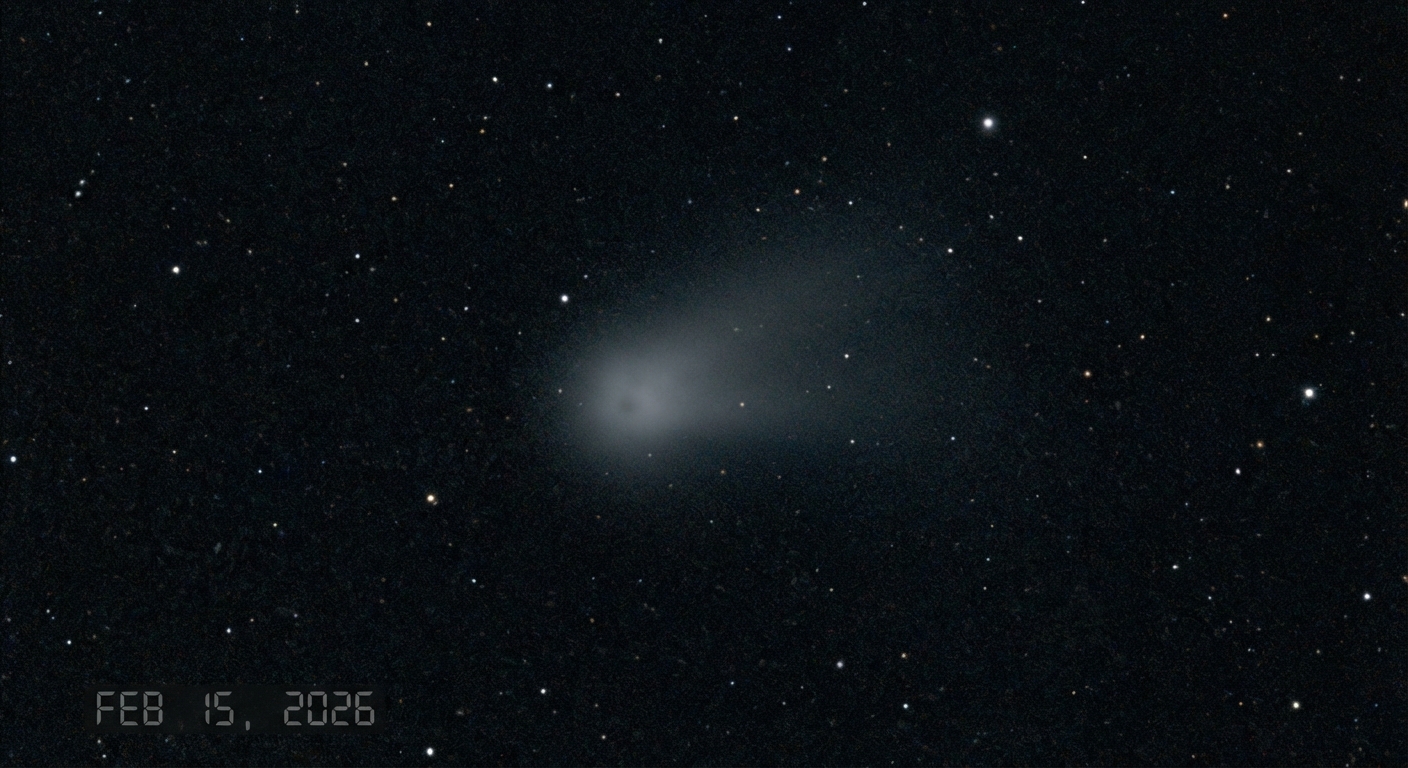

Astronomers with the international Virtual Telescope Project have released a new image of interstellar comet 3I/ATLAS, captured on February 15, 2026. The observations confirm that the third interstellar guest ever discovered has begun to fade significantly as it recedes from the Sun and Earth on its trajectory back into deep space.
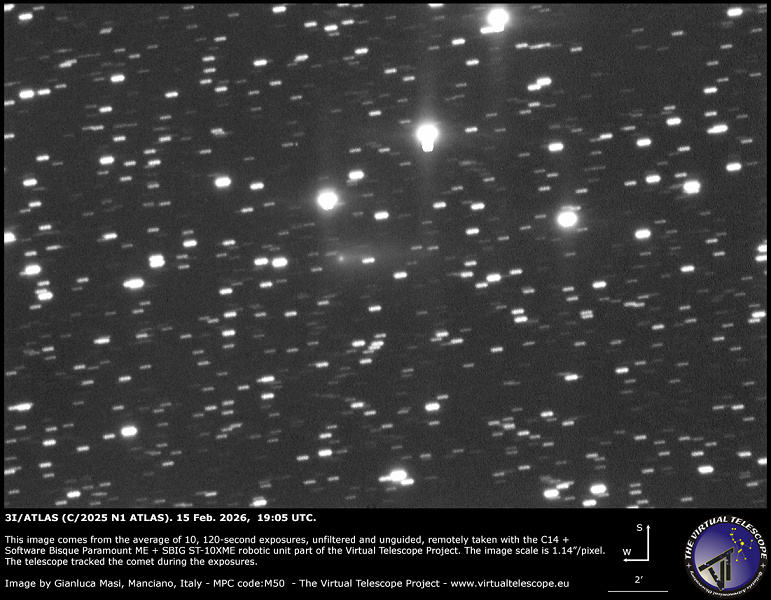
To capture the dimming object, astronomer Gianluca Masi used a technique of combining ten 120-second exposures. The resulting image shows the comet as a faint, fuzzy patch, a stark contrast to its appearance in January when it was at its peak activity. This dimming is a natural process for a comet that has passed its perihelion-its closest point to the Sun. As the distance increases, solar radiation has less effect on the comet’s icy nucleus, reducing the intensity of gas and dust emissions and making the object increasingly difficult to observe even with powerful professional telescopes.
A Messenger from Another Star System
Discovered in July 2025 by the ATLAS (Asteroid Terrestrial-impact Last Alert System) survey, 3I/ATLAS is only the third confirmed interstellar object detected passing through our solar system. Its predecessors were 1I/’Oumuamua (2017) and 2I/Borisov (2019). These visitors are invaluable to science, as they offer a rare opportunity to study material from planetary systems formed around other stars. Early observations of 3I/ATLAS with the James Webb Space Telescope revealed it is rich in carbon dioxide, suggesting it may have formed much farther out in its home star system than comets in our own solar system.
Unlike the enigmatic, asteroid-like ‘Oumuamua, both 2I/Borisov and 3I/ATLAS have displayed more typical cometary characteristics, such as a visible coma and tail created by outgassing. After its closest approach to the sun in late October 2025, 3I/ATLAS’s activity increased, and it even developed a green-hued coma, a common feature in comets caused by the presence of diatomic carbon being illuminated by sunlight.
The Science of a Fading Comet
A comet’s brightness is directly linked to its activity. As it approaches the Sun, ices on its surface sublimate (turn from solid to gas), releasing dust and creating a bright cloud, or coma, around the nucleus. This activity peaks around perihelion. As the comet travels away from the Sun’s heat, this process slows down, the coma dissipates, and the comet’s brightness diminishes. The fading of 3I/ATLAS follows this expected behavior perfectly.
The study of this process in an interstellar object is particularly significant. The composition and behavior of 3I/ATLAS provide rare clues about the chemical makeup and conditions of its star system of origin. Data gathered by various observatories, including NASA’s SPHEREx and the UAE’s Hope Probe, have provided unprecedented information on the gases erupting from the comet as it was heated by our Sun.
Future of Interstellar Observation
The journey of 3I/ATLAS out of our solar system marks the end of this particular observational opportunity, but it highlights the dawn of a new era in astronomy. With increasingly advanced sky surveys, astronomers anticipate discovering many more interstellar visitors in the coming years. Future observatories are being designed to detect these objects earlier, potentially allowing for rapid-response missions to study them up close.
While 3I/ATLAS will soon be beyond the reach of our telescopes, the data collected during its brief passage will be analyzed for years to come. Each interstellar object, with its unique characteristics, adds another piece to the puzzle of how planetary systems form and evolve across the galaxy.