





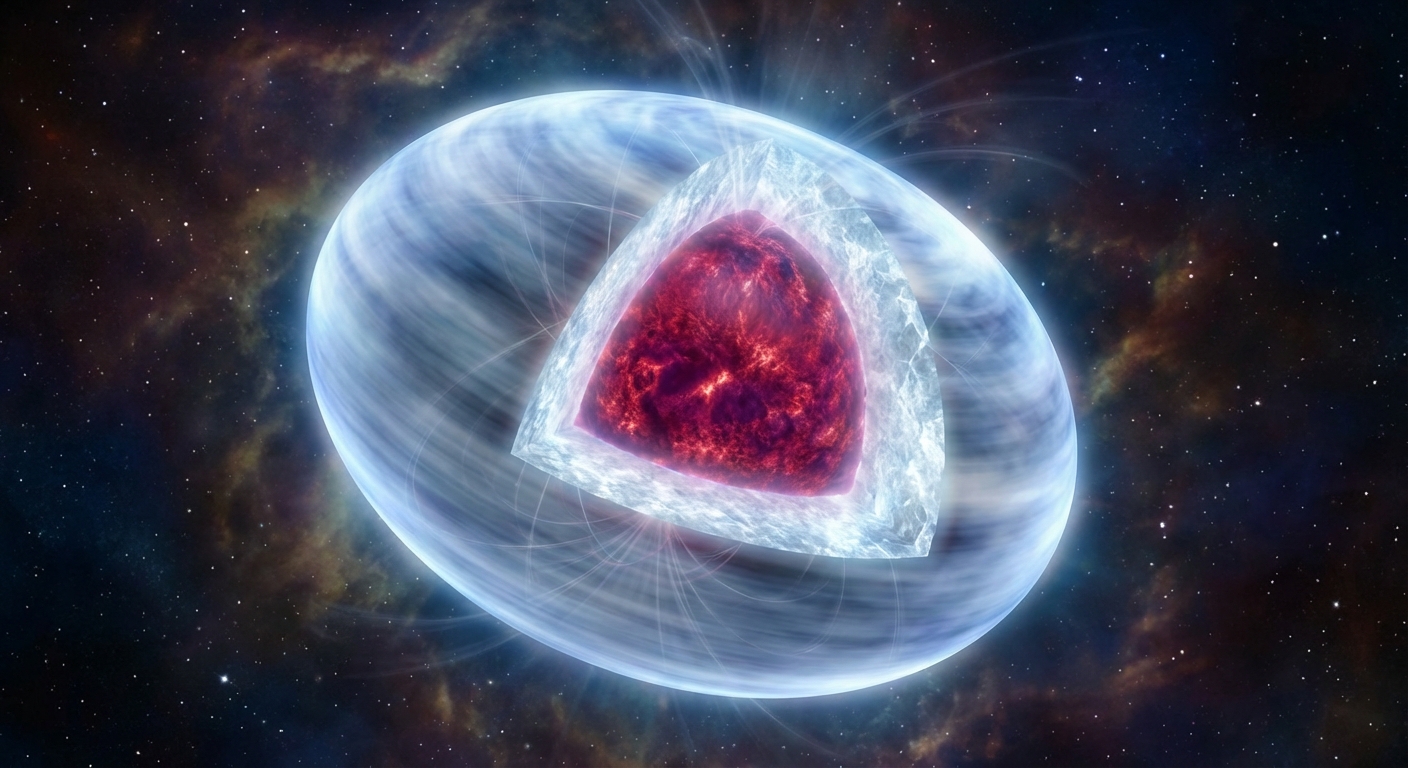

Scientists have proposed a new model for compact stars known as “strange dwarfs,” which may be outwardly indistinguishable from ordinary white dwarfs but possess an exotic internal structure. At the heart of these objects lies a core of quark matter, surrounded by a conventional shell of ions and electrons. This concept is built on the hypothesis that quark matter could be the most stable form of substance in the universe. A recent study reveals that as the rotational speed of a strange dwarf increases, its radius expands, causing its observable properties to increasingly align with those of a typical white dwarf. This suggests that some stars currently cataloged as white dwarfs could, in fact, be these exotic objects in disguise.
What is a ‘Strange Dwarf’?
A strange dwarf is a type of hybrid compact star, theorized to have a core composed of self-bound strange quark matter (SQM), enveloped by a crust similar to that of a white dwarf. The idea stems from the Bodmer-Witten hypothesis, which posits that matter made of up, down, and strange quarks might be the true ground state of matter at extreme densities, even more stable than the atomic nuclei that constitute our everyday world. While the stability of such objects has been a subject of debate, recent analyses suggest they could exist in a “slow-stable” state, where the boundary between the quark core and the nuclear crust is maintained by a strong electric field, preventing immediate conversion.
The Camouflage Effect of Rotation
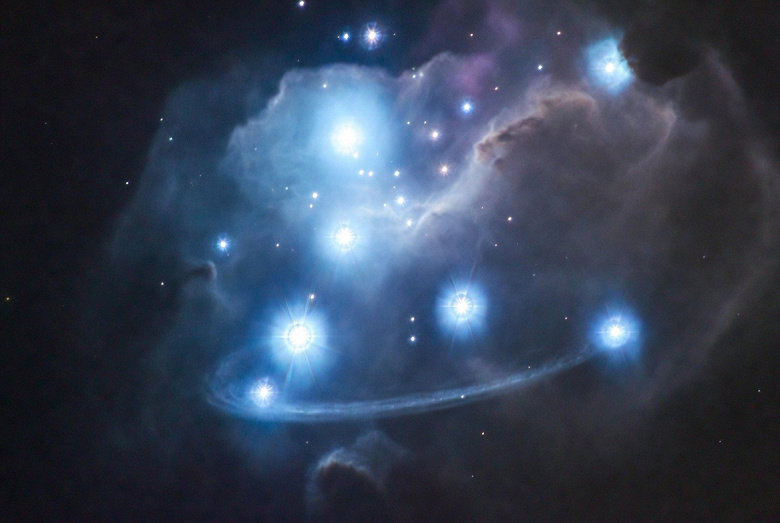
The primary challenge in identifying strange dwarfs lies in the effects of rotation. According to recent theoretical models, a star’s rotation causes it to expand at the equator due to centrifugal force. For a strange dwarf, this inflation can significantly alter its observable mass-to-radius ratio. As the star spins faster, its parameters on a mass-radius diagram shift to so closely mimic those of a conventional white dwarf that distinguishing between the two based on these measurements alone becomes nearly impossible. This means that even within existing astronomical catalogs, some stars we have classified as standard white dwarfs might be hiding a quark matter core.
Beyond Mass and Radius: How to Find the Hidden Stars
Since mass and radius measurements can be misleading for rapidly rotating objects, scientists propose alternative methods to unmask potential strange dwarfs. These techniques focus on probing the star’s internal composition rather than its external size.
- Gravitational Waves: One of the most promising methods involves the analysis of gravitational waves. The “tidal deformability” of a star-how much it is stretched by the gravity of a binary partner-depends heavily on its internal structure. A strange dwarf is predicted to have a different tidal deformability than a normal white dwarf, a signature that could be detected by advanced gravitational-wave observatories.
- Asteroseismology: This method involves studying the natural oscillations and vibrations of a star, akin to studying earthquakes to learn about Earth’s interior. A star with a dense quark core would pulsate differently than one with a uniform composition. These unique vibrational modes could serve as a clear indicator of the exotic physics within.
Implications for the Future of Astrophysics
The confirmation of strange dwarfs would have profound implications for our understanding of stellar evolution and fundamental physics. It would provide the first concrete evidence for the existence of stable strange quark matter, opening a new window into the behavior of matter under the most extreme conditions in the universe. Furthermore, it suggests that our current census of stellar remnants may be incomplete. A 2022 study has already identified seven white dwarf candidates that are smaller than expected for their mass, making them potential strange dwarfs. This new theoretical work emphasizes the need to account for rotational effects and encourages astronomers to employ these advanced detection methods in the search for what could be a completely new class of celestial object hiding in plain sight.