




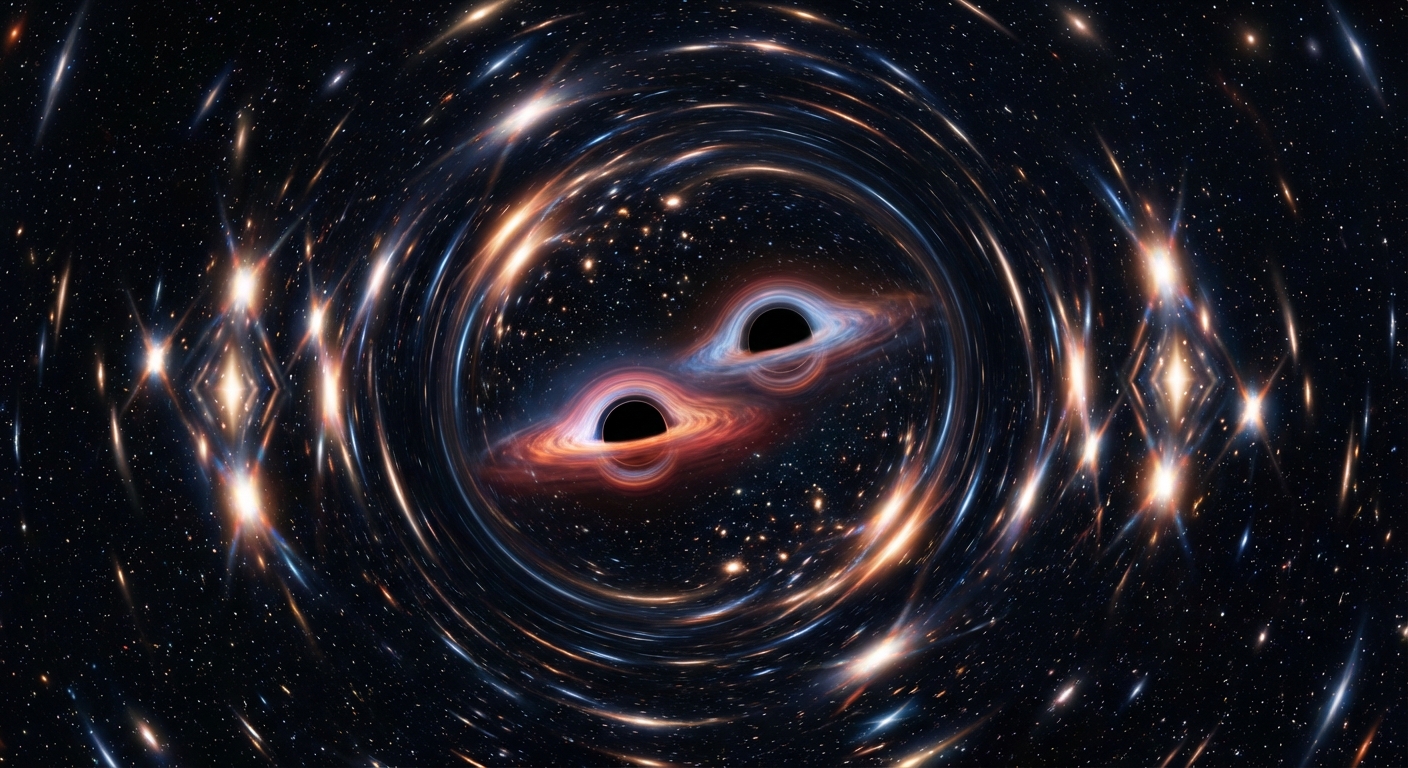

An international team of astrophysicists has proposed a novel method for detecting close pairs of supermassive black holes by observing the repeating flashes of starlight they produce. This work, published in *Physical Review Letters*, suggests that such systems can be found using conventional telescopes, without waiting for future gravitational-wave missions.
The Cosmic Conundrum of Binary Black Holes
Supermassive black holes are found at the centers of most galaxies. When galaxies collide and merge, their central black holes can eventually form a gravitationally bound pair. These binary systems are crucial to understanding galaxy evolution and are considered among the most powerful sources of gravitational waves in the universe. However, until now, only widely separated pairs have been reliably observed, leaving the more tightly-knit binaries hidden from view.
A Natural Telescope Effect
The authors propose searching for these elusive pairs using gravitational lensing-the bending of light by massive objects.
“Supermassive black holes act as natural telescopes,” explains Miguel Zumalacárregui from the Max Planck Institute for Gravitational Physics.
Their immense mass can focus the light of stars positioned behind them, making their images extraordinarily bright. For a single black hole, significant magnification occurs only during a near-perfect alignment with a background star.
In a binary system, the situation changes dramatically. The two black holes create a complex light-amplification structure, a diamond-shaped pattern known as a caustic curve, along which a star’s brightness can increase sharply.
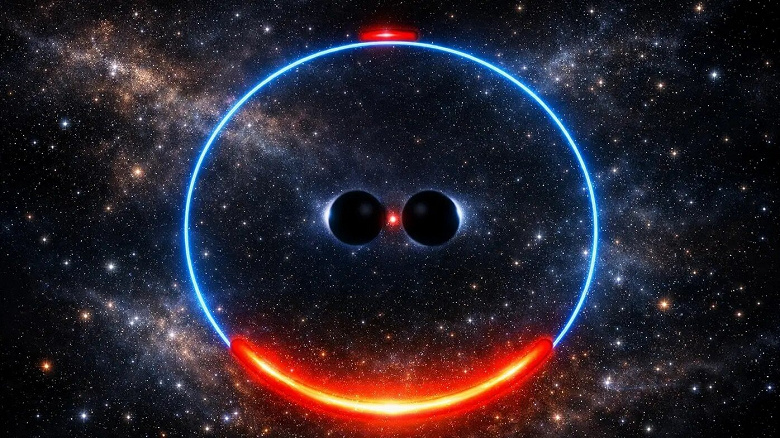
“The probability of strong amplification in a binary system is much higher than for a single black hole,” notes Bence Kocsis from the University of Oxford.
A Repeating Cosmic Beacon
Furthermore, these systems are not static. As the black holes orbit each other, they lose energy by emitting gravitational waves and gradually spiral closer. This orbital motion causes the caustic structure to rotate and change shape, effectively “sweeping” through the space behind the black holes.
“If a bright star happens to be in this region, it will produce an extremely powerful flash every time the caustic passes its position,” explains Hanxi Wang, the study’s lead author.
This results in repeating bursts of light-a distinctive signature of a binary black hole. The scientists have shown that the intervals between these flashes and their brightness carry information about the black holes’ masses and their orbital evolution. As the pair loses energy, the lensing structure gradually changes, leaving an imprint on the frequency and intensity of the signals. While the flashes themselves might repeat over several years, significant changes in their period occur much more slowly.
The Future of Multi-Messenger Astronomy
Detecting such signals will soon become easier thanks to new sky surveys, including the Vera C. Rubin Observatory and the Nancy Grace Roman Space Telescope. According to the authors, this method could allow them to find inspiraling black hole pairs years before they are registered by future gravitational-wave detectors like the Laser Interferometer Space Antenna (LISA). This work paves the way for comprehensive “multi-messenger” studies of black holes, combining observations of light with gravitational waves to create a more complete picture of these cosmic giants.