





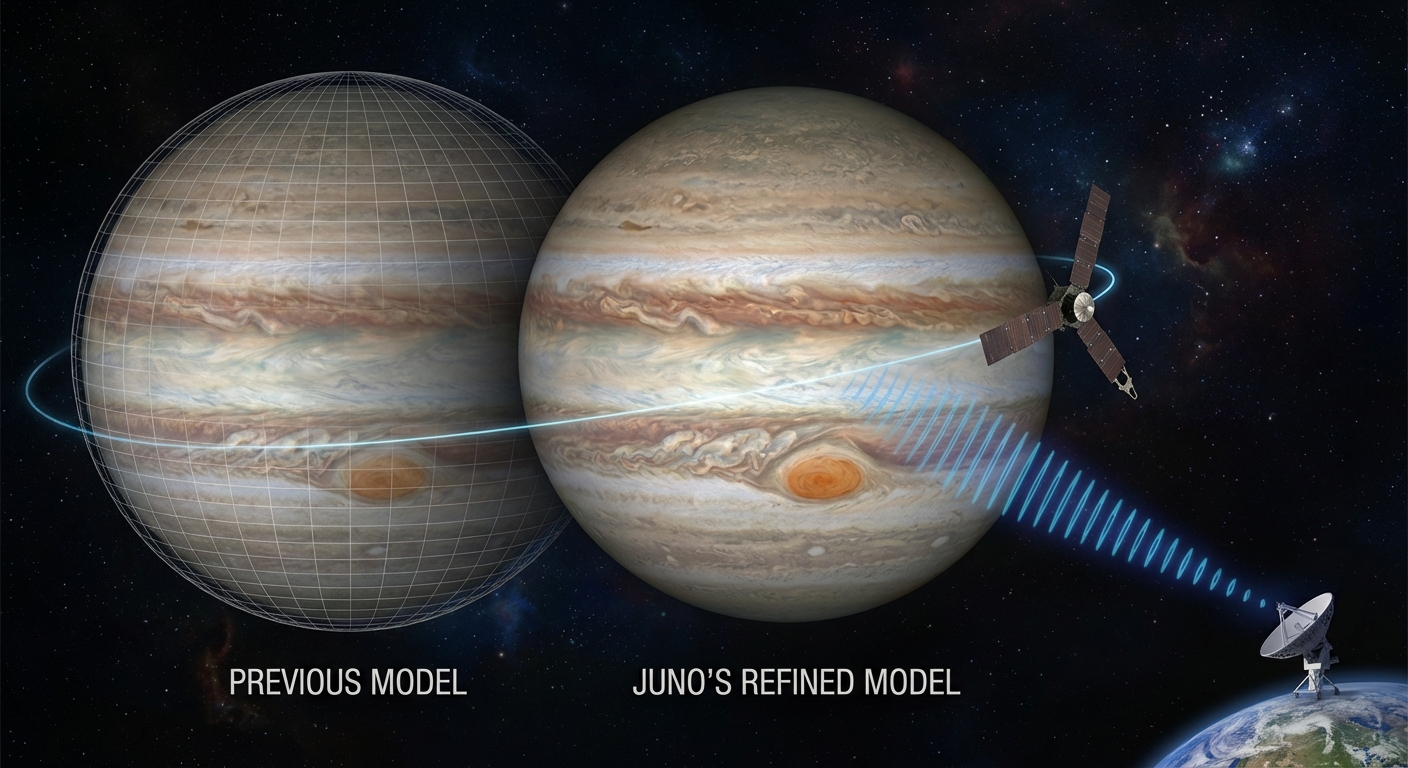

An international team of scientists from the Juno mission has redefined Jupiter’s shape with unprecedented sub-kilometer precision, revealing the gas giant is slightly smaller and more flattened than previously believed. By analyzing radio signals sent through the planet’s atmosphere-a technique known as radio occultation-the researchers have provided the most accurate measurements of Jupiter to date, forcing updates to scientific textbooks and refining our understanding of planetary formation.
A New Era of Precision Beyond Voyager and Pioneer
For decades, our knowledge of Jupiter’s dimensions relied on a handful of measurements from the Voyager and Pioneer missions in the 1970s. Those foundational estimates were limited by uncertainties of several kilometers and did not account for the dynamic effects of Jupiter’s powerful atmosphere. The new analysis, based on numerous high-quality flybys by the Juno spacecraft, has reduced the measurement uncertainty to mere tens of meters. This leap in accuracy was achieved by beaming radio signals from Juno through Jupiter’s atmosphere to Earth and measuring how they were bent and delayed by the atmospheric layers.
The Impact of Atmospheric Winds
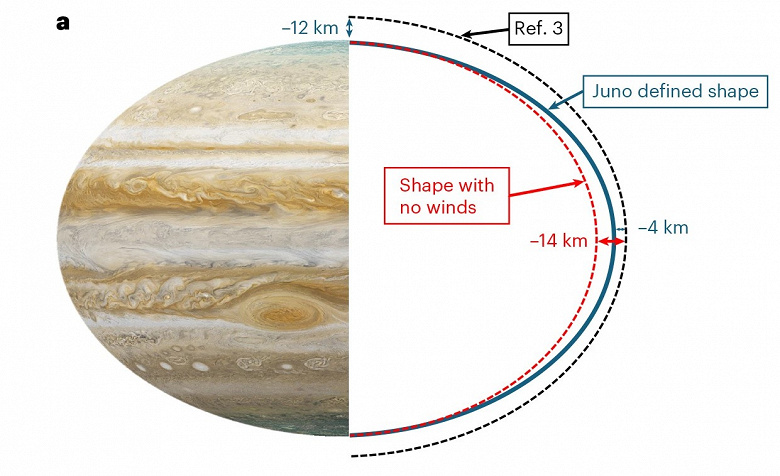
A key innovation in this study was accounting for the influence of Jupiter’s powerful zonal winds, which are massive atmospheric currents that can alter the planet’s observable shape. The findings confirm that these cloud-level jet streams extend deep into the planet, influencing its mass distribution. The new data shows that Jupiter’s equatorial radius is about 4 km (2 miles) smaller than previous estimates, while its polar radius is 12 km (7 miles) smaller. This makes the planet slightly more oblate, or squashed, than previously thought, a direct consequence of its rapid rotation.
Rethinking Jupiter’s Interior and Atmosphere
These revised dimensions have significant implications for planetary science. A more accurate shape allows for a recalculation of Jupiter’s average density and the composition of its atmosphere. The results better align with gravity measurements and models of the planet’s internal structure, helping to resolve longstanding questions about its core and the layers of metallic hydrogen deep beneath the clouds. The data confirms that the powerful zonal winds are a crucial part of a unified physical picture that connects the planet’s shape, gravity, and thermal structure.
A Glimpse into the Future
The refined measurements of Jupiter serve as a vital calibration standard for studying giant exoplanets. By understanding our own gas giant with greater precision, astronomers can better interpret data from distant star systems, particularly from planets discovered using the transit method. The new methodology can also be applied to other rapidly rotating planets. While the current study has limitations due to incomplete latitude coverage, future experiments involving the ESA’s JUICE (Jupiter Icy Moons Explorer) mission, which will arrive at Jupiter in 2031, are expected to provide even more detailed parameters for Jupiter and its moons. The synergy between the Juno and JUICE missions promises to further revolutionize our understanding of gas giants throughout the universe.