



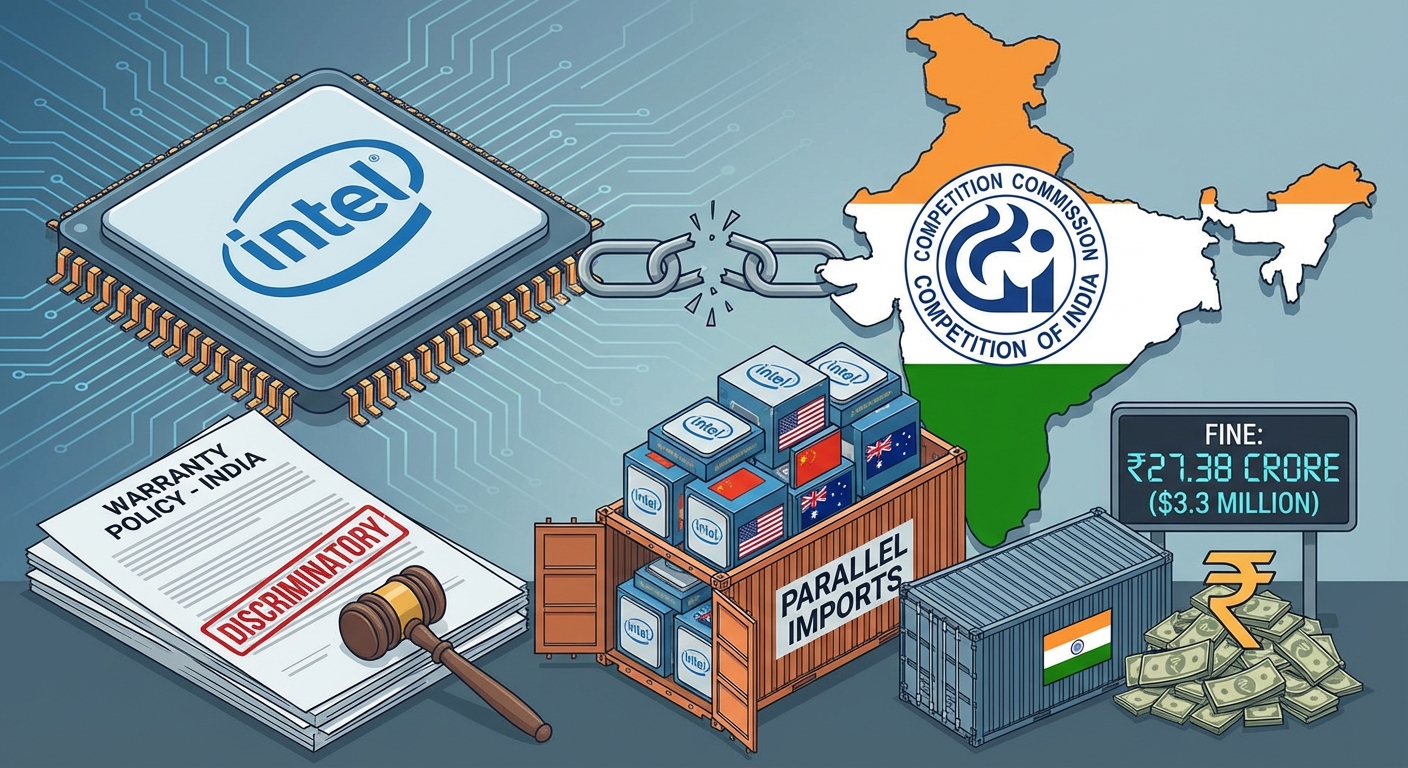

The Competition Commission of India (CCI) has found Intel Corporation guilty of abusing its dominant market position, imposing a penalty of ₹27.38 crore (approximately $3.3 million). The ruling addresses a discriminatory warranty policy that the company enforced for eight years, from April 2016 to April 2024, which specifically disadvantaged Indian consumers and businesses.

The Heart of the Dispute: A Barrier for Parallel Imports
The core of the issue was Intel India’s refusal to provide warranty services for boxed processors that were purchased outside of the country. This practice forced consumers and parallel importers who sourced genuine Intel products from other markets to send faulty CPUs back to the original country of purchase for any repairs, diagnostics, or replacements. The case was first brought to the CCI by Matrix Info Systems, a Delhi-based parallel importer directly affected by the policy. The CCI determined that this practice directly infringed upon consumer rights and unfairly handicapped parallel importers, who often contribute to competitive pricing in the market.
A Ruling on Dominance and Discrimination
In its investigation, the CCI established that Intel held a “significantly high market share” in India for desktop PC microprocessors between 2016 and 2021, affirming its dominant position. The commission found the India-specific policy to be uniquely harsh and discriminatory, noting that Intel offered a global warranty without such restrictions in other major markets, including China and Australia. This created an uneven playing field for Indian customers compared to their international counterparts. This policy stood in contrast to that of competitors like AMD, which has been reported by users to offer a more flexible international warranty for its processors in India.
The Penalty and the Path to Compliance
The initial penalty was calculated at 8% of Intel’s average turnover from the sale of boxed microprocessors in India during the eight-year period the policy was active. However, the CCI reduced the final amount, taking into account a significant mitigating factor: Intel voluntarily ceased the controversial practice starting April 1, 2024. Beyond the monetary fine, the commission has ordered Intel to conduct a widespread information campaign to formally announce the cancellation of the restrictive policy. The company must also submit a detailed report on the corrective measures it has undertaken.
Future Outlook: Technical and Regulatory Hurdles
This ruling marks a significant moment for consumer rights in India and serves as a strong signal to dominant technology firms operating in the country. For Intel, the immediate task is to comply with the CCI’s directives and rebuild any eroded trust within the crucial Indian market. Beyond regulatory hurdles, the company also faces formidable technical challenges with its upcoming product lines. For instance, recent reports concerning its next-generation Nova Lake-S processors suggest that top-tier models could reach a peak power consumption of over 700 watts, with some sources indicating spikes beyond 800W. This presents new and significant challenges in thermal management and system integration that the company must address as it pushes the performance envelope for the high-end enthusiast market.