





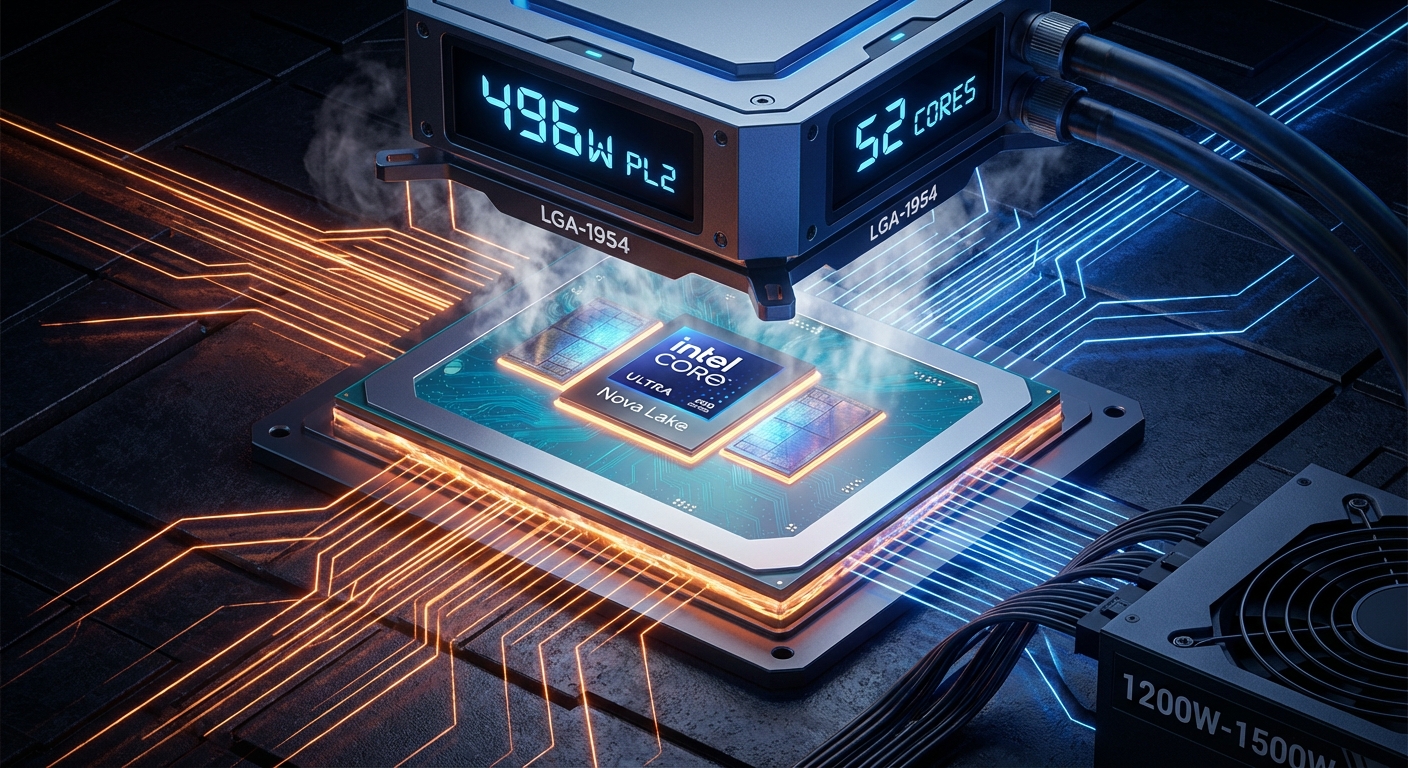

Intel’s next generation of desktop processors, known as Nova Lake (Core Ultra 400 series), promises an unprecedented leap in performance, but it will come at the cost of extreme power consumption. According to the latest insider leaks, the flagship 52-core, dual-chiplet configuration will have a power limit (PL2) of nearly 500W, fundamentally changing the cooling and power supply requirements for enthusiasts.
Beyond Conventional Limits: The Power Consumption Figures
Data from reputable sources like Kopite7kimi paint a picture of a processor that pushes the boundaries of the consumer segment. While some rumors pointed to peak consumption exceeding 700W, the more realistic and corroborated values for the flagship dual-chiplet model are as follows:
- PL1 (Base Power): 150W. This value is comparable to current special edition KS-series flagships from Intel, which is already 25W higher than standard K-series processors.
- PL2 (Maximum Turbo Power): 496W. This figure is nearly double the limit of the current Core Ultra 9 285K (250W) from the Arrow Lake generation.
- PL4 (Peak Short-Term Power): 854W. This limit serves to protect the die from damage during instantaneous load spikes and is almost twice the threshold of current flagships (around 425W).
Two Processors Under One Lid
Such high power requirements apply exclusively to the top-tier Nova Lake versions with two compute dies (chiplets). In essence, Intel is creating a High-End Desktop (HEDT) solution for the mainstream market by combining two full-fledged dies in a single package to achieve 52 cores (16 Performance-cores, 32 Efficient-cores, and 4 Low-Power E-cores). This approach is aimed at reclaiming leadership in multi-threaded performance.
More mainstream, single-chiplet versions of Nova Lake will maintain conventional thermal design powers and will not require extreme cooling systems. However, the flagship models are clearly aimed at enthusiasts willing to invest in the necessary supporting infrastructure.
What This Means for PC Builders
For potential owners of the 52-core Nova Lake monster, preparing for its installation will be a significant undertaking. It will require not only new 900-series motherboards with the LGA-1954 socket but also serious investment in supporting components. This includes high-performance all-in-one (AIO) liquid coolers or custom loops, as well as power supply units (PSUs) ranging from 1200W to 1500W to ensure stable operation under maximum load.
The Competitive Landscape and a Look to the Future
The Intel Nova Lake-S lineup is scheduled for release in the second half of 2026. By that time, AMD is expected to have its own answer on the market with the Zen 6 architecture (codename “Medusa”). It is anticipated that AMD will also increase the core count in its consumer processors to 24.
Intel’s strategy is clear: to reclaim the performance crown in the high-end segment, even at the cost of a significant increase in power consumption. Beyond raw power, Nova Lake will also feature technological innovations such as a Big Last-Level Cache (BLLC) of up to 288MB-a direct response to AMD’s 3D V-Cache technology-and a significantly more powerful Neural Processing Unit (NPU) for AI tasks. Thus, the battle for the title of the most powerful desktop processor in late 2026 promises to be heated in every sense of the word.