
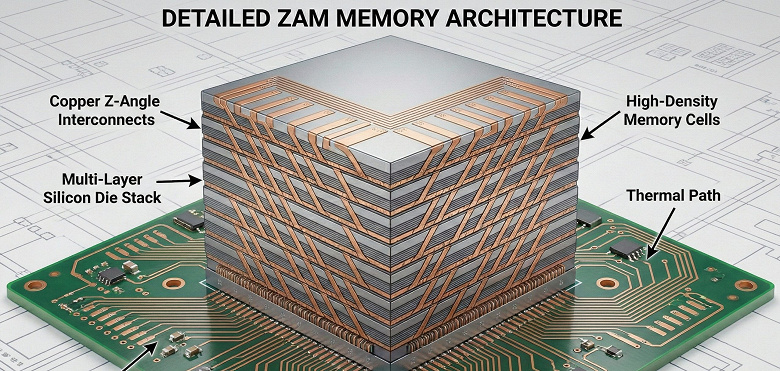
Intel is gearing up for a bold re-entry into the dynamic random-access memory (DRAM) industry. In collaboration with Saimemory, a subsidiary of the Japanese conglomerate SoftBank, Intel has developed the cutting-edge ZAM (Z-Angle Memory) technology. This new approach in memory architecture is characterized by its unique design: unlike traditional memory stacks that connect vertically through layers, ZAM utilizes a stepped topology with diagonal inter-chip connections.
Revolutionary Engineering Solutions
The key engineering aspects of ZAM include:
- Hybrid copper-copper bonding: Allows silicon layers to form a single monolithic block, thereby reducing thermal resistance and enhancing durability.
- Reduced capacitor count: Simplifies design and increases cell density.
- EMIB integration: Memory interfaces with AI chips using Intel’s Embedded Multi-die Interconnect Bridge technology, ensuring high-speed data exchanges.
According to preliminary data, ZAM is set to consume 40-50% less power than high-bandwidth memory (HBM). Each chip could house up to 512 GB of memory, with diagonal connections facilitating the assembly of multilayer structures.
A Historic Return
This marks a potentially historic return to the memory market for Intel, which exited the DRAM business in 1985 under pressure from Japanese rivals. Now, against the backdrop of the AI boom, Intel aims to reestablish itself as a major player. Concurrently, SoftBank plans to integrate ZAM in their Izanagi line of specialized processors (ASIC).
Implications and Future Prospects
Intel’s return could stir significant competition in the DRAM market, currently dominated by firms like Micron and Samsung, which have recently achieved advancements in low-power DRAM technologies. The ZAM technology could offer a competitive edge in energy efficiency and integration simplicity, potentially attracting sectors heavily reliant on efficient data processing, including AI and data centers.
With the semiconductor industry frequently innovating, Intel’s strategic re-entry bears watching, especially with potential applications for ZAM extending beyond AI, possibly influencing broader tech fields.