
New Insights from Juno on Jupiter’s Size
Jupiter, the largest planet in the Solar System, has recently been discovered to be slightly smaller and more oblate than scientists have believed for the past 50 years. According to new, more accurate calculations, the equatorial radius of Jupiter is four kilometers less, and the planet is 12 kilometers squatter at the poles than previously assumed. This conclusion has been reached by an international team of researchers led by the Weizmann Institute (Israel) after analyzing data from NASA’s Juno spacecraft. The study’s results, published in the journal Nature Astronomy, have refined the parameters of the gas giant, which had remained unchanged since the Voyager and Pioneer missions in the 1970s.
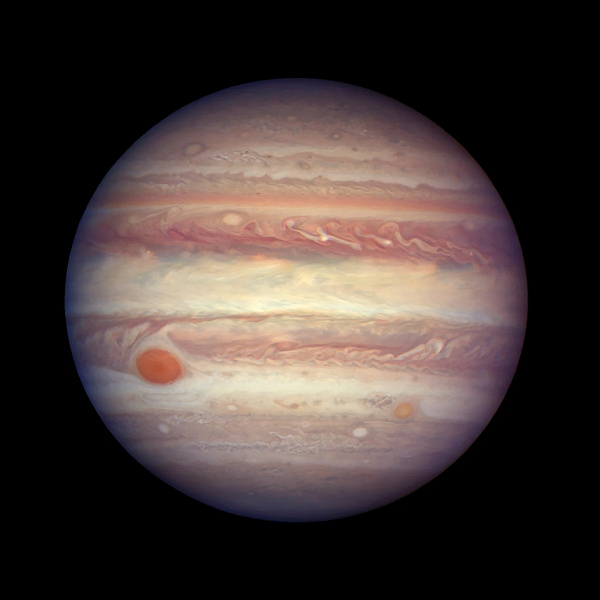
According to the new data, Jupiter’s equatorial radius is 71,488 kilometers, while the polar radius is 66,842 kilometers. 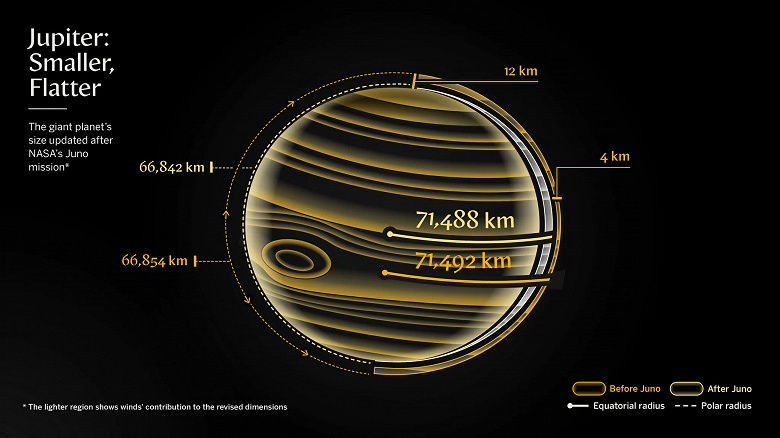 Image: Weizmann Institute of Science
Scientists used radio signal analysis to obtain these figures: when Juno moved behind the planet, its atmosphere distorted the radiowaves sent to Earth. By processing these changes, PhD student Maria Smirnova was able to calculate the gas density with unprecedented precision at different distances from the center.
Understanding Jupiter’s Core and Magnetic Field
Recent advancements have also been made in understanding Jupiter’s core structure and magnetic field using data from Juno. These findings suggest that Jupiter’s core may be more diffuse than a compact solid, providing insights into the planet’s formation and evolution. The complexities of its magnetic field have shed light on dynamic atmospheric processes.
Professor Yochai Kaspi noted the importance of these data for understanding the evolution of the entire Solar System, as Jupiter, being the most massive body, likely formed first, right after the Sun.