

NASA officially announced the commissioning of a next-generation supercomputer named Athena. Having successfully passed the testing phase, it became available to researchers in January 2026. The name was chosen via an internal competition: Athena in Greek mythology is the half-sister of Artemis, emphasizing the supercomputer’s connection to the ongoing Artemis lunar program.
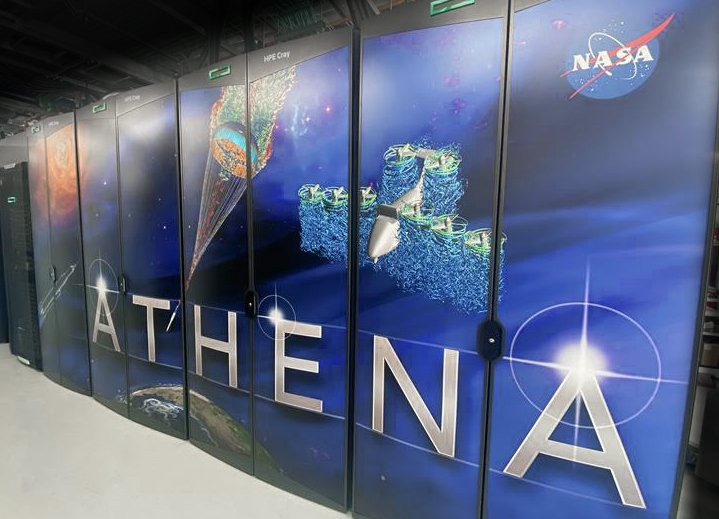
The peak performance of Athena exceeds 20 petaflops. Built by HPE, the system consists of 1,024 computing nodes, each using two 128-core AMD EPYC processors. Each node is equipped with 768 GB of DDR5 RAM. According to the agency, this new complex surpasses all previously deployed NASA systems (including predecessors Aitken and Pleiades) not only in terms of sheer computing power, but also in energy efficiency.
Athena is housed in the modular center at NASA’s Ames Research Center in Silicon Valley, a facility known for its initiatives in sustainability and energy efficiency. Its design takes advantage of cutting-edge cooling systems that minimize environmental impact.
Athena will be a key tool for solving the most complex tasks: simulating rocket launches and designing future aircraft; training large-scale AI models for scientific data analysis; supporting the planned crewed mission to the Moon, Artemis 2. Recent updates indicate that the Artemis 2 mission is slated for a mid-2026 launch, involving more international collaboration and enhanced technological integration aboard the Orion spacecraft.
Access to Athena’s capabilities is open to both internal NASA specialists and external scientists involved in agency projects. This includes the latest projects using machine learning to analyze climate data, a testament to Athena’s versatility.