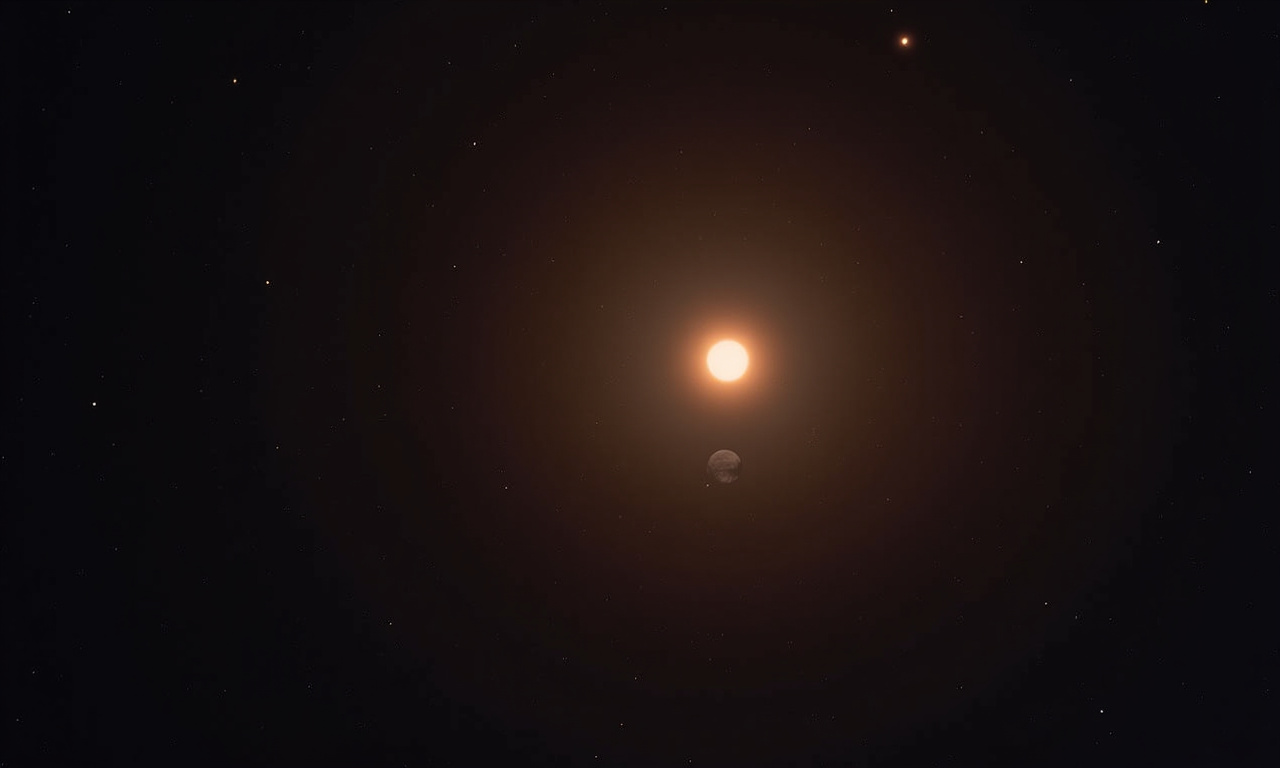

Scientists have announced the discovery of a candidate exoplanet HD 137010 b, comparable in size to Earth and orbiting the star HD 137010 – a tenth-magnitude K-dwarf star similar to the Sun. Recent advancements in telescope technology and data analysis precision have improved our ability to detect planets like HD 137010 b, capturing the scientific community’s attention. The planet was discovered using the Kepler space telescope during the K2 mission. The transit method for detecting exoplanets relies on recording the periodic dimming of a star’s brightness when a planet passes between the star and the observer. This method remains one of the most effective ways to search for potentially habitable Earth-like exoplanets.
The observed transit lasted 10 hours and was characterized by a relatively small decrease in the star’s brightness but was captured with a high signal-to-noise ratio due to the exceptional accuracy of photometric measurements. Improved algorithms and observational techniques are proving crucial in distinguishing meaningful signals from cosmic noise. The authors analyzed K2 data, historical and new images, as well as archival data on radial velocities and astrometry of the star. Data analysis indicated that the event was indeed caused by an object passing in front of the star HD 137010, best explained by the presence of a planet.
A single observable transit allows the estimation of the planet’s radius at 1.06 Earth radii. Assuming a negligible orbital eccentricity, scientists estimated the planet’s orbital period around the star to be 355 days, and its distance from the star – about 1 astronomical unit. The calculated radiation flux received by the planet from the star is almost half of that received by Earth from the Sun, placing HD 137010 b on the outer edge of the habitable zone, where the planet’s surface temperature can support liquid water. Noted astronomer Dr. Eleanor Jackson commented, “Discoveries like HD 137010 b push the boundaries of our understanding, challenging us to rethink the conditions that might allow life to exist.”
The brightness of the star HD 137010 makes it possible to conduct further studies of the planet using other methods. New instruments and observatories, such as the James Webb Space Telescope, are expected to continue providing deeper insights into planetary atmospheres and compositions, greatly enhancing our exploration capacity in the cosmos.