







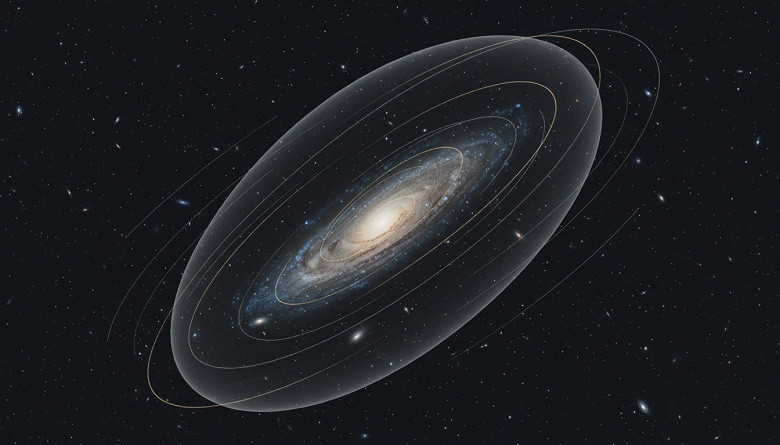
Stellar streams, structures emerging during the tidal disruption of dwarf galaxies and globular clusters, have long been considered sensitive probes of the gravitational potential of galaxies. Their form directly reflects the mass distribution, primarily the dark matter halo structure. However, for external galaxies, the observation of streams is generally limited to two-dimensional photometric projections, making the inference of halo parameters for each individual object poorly defined. A new study proposes and implements a hierarchical Bayesian approach that overcomes this fundamental limitation. Instead of evaluating the halo shape for each stream separately, scientists used a Bayesian approach that allows combining all observations to extract a common pattern. The logic of the method is that while each stream gives only a vague and ambiguous impression of the halo, together dozens of such streams form a stable picture. Bayesian analysis formally weighs all possible variants, assessing which configurations are most likely for the entire population of streams. As a result, it becomes possible to overcome the fundamental uncertainty of individual observations and obtain reliable conclusions about the typical shape of dark matter halos.
In the study, the authors practically implemented a large-scale Bayesian analysis requiring hundreds of thousands of simulations for each of the dozens of streams.
Underlying the modeling is the “particle spraying” method. The stream progenitor moves in the gravitational potential of the parent galaxy, and stars tear away from it near the Lagrange points L1 and L2. After that, the particles evolve as massless bodies. Their independent dynamics allow for effective parallelization of calculations, which is used in the StreaMAX software package. This technological element of the work provided an acceleration in direct modeling of stellar streams by several orders of magnitude. The obtained three-dimensional simulations are then brought into conformity with observable data. The stream is projected onto the celestial sphere, after which only the central track is extracted-a “line” describing the stream’s geometry. Information about width and density is intentionally discarded, as the current model version does not reproduce these characteristics with the necessary accuracy. The analysis focuses exclusively on the geometric constraints imposed by the track’s shape.
A non-trivial parameterization is used to define the halo’s shape and orientation: instead of angles, a three-dimensional vector of flattening axis is introduced, whose length is transformed into a parameter. This approach allows setting a uniform prior on flattening and avoids artificial multimodality characteristic of angular parameters. After considering symmetries, each stream model is described by 13 parameters. Analyzing individual streams revealed that even with correctly restored true parameters, the posterior distributions remain broad and multimodal. This is due to fundamental physical degeneracies, primarily the inability to separately determine the mass scale of the halo and the characteristic velocities of stars without kinematic information, as well as degeneracies arising from projecting a three-dimensional structure onto a two-dimensional plane. As a result, flattened and elongated halos observed at different angles can give practically indistinguishable tracks. This ambiguity makes individual streams ideal objects for hierarchical analysis.
By combining a sample of 35 streams simulating the STRRINGS catalog, the authors applied a Bayesian model that includes the distribution of halo flattening in the population. The use of the re-weighting method allowed avoiding the complete re-analysis of each stream and significantly reduced computational costs. Hierarchical inference allowed restoring the parameters of the original distributions for three model populations-flattened, spherical, and elongated-with high accuracy. At the population level, the multimodality characteristic of the analysis of single streams completely disappeared. A small systematic bias of estimates towards sphericity is explained by geometric effects and orientation errors but does not prevent confident discrimination of different halo morphologies. The authors consider the work as proof-of-concept and emphasize that even exclusively photometric data of stellar streams contain enough information for strict constraints on the dark matter halo shape during population analysis. In future, the method is planned to be applied to real observation catalogs and expand the model.
Recent Advances and Future Prospects in Dark Matter Research
Recent advances in dark matter research have been profound with new observational technologies, such as the use of the Vera C. Rubin Observatory anticipated to significantly enhance our understanding. This vast international project is expected to generate an unprecedented amount of data that can be applied to hierarchical Bayesian models like the one discussed, providing clearer insights into dark matter halos.
Another noteworthy development is the adoption of machine learning techniques for quicker analysis of photometric data, assisting astrophysicists in identifying potential dark matter structures more efficiently. These methods are being incorporated into the hierarchical approaches for better performance with large datasets.
Furthermore, recent collaborations in astrophysics are focusing on multi-messenger astronomy, which combines different observational modes, such as gravitational waves and electromagnetic observations, to gain a more comprehensive understanding of cosmic phenomena influenced by dark matter, reinforcing these methodologies.