
Chinese private aerospace company Galactic Energy is approaching the maiden flight of its new reusable liquid-fueled carrier rocket, the Pallas II. According to the Science and Technology Innovation Board Daily, at the Beijing International Forum on Commercial Spaceflight 2026, the company’s chief engineer, Li Jun, stated that the first launch is expected as early as 2026. Li Jun clarified that the inaugural flight of Pallas II will occur if subsequent testing stages proceed without delays.
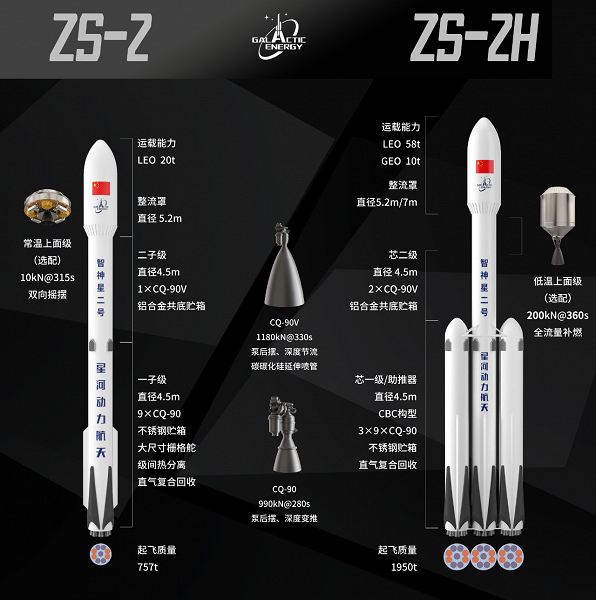
The Pallas II (also known as Zhishenxing-2) is a large modular rocket with a liquid-fueled returnable first stage. The rocket boasts a diameter of 4.5 meters and features two configurations. The basic version has a liftoff mass of approximately 757 tons, thrust of about 910 tons, and can deliver up to 20 tons of payload to low Earth orbit. The heavier CBC configuration reaches a liftoff mass of 1,950 tons, develops up to 2,730 tons of thrust, and is designed to deliver up to 58 tons to LEO. Accordingly, the first version is analogous to SpaceX’s Falcon 9, while the second parallels Falcon Heavy.
Previously, on January 20, Galactic Energy announced the successful completion of full-scale fire tests of the Pallas II’s main engine at a stand in Nyutoushan. The engine in question is the CQ-90, which operates on liquid oxygen and kerosene, to be used in the rocket’s first stage. More than 90% of the engine’s components are made using 3D printing. The engine can develop thrust ranging from 30 to 120 tons at sea level, supports multiple ignitions, and is designed for reuse. According to the company, fire tests confirmed the correct operation of all modes, from ignition to shutdown.
The development of Pallas II positions Galactic Energy as one of the most promising players in the Chinese commercial spaceflight market, where competition in the reusable heavy rocket segment is rapidly intensifying.