






Well-known insider Moore’s Law Is Dead (MLID) has revealed that Nvidia is also cutting the production of the GeForce RTX 5060. A distributor source informed MLID that after discussions with AIB partners (graphics card manufacturers), it became clear that the RTX 5060 is ‘shut down for the next six months.’
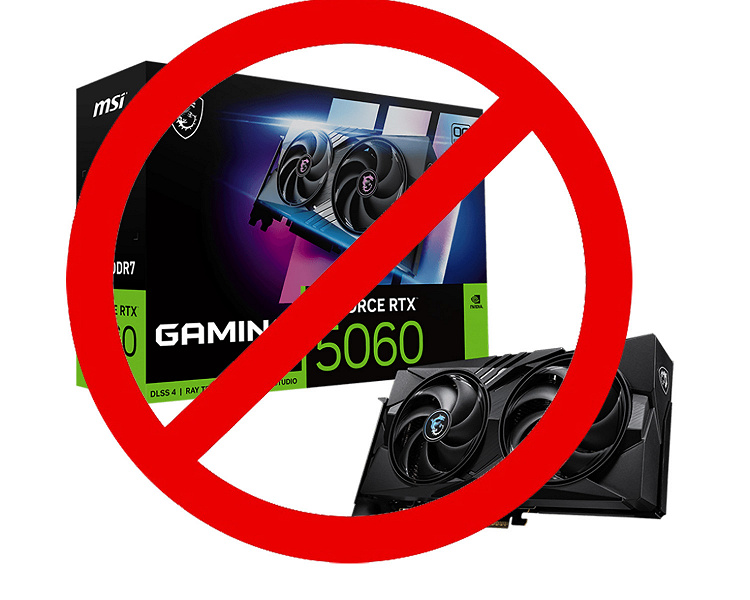
According to the source, Nvidia has concentrated its production facilities on the AI sector: the company is forced to halt the release of almost the entire RTX 50 line to compensate for prioritized shipments for artificial intelligence accelerators. The same source reported that the GeForce RTX 5070, RTX 5080, and RTX 5060 Ti with 8 GB of memory will remain on sale, but their supplies will be extremely limited. The rest of the RTX 50 series graphics cards, according to him, will soon turn into ‘unobtanium’-a product that is nearly impossible to buy.
This information was also confirmed by another MLID source-a representative from a major retail network. He claims that the availability situation with the GeForce RTX 5060 will deteriorate until the fourth quarter of 2026.

More details were revealed by a source among AIB partners. He reported that Nvidia is raising prices on the BOM (Bill of Materials) kits it supplies to graphics card manufacturers, while effectively ensuring only the production of the GeForce RTX 5080, RTX 5070, RTX 5060 Ti 8GB, and RTX 5050. The production of the RTX 5060, he says, was halted due to issues with memory and production costs. The same source issued a warning for buyers: expect at least a 30% price increase soon. This corroborates reports from Taiwan that MSI, Asus, and Gigabyte are already raising prices on their RTX 50 series.
Moore’s Law Is Dead has previously announced the launch dates of the Radeon RX 7800 and Radeon RX 7700, shared insights on iGPU performance in Intel’s Meteor Lake processors, and more.
Shifting Priorities: AI over Graphics
The competitive market shift towards AI is a significant driver behind these changes. Nvidia’s pivot reflects the broader trend in the tech industry, prioritizing AI capabilities and infrastructure. As a consequence, consumers may experience limited availability and increased prices in consumer electronics, particularly those related to gaming graphics.