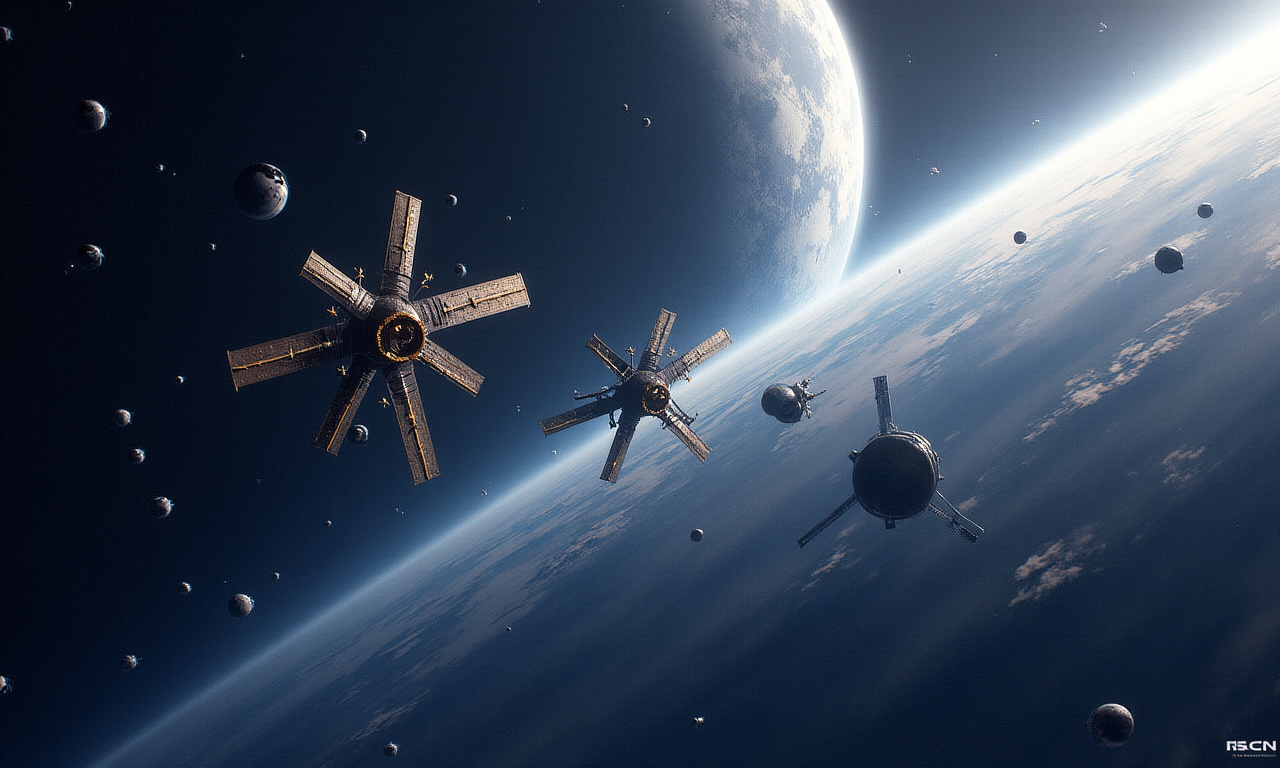

From June to November 2025, Starlink satellites executed a staggering 148,696 evasive maneuvers to avoid collisions with other spacecraft and space debris. These figures were provided by SpaceX in a report submitted to the U.S. Federal Communications Commission. In effect, satellites had to alter their trajectory nearly every hour, highlighting the rapidly growing risks in low Earth orbit.

As noted by the South China Morning Post, a significant portion of the dangerous approaches was associated with Chinese-origin objects. SpaceX’s greatest concern is the experimental satellite Hung-Hu-2, developed by Hongqing Technology. Due to this single apparatus, Starlink satellites had to perform 1,143 evasive maneuvers in just six months. The density of objects in orbit continues to grow, with approximately 9,500 Starlink satellites already in orbit.
Increasing Orbit Traffic
The issue of space debris and orbital crowding has received significant attention recently. As of January 2026, international space agencies are urging for stricter regulations and collaborative efforts to manage the escalating congestion in space.
Bracing for the Future
With technological advancements, SpaceX has improved its collision avoidance systems. Elon Musk mentioned in a recent interview that these systems rely on advanced AI algorithms to predict potential collisions more accurately, thus enhancing their response time and effectiveness.
SpaceX’s Role
SpaceX is leading efforts in enhancing satellite safety. They are investing in next-generation collision avoidance technologies and advocating for better international space traffic management systems. With the launch of their new Gen2 satellites, which possess enhanced maneuverability and lower latency, SpaceX hopes to set new standards in satellite operation.